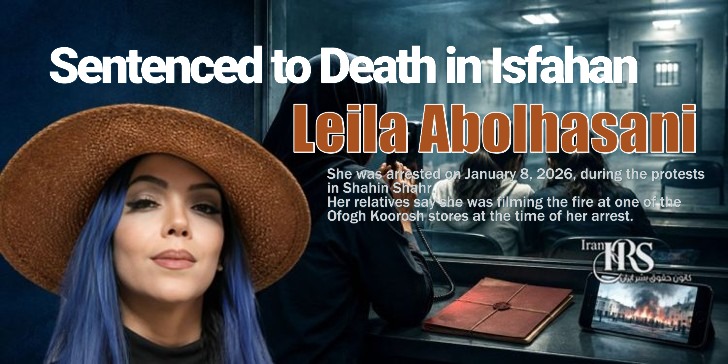
Leila Abolhasani, one of the detainees of the 2025/2026 nationwide protests in Shahin Shahr, has been sentenced to death on the charge of “Moharebeh” and her case is currently awaiting review by the Supreme Court

Iran Human Rights Society, Thursday, August 27, 2026 – Leila Abolhasani, a 43-year-old citizen and mother of two teenage daughters, one of the detainees of the 2025/2026 nationwide protests in Shahin Shahr, Isfahan, has been sentenced to death by Branch 5 of the Revolutionary Court of Isfahan on the charge of “Moharebeh” (enmity against God).
This verdict was issued in May 2026, presided over by Judge Vahid Hemmatnejad. Following an appeal against the court ruling, the case has been sent to the Supreme Court for appeal review. The result of the case review is not yet clear, and if the sentence is confirmed, this prisoner will face the risk of execution.
Arrest While Filming a Burning Store
Based on received information, Leila Abolhasani was arrested on January 8, 2026, during the protests in Shahin Shahr. Her relatives say she was filming the fire at one of the Ofogh Koorosh stores at the time of her arrest.
Following her arrest, she was transferred to Dowlatabad Prison in Isfahan and has been held in this prison ever since. This citizen’s detention period has exceeded seven months, and no information has been published regarding her enjoyment of furlough or the possibility of temporary release.
Conflict Between Case Allegations and Account of Leila Abolhasani’s Relatives
In the case file, it is alleged that Leila Abolhasani personally played a role in setting fire to the store. Her relatives reject this claim, stating she was not the cause of the fire and was merely filming the scene of the incident and the burning store at the time of her arrest.
The fundamental difference between the allegation raised in the case and the account of this prisoner’s relatives makes a transparent review of the charge documents necessary. It is not clear what evidence the court relied upon to prove her direct role in the arson, and whether videos, witness testimonies, or independent technical evidence exist in the file.
Awaiting Decision of the Supreme Court
The case of Leila Abolhasani was sent to the Supreme Court after appealing the issued ruling. Currently, it is unknown to which branch the case was referred and when the final decision will be issued.
Leila Abolhasani is 43 years old and the mother of two teenage daughters. Continued detention and the unclear outcome of the appeal have increased concerns regarding her and her family’s status.
Information Box | Case Information at a Glance
| Subject | Information |
| Name | Leila Abolhasani |
| Age | 43 years |
| Family Status | Mother of two teenage daughters |
| Date of Arrest | January 8, 2026 |
| Place of Arrest | Shahin Shahr, Isfahan |
| Place of Detention | Dowlatabad Prison, Isfahan |
| Charge | Moharebeh |
| Issuing Authority of Sentence | Branch 5 of the Revolutionary Court of Isfahan |
| Judge | Vahid Hemmatnejad |
| Sentence | Death |
| Case Status | Awaiting review by the Supreme Court |
Legal Review of Leila Abolhasani’s Case Based on Domestic Laws
The laws of the dictatorship ruling Iran in past years have been criticized repeatedly due to conflict with standards of fair trial, ambiguity in handling security cases, and restricting freedom of expression. Reviewing the case of Leila Abolhasani based on domestic laws does not mean confirmation of these laws; the goal is to show instances where even these same laws have not been observed by the judiciary.
Legal Ambiguities of the Case
The most important ambiguity is the conflict between the case allegation regarding Leila Abolhasani’s participation in setting fire to the store and her relatives’ account that she was filming the incident. Evidence proving her direct role in the arson has not yet been published.
Based on Article 279 of the Islamic Penal Code, the realization of the charge of “Moharebeh” requires drawing a weapon with the intention of creating insecurity or depriving public security. If the action attributed to her was merely filming a burning store, such behavior in itself does not constitute the legal elements of the charge of Moharebeh.
Related Legal Articles
- Article 32 of the Constitution: Arrest must be carried out in accordance with law and accompanied by notification of reasons for charges.
- Article 35 of the Constitution: Recognizes the right to have a lawyer.
- Article 37 of the Constitution: Emphasizes the presumption of innocence.
- Article 38 of the Constitution: Prohibits compulsion to extract confessions.
- Article 39 of the Constitution: Prohibits violation of the honor and dignity of detainees.
- Article 279 of the Islamic Penal Code: Determines legal elements necessary for the realization of the charge of Moharebeh.
- Code of Criminal Procedure: Emphasizes access to a lawyer, knowledge of charge evidence, and possibility of effective defense.
Cases of Law Violation
- Issuance of a death sentence despite serious conflict between the case allegation and relatives’ account;
- Ambiguity regarding evidence proving participation in arson;
- Unclear manner of matching alleged behavior with legal elements of Moharebeh;
- Ambiguity regarding full access of the lawyer to case documents;
- Issuance of the heaviest punishment in a case with fundamental ambiguities;
- Continued detention for more than seven months until final determination of the case.
Reviewing the Case from the Perspective of Human Rights and Violation of International Standards
From the perspective of human rights, the right to life, freedom of expression, enjoyment of a fair trial, and the presumption of innocence are fundamental rights of every defendant. Issuing a death sentence for Leila Abolhasani in a case where two conflicting accounts exist regarding her attributed behavior creates serious concern about the observance of these rights.
Human Rights Ambiguities of the Case
It is not clear how the court established Leila Abolhasani’s direct role in the arson and whether sufficient opportunity to review and object to charge documents was placed at her and her lawyer’s disposal.
Based on international standards, in countries that have not abolished the death penalty, this punishment must be applied only for “the most serious crimes” and following trial conforming to all fair guarantees. Any fundamental defect in such trial can convert sentence execution into an arbitrary deprivation of the right to life.
Related International Documents
- Article 3 of the Universal Declaration of Human Rights: Right to life, liberty, and personal security.
- Articles 10 and 11 of the Universal Declaration of Human Rights: Right to a fair trial and presumption of innocence.
- Article 6 of the International Covenant on Civil and Political Rights: Protection of the right to life and restricting the death penalty to the most serious crimes.
- Article 9 of the International Covenant on Civil and Political Rights: Prohibition of arbitrary arrest.
- Article 14 of the International Covenant on Civil and Political Rights: Right to a fair trial, lawyer, and effective defense.
- Nelson Mandela Rules: Necessity of observing dignity, communication rights, and legal guarantees of individuals deprived of liberty.
See also the below articles:
- Report on Death Sentences Issued for 10 Detainees in Vakilabad Prison
- Deprivation of Afshin Rangriz Heirati from Treatment in Evin Prison
Follow Iran Human Rights Society on social networks:
Telegram /Twitter /Instagram / YouTube / Facebook
Join Iran Human Rights Society on Twitter