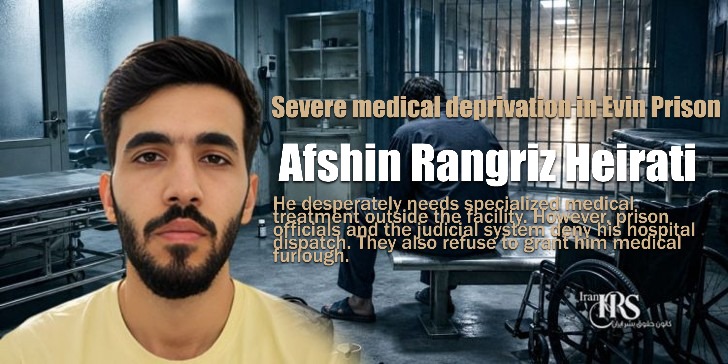
Despite needing specialized treatment, Afshin Rangriz Heirati has been deprived of dispatch to hospital and medical furlough; he was also beaten during the guard’s raid on Ward 7 of Evin and subsequently transferred to another location

Iran Human Rights Society, Wednesday, August 26, 2026 – Afshin Rangriz Heirati, a political prisoner held in Evin Prison, has been deprived of access to appropriate medical services for a long time despite suffering from illness and needing continued treatment. Prison officials and the judicial system have opposed his dispatch to medical centers outside the prison; while the necessary facilities for continuing his treatment do not exist in the prison clinic either.
Based on received information, the possibility of using medical furlough has not been provided for Afshin Rangriz Heirati either. The type of illness, results of medical examinations, and treatment that must be performed for him are not possible with continued treatment inside the prison, and he must be dispatched to an equipped medical center outside the prison.
Continued deprivation of treatment can cause worsening of the illness and create irreversible complications. Prison officials and the judicial system, due to depriving the prisoner of liberty, are directly responsible for securing his health, medication, specialized examination, and timely dispatch.
Opposition to Dispatching Afshin Rangriz Heirati to the Hospital
Despite the medical need of Afshin Rangriz Heirati, responsible officials have so far not agreed to his transfer to a hospital or specialized center. At the same time, Evin Prison clinic also lacks sufficient facilities to pursue his treatment.
This situation has placed him in a cycle of deprivation: on one hand, the required treatment is not provided inside the prison, and on the other hand, permission to visit a specialist doctor or hospital outside the prison is not issued either.
It is not clear which judicial official or prison authority voiced opposition to the dispatch or medical furlough, and whether his medical file has been placed at the disposal of legal medicine or an independent authority for review. Likewise, no information has been published regarding the latest examination, required medications, and the doctor’s opinion on the necessity of his transfer.
The decision regarding a prisoner’s treatment must be taken based on doctor’s opinion and medical needs, not security or punitive considerations. Deliberate delay in treatment, if it leads to severe pain or deterioration of illness, can constitute cruel and inhuman behavior.
Beating During Guard Raid on Ward 7 of Evin
Before relocation, Afshin Rangriz Heirati was held in Ward 7 of Evin Prison. On the morning of Saturday, August 8, 2026, Halls Three and Four of this ward were targeted by a widespread raid of prison guard forces.
Based on received information, about 50 guard officers entered the halls at 11:00 AM. During the inspection, a number of prisoners were beaten, and their personal belongings, which were prepared at their own expense, were destroyed or confiscated.
Afshin Rangriz Heirati was also beaten during this raid. This incident occurred under conditions where he previously required medical care due to illness. Any physical blow to a sick prisoner can worsen his health status and increase the necessity of performing an immediate examination.
After the raid, five political prisoners named Amir-Hossein Moradi, Hasan Omidi, Afshin Rangriz Heirati, Ehsan Rostami, and Mojtaba Taghavi were removed from Ward 7. The current location of holding Afshin Rangriz Heirati and four other prisoners has not been precisely announced.
Relocation After Raid and Increase in Medical Concerns
The transfer of Afshin Rangriz Heirati from Ward 7, without publishing information about the new location of holding or continuation of treatment, has increased concerns about his status. Relocating a sick prisoner may disrupt the process of receiving medication, access to medical file, and communication with the doctor.
Officials must announce his location of holding and provide the possibility of contact with family and lawyer. Also, Afshin Rangriz Heirati must be examined without delay by an independent doctor to review potential effects of the beating and the condition of his underlying illness.
Opposition to medical furlough, preventing dispatch to hospital, and relocation after beating have created a collection of pressures that can face the life and health of this political prisoner with danger.
Information Box | Afshin Rangriz Heirati Case File
| Subject | Status |
| Name | Afshin Rangriz Heirati |
| Status | Political prisoner |
| Previous Place of Detention | Ward 7 of Evin Prison |
| Main Need | Specialized treatment outside prison |
| Medical Dispatch Status | Opposition to transfer to medical center |
| Furlough Status | Deprivation of medical furlough |
| Recent Incident | Beating in guard raid on Ward 7 |
| Date of Raid | Saturday, August 8, 2026 |
| Current Place of Detention | Unspecified |
| Main Concern | Worsening of illness as a result of interruption or delay in treatment |
Legal Review of Afshin Rangriz Heirati’s Case Based on Domestic Laws
The laws of the dictatorship ruling Iran in past years have been criticized repeatedly due to conflict with standards of fair trial, restricting prisoners’ rights, and providing grounds for deprivation of treatment. Reviewing the case of Afshin Rangriz Heirati based on domestic laws does not mean confirmation of these laws; the goal is to show instances where even these same laws have not been observed by prison officials and the judicial system.
Legal Ambiguities of the Case
The type of illness of Afshin Rangriz Heirati, doctor’s opinion on necessity of dispatch, reason for opposition to hospital transfer, and the authority issuing the decision to prevent medical furlough have not been announced.
Also, it is not clear whether after the beating in the Ward 7 raid he was examined and potential signs of physical damage were recorded in his medical file or not. The new location of holding and the manner of his access to medication and treatment are also unknown.
Related Legal Articles
- Article 22 of the Constitution: Considers life and rights of persons immune from violation.
- Article 29 of the Constitution: Introduces enjoyment of health and medical services as a public right.
- Article 39 of the Constitution: Prohibits violation of honor and dignity-defying treatment of prisoners.
- Article 502 of the Code of Criminal Procedure: Anticipates the possibility of postponing sentence execution in case of worsening illness or delay in recovery due to punishment execution.
- Executive Regulations of the Prisons Organization: Obligates officials to provide medical care, medication, and dispatch of sick prisoners to specialized centers.
Cases of Law Violation
- Preventing the dispatch of a sick prisoner to an equipped medical center;
- Not granting medical furlough despite lack of medical facilities in prison;
- Beating a sick prisoner during guard raid;
- Unclear medical examination after beating;
- Relocation without guaranteeing continuation of treatment and access to medication;
- Failure to announce current location of holding and health status;
- Destruction and confiscation of prisoners’ personal belongings.
Reviewing the Case from the Perspective of Human Rights and Violation of International Standards
From the perspective of human rights, protection of the right to health, enjoyment of medical care, prohibition of torture and inhuman treatment, and respectful treatment of all persons deprived of liberty are among fundamental principles of international law. Published reports regarding the status of Afshin Rangriz Heirati, his deprivation of treatment, and beating in Ward 7 of Evin Prison have created serious concerns regarding the observance of these rights.
Human Rights Ambiguities of the Case
Continued opposition to dispatching Afshin Rangriz Heirati to hospital, under conditions where the possibility of treating him inside prison does not exist, is the most important human rights concern of this case. If delay in treatment causes severe pain, progression of illness, or lasting damage, this deprivation can be examined within the framework of cruel, inhuman, or degrading treatment.
Beating during guard raid, relocation to an unknown location, and lack of information about medical examination after the incident have also added to concerns. The government is obligated to provide prisoners’ medical services at the same level as services available in society without discrimination.
Related International Documents
- Article 3 of the Universal Declaration of Human Rights: Right to life, liberty, and security of person.
- Article 5 of the Universal Declaration of Human Rights: Prohibition of torture and cruel, inhuman, or degrading treatment or punishment.
- Article 25 of the Universal Declaration of Human Rights: Right to enjoy health, medical care, and necessary services.
- Article 7 of the International Covenant on Civil and Political Rights: Prohibition of torture and inhuman treatment.
- Article 10 of the International Covenant on Civil and Political Rights: Obligation for humane and respectful treatment of all persons deprived of liberty.
- Rules 24 to 27 of the Nelson Mandela Rules: Prisoners’ right to enjoy medical services without discrimination and dispatch to specialized centers if necessary.
- Nelson Mandela Rules on medical investigations: Necessity of recording and reporting signs of torture or ill-treatment observed in prisoners.
See also the below articles:
- Death Sentence Issued for Amir-Mohammad Mojallal Choubari
- Execution of Majid Adineh Following Opaque Trial
Follow Iran Human Rights Society on social networks:
Telegram /Twitter /Instagram / YouTube / Facebook
Join Iran Human Rights Society on Twitter