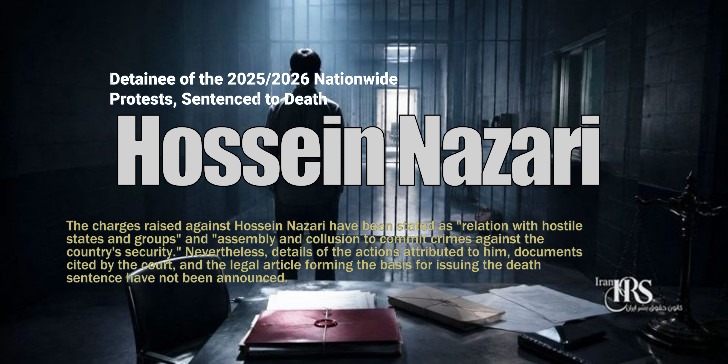
Branch 1 of the Revolutionary Court of Mashhad has sentenced this 25-year-old citizen to death on security charges; the legal basis for issuing the death penalty remains unclear

Iran Human Rights Society, Wednesday, August 26, 2026 – Hossein Nazari, a 25-year-old citizen and one of the detainees of the 2025/2026 nationwide protests, has been sentenced to death by Branch 1 of the Revolutionary Court of Mashhad. This verdict was issued in July 2026, and he is currently being held in Vakilabad Prison in Mashhad.
According to published information, the charges raised against Hossein Nazari have been stated as “relation with hostile states and groups” and “assembly and collusion to commit crimes against the country’s security.” Nevertheless, details of the actions attributed to him, documents cited by the court, and the legal article forming the basis for issuing the death sentence have not been announced.
Arrest of Hossein Nazari During the 2025/2026 Nationwide Protests
Hossein Nazari, born in 2001, was arrested by security forces in January 2026 coinciding with nationwide protests. After passing through interrogation stages and judicial proceedings, he was transferred to Vakilabad Prison in Mashhad and remains imprisoned there.
No information has been published regarding the arresting institution, Hossein Nazari’s location of detention during the interrogation period, duration of solitary confinement, and how the preliminary investigations were conducted. Likewise, it is not clear whether he had access to a lawyer of choice during interrogations and court sessions, or whether the possibility of full study of the case file and effective defense was provided to him.
Ambiguity in the Basis for Issuing the Death Sentence
The announced charges, without providing further details, do not clarify the basis for issuing the death penalty. So far, it has not been specified which legal article Branch 1 of the Revolutionary Court of Mashhad cited and based on what documents it sentenced Hossein Nazari to death.
This ambiguity creates serious concern in a case accompanied by an irreversible punishment. Clarification of the indictment contents, prosecutor’s evidence, court trial procedure, quality of the defendant’s access to a lawyer, and possibility of effective appeal against the ruling are necessary for evaluating the validity of the sentence.
Information Box | Hossein Nazari Case File
| Subject | Status |
| Name | Hossein Nazari |
| Age | 25 years (Born 2001) |
| Status | Detainee of 2025/2026 nationwide protests |
| Date of Arrest | January 2026 |
| Place of Detention | Vakilabad Prison, Mashhad |
| Issuing Authority | Branch 1 of the Revolutionary Court of Mashhad |
| Date of Verdict | July 2026 |
| Stated Charges | Relation with hostile states and groups; Assembly and collusion against security |
| New Status | Sentenced to death |
| Main Ambiguity | Unannounced legal basis, evidence, and court documents for the death sentence |
Legal Review of Hossein Nazari’s Case Based on Domestic Laws
The laws of the dictatorship ruling Iran in past years have been criticized repeatedly due to conflict with standards of fair trial, ambiguity in handling security cases, and restricting defendants’ rights. Reviewing the case of Hossein Nazari based on domestic laws does not mean confirmation of these laws; the goal is to show instances where even these same laws may not have been observed by the judiciary.
Legal Ambiguities of the Case
The most important ambiguity is the unclear legal article forming the basis for the death sentence. Also, no information has been published regarding whether the court was public or non-public, the presence of a lawyer of choice, sufficient opportunity for defense, manner of gathering evidence, and possibility of appealing the ruling.
Related Legal Articles
- Article 32 of the Constitution: Arrest must be carried out in accordance with legal criteria.
- Article 34 of the Constitution: Considers seeking justice to be the indisputable right of every individual.
- Article 35 of the Constitution: Recognizes the right to have a lawyer.
- Article 37 of the Constitution: Emphasizes the presumption of innocence.
- Article 38 of the Constitution: Prohibits torture and forced confession.
- Article 190 of the Code of Criminal Procedure: Considers the presence of a lawyer in preliminary investigations to be among the defendant’s rights.
Cases of Law Violation
- Unclear legal basis for issuing the death sentence;
- Ambiguity regarding Hossein Nazari’s access to a lawyer of choice;
- Non-publication of documents and evidence cited by the court;
- Unclear possibility of effective defense and appeal against the ruling;
- Potential violation of the presumption of innocence and fair trial guarantees.
Reviewing the Case from the Perspective of Human Rights and Violation of International Standards
From the perspective of human rights, the right to life, prohibition of arbitrary detention, possession of a lawyer, and fair trial are among fundamental principles of international law. In cases leading to execution, observance of these guarantees carries double importance; because sentence execution permanently eliminates the possibility of compensating for a judicial mistake.
Human Rights Ambiguities of the Case
The issuance of a death sentence for Hossein Nazari has been reported under conditions where the legal basis, case documents, and quality of proceedings have not been made public. Lack of information about his access to a lawyer of choice and sufficient opportunity for defense increases concerns regarding compliance with fair trial standards.
Related International Documents
- Article 3 of the Universal Declaration of Human Rights: Right to life, liberty, and security of person.
- Articles 10 and 11 of the Universal Declaration of Human Rights: Right to a fair trial and presumption of innocence.
- Article 6 of the International Covenant on Civil and Political Rights: Protection of the right to life.
- Article 9 of the Covenant: Prohibition of arbitrary arrest.
- Article 14 of the Covenant: Guaranteeing a fair trial, access to a lawyer, and sufficient opportunity for defense.
Given the irreversible nature of the death penalty, halting the execution of Hossein Nazari’s sentence until the publication of case details, his full access to a lawyer of choice, and the conduct of an independent and fair review is necessary.
See also the below articles:
- Deprivation of Afshin Rangriz Heirati from Treatment in Evin Prison
- Death Sentence Issued for Amir-Mohammad Mojallal Choubari
Follow Iran Human Rights Society on social networks:
Telegram /Twitter /Instagram / YouTube / Facebook
Join Iran Human Rights Society on Twitter