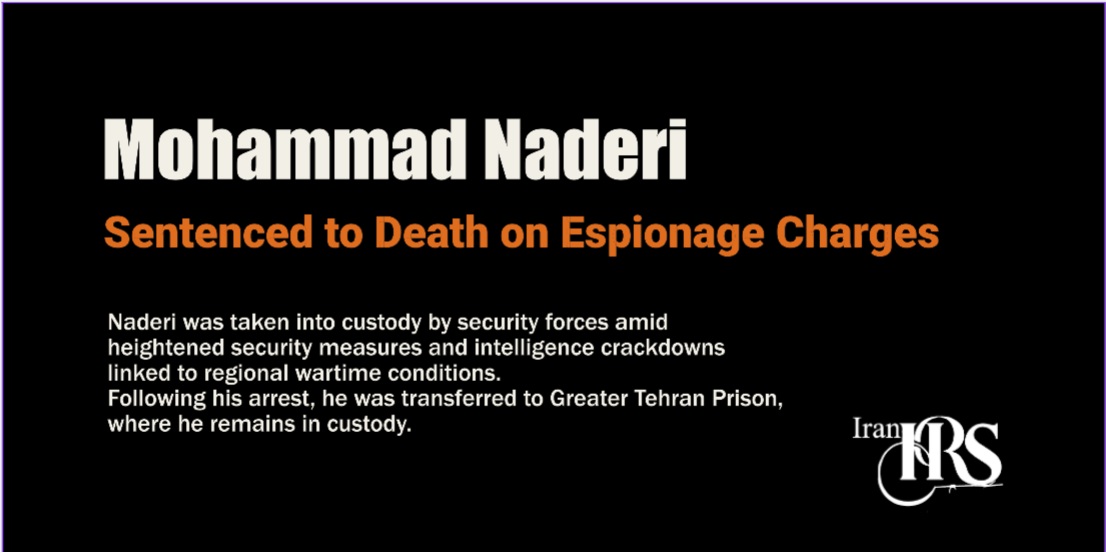
Mohammad Naderi, a prisoner held in Greater Tehran Prison, has been sentenced to death by Branch 23 of the Tehran Revolutionary Court; details of the charges, court evidence, and his access to chosen legal counsel remain entirely unknown
Iran Human Rights Society, Friday, September 25, 2026– Mohammad Naderi, a prisoner held in Greater Tehran Prison, has been sentenced to capital punishment on charges of “espionage” by Branch 23 of the Tehran Revolutionary Court, presided over by Judge Taghizadeh.
According to published information, Mohammad Naderi was arrested by security forces concurrently with security developments linked to wartime conditions, and following interrogation, was transferred to Greater Tehran Prison. The exact date of arrest, the arresting security agency, and the details of his transfer to prison have not been disclosed.
Ambiguities Surrounding Evidence in Mohammad Naderi’s Death Sentence
Branch 23 of the Tehran Revolutionary Court sentenced Mohammad Naderi to death under the broad charge of “espionage.” To date, it has not been clarified on what specific actions, documents, or evidence the court based this charge, nor what primary documentation was utilized as the foundation for issuing the death penalty.
Information regarding the number of court sessions, access to review the case file, the presence of chosen legal counsel, defense arguments presented, or whether the sentence is subject to appeal or final has not been released. The concealment of this information in a case resulting in a capital sentence raises grave concerns regarding the respect for defense rights and fair trial guarantees.
Branch 23 of the Tehran Revolutionary Court is headed by Judge Taghizadeh, a magistrate previously associated with issuing death sentences in security-related cases.
Information Box | Case Information at a Glance
| Subject | Details |
| Name | Mohammad Naderi |
| Place of Detention | Greater Tehran Prison |
| Judicial Authority / Judge | Branch 23 of Tehran Revolutionary Court / Judge Taghizadeh |
| Formal Charge | “Espionage” (Broadly cited) |
| Sentence Issued | Death penalty |
| Context of Arrest | Concurrently with security developments linked to war conditions |
| Rights Violations | Concealment of court evidence, unknown status of chosen legal counsel, lack of transparent proceedings |
Legal Review of Mohammad Naderi’s Case Based on Domestic Laws
The laws governing such proceedings have consistently been criticized for non-compliance with fair trial standards. Reviewing this case under domestic statutes does not signify an endorsement of these laws, but serves to demonstrate that even internal legal mandates have failed to be observed.
Legal Ambiguities of the Case
A generalized charge of “espionage” without specifying criminal behavior, submitting concrete documentation, citing specific statutory provisions, or guaranteeing the defendant’s access to defense counsel is legally insufficient to justify a death sentence.
Relevant Statutory Provisions
- Article 35 of the Constitution: Formally guarantees the right of all parties to select defense counsel in all courts.
- Article 37 of the Constitution: Codifies the presumption of innocence until proven guilty in a competent tribunal.
- Article 501 of the Islamic Penal Code: Designates a sentence of one to 10 years of imprisonment for specific forms of espionage; consequently, the exact legal basis for issuing a capital sentence must be explicitly declared.
Procedural Violations
The unannounced nature of court evidence, statutory grounds, the status of chosen legal counsel, and the overall judicial process directly undermines the right to an effective defense and the legal obligation to issue reasoned judicial verdicts.
Human Rights Violations in Mohammad Naderi’s Case
The issuance of a death sentence for Mohammad Naderi directly intersects with core articles of international human rights declarations:
- Article 3 of the Universal Declaration of Human Rights (UDHR): Guarantees the right to life, liberty, and security of person.
- Article 10 of the Universal Declaration of Human Rights (UDHR): Entitles everyone to a fair and public hearing by an independent and impartial tribunal.
- Article 11 of the Universal Declaration of Human Rights (UDHR): Upholds the presumption of innocence and all guarantees necessary for a full defense.
Executing capital punishment in a case characterized by undisclosed evidence and restricted access to legal representation carries an irreversible risk of violating the right to life and fair trial standards.
See also the below articles:
- Incommunicado Detention of Law Professor Hamid Rahmani Menshadi
- Forced Confessions and Detention of Dr. Sobhan Esmailpour
Follow Iran Human Rights Society on social networks:
Telegram /Twitter /Instagram / YouTube / Facebook
Join Iran Human Rights Society on Twitter