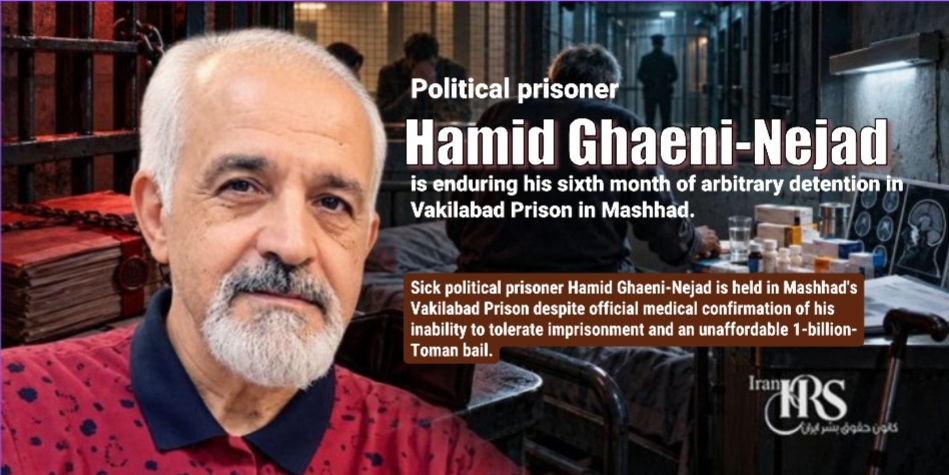
Hamid Ghaeni-Nejad, a former political prisoner suffering from severe illness, is enduring his sixth month of indefinite detention in Mashhad’s Vakilabad Prison; despite forensic medical board confirmation that he cannot physically tolerate imprisonment, a 10-billion-Rial bail actively blocks his release
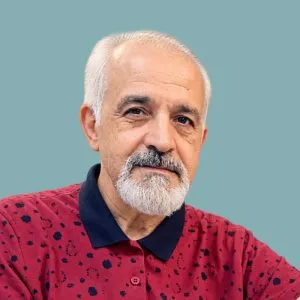
Iran Human Rights Society, Friday, September 25, 2026– Hamid Ghaeni-Nejad, despite a history of stroke, loss of speech and movement, and a daily requirement for approximately 15 different medications, continues to be held in Vakilabad Prison in Mashhad. The setting of a bail amount far beyond his and his family’s financial capabilities has turned temporary detention into a form of pre-sentencing punishment.
Sixth Month of Indefinite Detention for Hamid Ghaeni-Nejad
According to published reports, Hamid Ghaeni-Nejad was arrested in April 2026 in front of Vakilabad Prison in Mashhad and transferred to the facility’s quarantine ward. With nearly six months having elapsed, no clear information regarding formal charges, the status of investigations, a trial date, or the fate of his case has been released.
Hamid Ghaeni-Nejad was previously imprisoned for several years during the 2010s (1390s SH). He was released from prison following a brain injury and severe physical decline; however, he has been re-arrested under conditions where the lasting effects of his illness persist.
Forensic Medical Board Confirms Inability to Tolerate Imprisonment
Existing reports show that Hamid Ghaeni-Nejad suffers from speech and mobility impairments, partial cognitive decline, and complications associated with advanced age. To manage his multiple illnesses, he requires approximately 15 medications daily.
The Forensic Medical Organization previously confirmed his inability to tolerate imprisonment. Continuing to hold this prisoner in a prison environment increases the risk of deteriorating physical health, disruption of medication administration, and irreversible medical complications. The responsibility for protecting his life and health rests squarely on judicial authorities and prison officials.
Excessive Bail: Gradual Torture of the Prisoner and His Family
A bail of 10 billion Rials (equivalent to 1 billion Tomans) has been set for Hamid Ghaeni-Nejad’s release. His and his family’s inability to provide this sum has resulted in his continued detention.
Bail is intended to ensure a defendant’s presence during proceedings; however, setting an amount that the prisoner cannot afford effectively produces the same result as a mandatory detention order. In this case, the heavy bail amount is not a pathway to release, but a mechanism to keep an ill prisoner behind bars.
Imposing months of imprisonment on an individual officially certified as unable to tolerate incarceration, combined with the pressure of failing to secure bail, constitutes a form of gradual torture in practice. This situation simultaneously inflicts severe psychological and financial strain on a family struggling to save the prisoner’s life against a financial demand beyond their means.
Information Box | Case Information at a Glance
| Subject | Details |
| Name | Hamid Ghaeni-Nejad |
| Status | Former political prisoner / Currently in 6th month of indefinite detention |
| Place of Detention | Vakilabad Prison, Mashhad |
| Medical Condition | History of stroke, speech/mobility impairment, cognitive decline, daily need for ~15 medications |
| Forensic Medical Status | Official confirmation of inability to tolerate imprisonment (Inability to tolerate sentence/detention) |
| Bail Amount | 10 billion Rials (1 billion Tomans) – Unaffordable for family |
| Rights Violations | Disproportionate bail, deprivation of necessary medical care, arbitrary detention despite medical exemption |
Legal Review of Hamid Ghaeni-Nejad’s Case Based on Domestic Laws
Reviewing this case under domestic statutes does not signify an endorsement of the governing laws, but serves to demonstrate that even existing legal provisions are being ignored.
Legal Ambiguities of the Case
Setting an exorbitant bail for a severely ill prisoner whose inability to tolerate detention has been officially confirmed contradicts fundamental legal principles governing bail orders.
Relevant Statutory Provisions
- Article 250 of the Criminal Procedure Code: Mandates that bail decisions must be reasoned and strictly proportional to the nature of the charge, available evidence, risk of flight, prior record, age, and physical and mental health of the defendant.
- Executive Regulations of the Prisons Organization: Require the immediate release or transfer of prisoners whose medical conditions are certified as incompatible with detention by official medical authorities.
Procedural Violations
Setting a 1-billion-Toman bail for an elderly, stroke-afflicted detainee contradicts the principle of proportionality outlined in Article 250. Continued detention solely due to financial inability effectively transforms bail into an illegal pre-trial punishment.
Human Rights Violations in the Continued Detention of Hamid Ghaeni-Nejad
The continued incarceration of Hamid Ghaeni-Nejad under severe medical distress intersects with core international human rights standards:
- Article 3 of the Universal Declaration of Human Rights (UDHR): Guarantees the right to life, liberty, and security of person.
- Article 5 of the Universal Declaration of Human Rights (UDHR): Strictly prohibits cruel, inhuman, or degrading treatment or punishment.
- Article 9 of the Universal Declaration of Human Rights (UDHR): Prohibits arbitrary arrest, detention, or exile.
- Article 25 of the Universal Declaration of Human Rights (UDHR): Recognizes the fundamental right to an adequate standard of health and necessary medical care.
Maintaining the imprisonment of Hamid Ghaeni-Nejad despite his multiple illnesses, official medical confirmation of his inability to endure confinement, and the imposition of an unaffordable bail places his basic human rights under severe and ongoing violation.
See also the below articles:
- Mohammad Naderi Sentenced to Death on Espionage Charges
- Incommunicado Detention of Law Professor Hamid Rahmani Menshadi
Follow Iran Human Rights Society on social networks:
Telegram /Twitter /Instagram / YouTube / Facebook
Join Iran Human Rights Society on Twitter