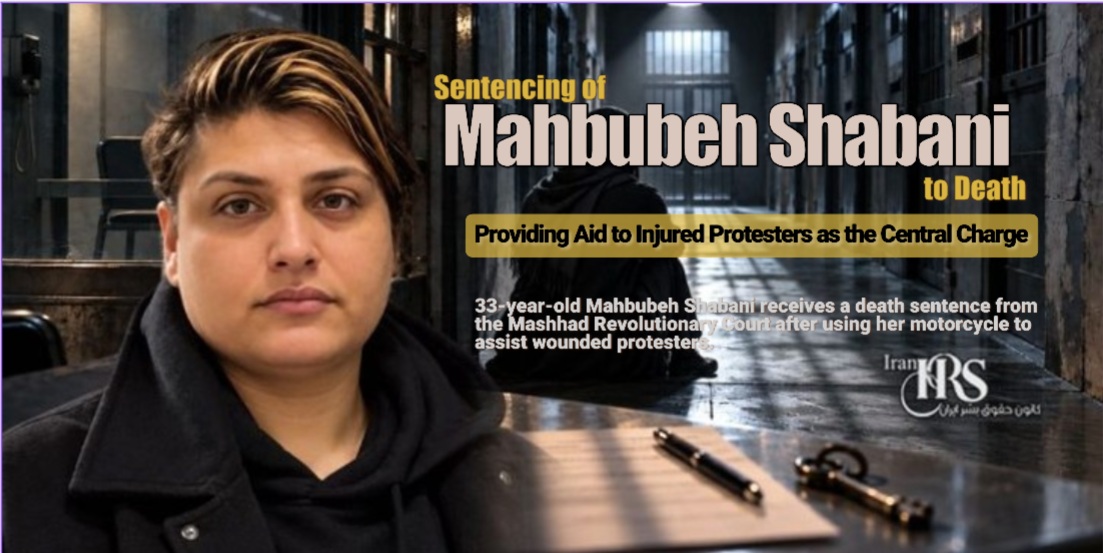
Mahbubeh Shabani, a 33‑year‑old resident of Mashhad, has been sentenced to death by Branch One of the Revolutionary Court in this city. According to information received, the primary basis for the charges against her is providing assistance and transporting injured protesters to medical facilities during the nationwide protests of 2025.

Iran Human Rights Society – Sunday, 27 September 2026 – Mahbubeh Shabani, a 33‑year‑old resident of Mashhad, has been sentenced to death by Branch One of the Revolutionary Court in this city. Her death sentence was formally delivered to her defense attorney on Saturday, 26 September 2026. Based on available information, the main charge brought against her is “operational action to strengthen Israel, the United States, and agents affiliated with opposition groups,” a charge that had previously been examined during the interrogation phase under the category of “moharebeh.” Reports related to the case indicate that providing aid and transporting injured protesters on her personal motorcycle has been cited as the principal example of the actions attributed to her.
Issuance of the Death Sentence for Mahbubeh Shabani
According to received information, Branch One of the Mashhad Revolutionary Court, after reviewing Mahbubeh Shabani’s case, has sentenced her to death. Her trial session was held on 31 August 2026 in the same branch, and the verdict was delivered to her attorney on Saturday, 26 September.
The charge brought against Mahbubeh Shabani is described as “operational action to strengthen Israel, the United States, and agents affiliated with opposition groups.” This charge was raised despite the fact that, during the interrogation phase, her case had been examined under the accusation of “moharebeh.”
Providing Aid to Injured Protesters; Core of the Charges
Based on available information, one of the central elements of Mahbubeh Shabani’s case concerns her efforts to assist injured protesters during the nationwide protests of 2025. It has been reported that she used her personal motorcycle to transport several injured protesters to medical facilities and provided them with emergency assistance.
No further details have been released regarding the judicial evidence cited by the court or the precise manner in which additional actions have been attributed to her.
Violent Arrest in Mashhad
Mahbubeh Shabani was arrested on the evening of 2 February 2026 during the nationwide protests, by agents of the Intelligence Office in Mashhad’s Azadi Square. According to received information, her arrest took place around 8 p.m. and involved severe violence and physical assault.
She was transferred to prison following her arrest and now awaits the continuation of judicial proceedings after the issuance of her death sentence.
Mahbubeh Shabani’s Fragile Condition in Prison
Her personal and family circumstances have heightened concerns about her situation. According to available information, she has no guardian or family support, placing her in an extremely vulnerable condition.
A report by the Iran Human Rights Society regarding the “Aramesh Ward” of Vakilabad Prison in Mashhad lists Mahbubeh Shabani among the women detained in connection with the protests. The report highlights severe overcrowding among protest detainees in Vakilabad Prison and notes that several women protesters continue to be held in the Aramesh and quarantine wards.
The same report states that many protest detainees are being held under conditions where the principle of separation of crimes is not observed, and some face restrictions in accessing chosen legal counsel and encounter non‑transparent judicial procedures.
Ambiguities in the Case and the Death Sentence
The issuance of a death sentence for Mahbubeh Shabani comes despite the fact that publicly available information about the case does not clarify the full details of the evidence and judicial documentation relied upon by the court.
Furthermore, the transformation of actions such as providing aid to injured protesters into the basis for severe charges underscores the need for a thorough review of the case’s evidence, the circumstances of her arrest, and the judicial process.
Legal Examination of Mahbubeh Shabani’s Case Under Domestic Law
The authoritarian laws governing Iran have long been criticized for violating fair trial standards and restricting defendants’ rights. Examining this case under domestic law does not imply endorsement of these laws; rather, it highlights the necessity of adhering even to existing legal provisions.
Article 32 of the Constitution emphasizes the need to inform the accused of charges and to observe legal procedures during arrest. Article 35 recognizes the right to legal counsel. Article 38 prohibits any form of torture for obtaining confessions or information.
In Mahbubeh Shabani’s case, reviewing the manner of her arrest, the evidence supporting the charges, the judicial process, and the protection of her defense rights is of particular importance.
Human Rights Perspective on the Case
Article 3 of the Universal Declaration of Human Rights affirms the right to life, and Article 5 prohibits torture and cruel or inhuman treatment. Article 10 emphasizes the right of every individual to a fair and public hearing.
Given the issuance of a death sentence for Mahbubeh Shabani, the need for an independent review of the judicial process, the evidence presented, and her ability to exercise an effective defense becomes even more critical.
If you want, I can also prepare a Word document with Heading 1 / Heading 3 styles applied, or format a parallel bilingual version.
See also the below articles:
- Hamid Ghaeni-Nejad: 1-Billion-Toman Bail Extends Detention of Ill Political Prisoner
- Mohammad Naderi Sentenced to Death on Espionage Charges
Follow Iran Human Rights Society on social networks:
Telegram /Twitter /Instagram / YouTube / Facebook
Join Iran Human Rights Society on Twitter