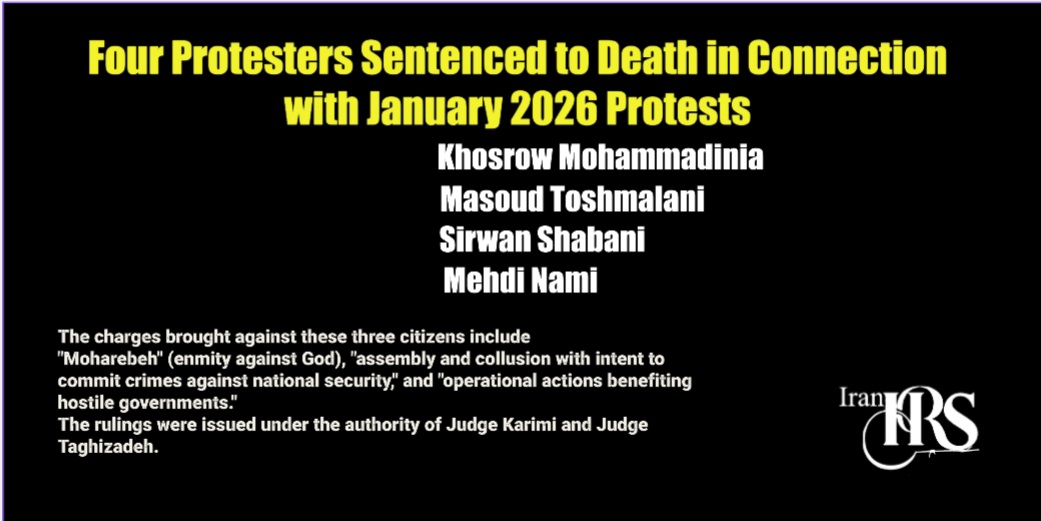
Khosrow Mohammadinia, Masoud Toshmalani, Sirwan Shabani, and Mehdi Nami, four individuals arrested during the January 2026 protests, have been sentenced to death in joint and separate cases; details regarding interrogation procedures, trial proceedings, and access to chosen counsel remain unclear
Iran Human Rights Society, Thursday, October 1, 2026– Khosrow Mohammadinia, Masoud Toshmalani, Sirwan Shabani, and Mehdi Nami, four protesters facing death sentences following their arrests during the January 2026 nationwide protests, are currently incarcerated in Ghezel Hesar Prison in Karaj. Their death sentences were issued by Branch 23 of the Revolutionary Court of Tehran. Despite these severe sentences, precise details regarding court proceedings, interrogation conditions, access to chosen legal counsel, and their ability to present an effective defense remain undisclosed.
Death Sentences Issued for Three Kermanshah Citizens
According to received information, Khosrow Mohammadinia, Masoud Toshmalani, and Sirwan Shabani were sentenced to death in a joint legal case by Branch 23 of the Revolutionary Court of Tehran.
The charges brought against these three citizens include “Moharebeh” (enmity against God), “assembly and collusion with intent to commit crimes against national security,” and “operational actions benefiting hostile governments.” The rulings were issued under the authority of Judge Karimi and Judge Taghizadeh.
The three Kermanshah residents were arrested by security forces on a street in Islamshahr during the January 2026 protests. Masoud Toshmalani was temporarily released on bail following his initial detention, only to be re-arrested a few days later. Sirwan Shabani is approximately 22 years old, while the other two defendants are between 30 and 50 years old. Additionally, a woman prosecuted within the same case file received a five-year prison sentence.
Mehdi Nami; Arrested at Home and Sentenced to Death
Mehdi Nami, another protester sentenced to death, was arrested in January 2026 by security personnel at his personal residence in Tehran in connection with nationwide protests.
Based on received reports, Branch 23 of the Revolutionary Court of Tehran sentenced him to death on charges of “operational actions benefiting hostile governments.”
Mehdi Nami was violently arrested around 4:00 AM on Wednesday, January 14, 2026, during a raid on his home by intelligence agents, who transported him to an undisclosed location in an unmarked ambulance. Despite repeated inquiries at various state institutions, his family received no clear information regarding his location or legal standing. He is currently held in Ghezel Hesar Prison.
Ambiguities Regarding Due Process and Legal Representation
For all four protesters, clear documentation remains lacking regarding court session procedures, interrogation standards, prosecution evidence, and access to chosen defense representation.
It remains unconfirmed to what extent the defendants were granted fair defense guarantees during interrogation and judicial hearings. These procedural ambiguities raise fundamental concerns, particularly given the irrevocable nature of the death penalty.
Mehdi Nami was previously arrested during the 2022 protests and was reportedly subjected to physical torture. Independent reports regarding his current health condition and detailed case records have not been released.
Information Box | Case Information at a Glance
| Subject | Details |
| Defendants | Khosrow Mohammadinia, Masoud Toshmalani, Sirwan Shabani & Mehdi Nami |
| Arrest Context & Locations | January 2026 nationwide protests (Islamshahr & residential raid in Tehran) |
| Sentencing Authority | Branch 23 of the Revolutionary Court of Tehran (Judges Karimi & Taghizadeh) |
| Primary Charges | “Moharebeh,” assembly/collusion against national security, operational actions benefiting hostile governments |
| Current Detention Facility | Ghezel Hesar Prison, Karaj |
| Key Concerns | Violent arrest, incommunicado transfer, lack of access to chosen legal counsel, lack of trial transparency |
Legal Review of the Case Based on Domestic Laws
Reviewing these judicial actions under domestic statutes does not signify an endorsement of the governing legal framework, but serves to highlight that even internal statutory provisions are routinely bypassed.
Relevant Statutory Provisions
- Article 32 of the Constitution: Mandates that arrests must occur strictly in accordance with statutory procedures, with written notice of charges served promptly.
- Article 35 of the Constitution: Upholds the right of all citizens to select qualified defense counsel in all judicial tribunals.
- Article 37 of the Constitution: Establishes the presumption of innocence until guilt is proven in a competent judicial court.
- Article 38 of the Constitution: Strictly prohibits all forms of torture to extract confessions and voids coerced statements.
Procedural Violations
The lack of transparent trial hearings, denial of access to chosen defense counsel during preliminary investigations, and violent arrests without visible warrants represent direct violations of statutory guarantees codified under internal law.
Human Rights Violations Regarding the Death Sentences
The capital rulings and opaque legal proceedings against these four protesters violate fundamental international human rights principles:
- Article 3 of the Universal Declaration of Human Rights (UDHR): Guarantees the fundamental right to life, liberty, and security of person.
- Article 5 of the Universal Declaration of Human Rights (UDHR): Prohibits torture or cruel, inhuman, or degrading treatment.
- Article 9 of the Universal Declaration of Human Rights (UDHR): Bans arbitrary arrest, detention, or exile.
- Articles 10 & 11 of the Universal Declaration of Human Rights (UDHR): Entitle all individuals to a fair and public hearing by an independent tribunal and guarantee full rights of defense and the presumption of innocence.
Issuing death sentences through opaque judicial proceedings without independent defense counsel violates international standards, necessitating complete transparency, immediate access to legal representation, and independent case reviews.
See also the below articles:
- Majid Nikandish & Ali Hemmati Executed in Mashhad
- Iran Imposes Extrajudicial Bank and SIM Card Freezes on Journalist Nasrin Hasani
Follow Iran Human Rights Society on social networks:
Telegram /Twitter /Instagram / YouTube / Facebook
Join Iran Human Rights Society on Twitter