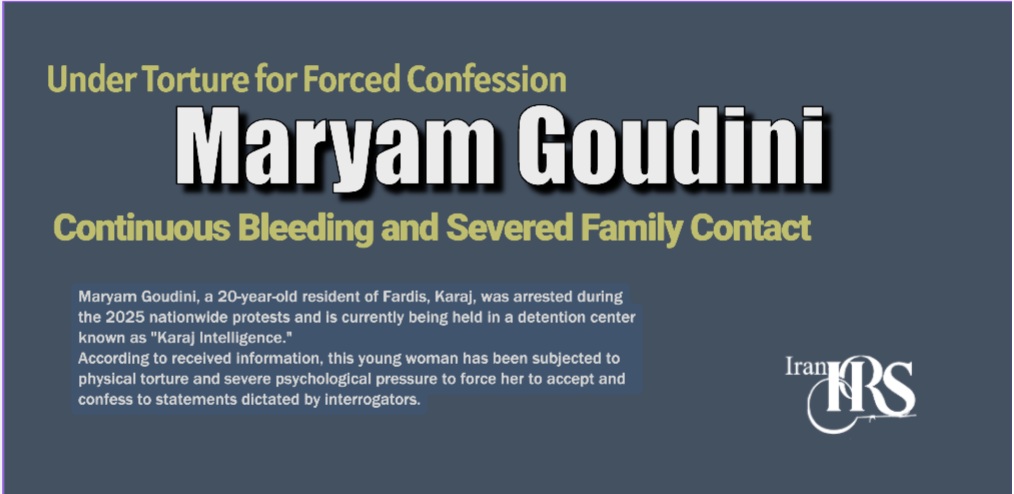
Maryam Goudini, a 20-year-old citizen detained during the 2025 nationwide protests, is being subjected to torture and pressure for forced confessions in a security detention facility in Karaj. She has been denied contact and visitation with her family as well as access to chosen legal counsel

Iran Human Rights Society, Tuesday, September 29, 2026– Maryam Goudini, a 20-year-old resident of Fardis, Karaj, was arrested during the 2025 nationwide protests and is currently being held in a detention center known as “Karaj Intelligence.” According to received information, this young woman has been subjected to physical torture and severe psychological pressure to force her to accept and confess to statements dictated by interrogators.
Precise details regarding the exact date of her arrest, formal charges brought against her, the issuing judicial authority, and the current legal stage of Maryam Goudini’s case are unavailable. Responsible officials have also failed to provide any transparent explanation regarding the grounds for her arrest or her legal standing.
Continuous Bleeding Following Torture and Physical Assault
Based on received reports, Maryam Goudini was severely tortured and physically assaulted during her interrogation period, resulting in continuous medical bleeding. Further details regarding the medical cause of the bleeding, the full extent of injuries inflicted, or her access to a physician have not been made public.
Continuous bleeding can indicate severe physical trauma, and withholding her immediate transfer to an independent medical facility directly jeopardizes her health and life. It remains unclear whether any medical examination has been conducted or if any potential medical findings have been formally logged into her case file.
According to received information, an individual with the surname “Garavand” has been named as the case officer supervising Maryam Goudini. The responsibility for protecting the life and health of this detainee rests with the interrogators, detention facility officials, and the supervising judicial authority.
Shaving Maryam Goudini’s Hair for Psychological Humiliation
Reports indicate that officers shaved Maryam Goudini’s head as a measure of humiliation and psychological torture. This action, combined with physical beatings, isolation, and denial of contact with her family, was executed to escalate psychological pressure on her.
Interrogators are utilizing these pressures to coerce the young woman into delivering forced statements dictated by authorities. Any confession extracted under conditions of torture, threat, isolation, or psychological coercion is entirely void of legal validity and cannot serve as a lawful basis for bringing charges or issuing a verdict.
Deprivation of Family Contact and Chosen Counsel
Since her transfer to the Karaj Intelligence detention center, Maryam Goudini has been deprived of phone calls and visitation with her family. This complete lack of news has heightened her family’s grave concerns regarding her physical condition, exact location of custody, and interrogation conditions.
Furthermore, Maryam Goudini has been denied access to chosen legal representation, and it is unknown whether any defense attorney was present during her interrogation and formal arraignment sessions. Severing all communication with family and legal counsel eliminates oversight regarding officers’ conduct, prevents documenting evidence of physical torture, and leaves the detainee defenseless against interrogator demands.
Information Box | Case Information at a Glance
| Subject | Details |
| Name | Maryam Goudini |
| Age / Residence | 20 years old / Fardis, Karaj |
| Arrest Context | Detained during the 2025 nationwide protests |
| Current Place of Custody | Karaj Intelligence Detention Center (Case Officer: “Garavand”) |
| Medical Status | Continuous bleeding due to physical beatings/torture; denied independent medical evaluation |
| Documented Abuses | Forced head shaving for psychological humiliation, physical beatings, forced confession pressure |
| Rights Violations | Incommunicado detention, denied family visitation/phone access, denied chosen defense counsel |
Legal Review of Maryam Goudini’s Case Based on Domestic Laws
Reviewing this case under domestic statutes does not constitute an endorsement of the governing legal frameworks, but serves to demonstrate that even internal legal mandates are being directly violated.
Legal Ambiguities of the Case
Subjecting a detainee to physical abuse, psychological torture, and forced confessions while denying access to defense counsel severely undermines the legal integrity of any potential judicial proceedings.
Relevant Statutory Provisions
- Article 35 of the Constitution: Guarantees the right of all individuals to select defense counsel in all stages of legal proceedings.
- Article 38 of the Constitution: Strictly prohibits all forms of torture to extract confessions and declares coerced confessions legally invalid.
- Article 39 of the Constitution: Forbids any affront to the honor and dignity of individuals who are arrested or detained.
- Articles 48 & 190 of the Criminal Procedure Code: Affirm the right of defendants to access legal representation during preliminary investigations.
- Article 578 of the Islamic Penal Code: Designates physical abuse of a defendant for the purpose of obtaining a confession as a criminal offense.
Procedural Violations
Inflicting torture, forcibly shaving a female detainee’s head to cause psychological humiliation, and denying access to legal representation represent explicit breaches of statutory protections codified under internal procedural law.
Human Rights Violations in Maryam Goudini’s Case
The treatment of Maryam Goudini in custody directly violates fundamental international human rights treaties and conventions:
- Article 3 of the Universal Declaration of Human Rights (UDHR): Guarantees the right to life, liberty, and security of person.
- Article 5 of the Universal Declaration of Human Rights (UDHR): Strictly prohibits torture, or cruel, inhuman, or degrading treatment or punishment.
- Article 9 of the Universal Declaration of Human Rights (UDHR): Prohibits arbitrary arrest and detention.
- Articles 10 & 11 of the Universal Declaration of Human Rights (UDHR): Entitle everyone to a fair and public hearing by an independent tribunal, effective defense guarantees, and the presumption of innocence.
- Articles 7 & 14 of the International Covenant on Civil and Political Rights (ICCPR): Establish an absolute prohibition on torture and mandate comprehensive fair trial protections.
Extracting confessions through torture, maintaining total incommunicado detention, withholding chosen legal representation, and ignoring ongoing physical injuries require immediate intervention, an independent medical evaluation, access to family and legal counsel, and an impartial investigation into the perpetrators of torture.
See also the below articles:
- Ali Younesi 5-Year Sentence Upheld | Sharif University Student Report
- Death Sentence Issued for Mahbubeh Shabani in Mashhad
Follow Iran Human Rights Society on social networks:
Telegram /Twitter /Instagram / YouTube / Facebook
Join Iran Human Rights Society on Twitter