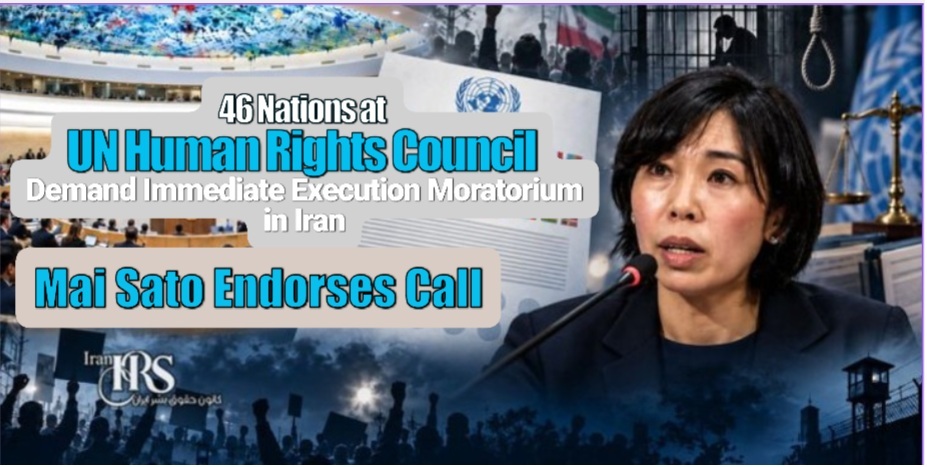
Liechtenstein, speaking on behalf of 46 countries at the UN Human Rights Council session, condemned the surge in executions, particularly targeting protesters; Special Rapporteur Mai Sato welcomed the statement and emphasized the urgent need for an immediate moratorium on the death penalty
Iran Human Rights Society, Friday, October 2, 2026– The United Nations Human Rights Council was presented with a joint statement by 46 member states on September 30, 2026, addressing the dramatic escalation of executions and capital sentences in Iran. Delivered by the representative of Liechtenstein during the 63rd Session of the Human Rights Council, the statement expressed acute alarm over the execution of protesters and the pending death sentences issued against dozens of other demonstrators, including women and children.
The signatory nations further issued warnings regarding judicial proceedings lacking fair trial guarantees, systematic torture, ill-treatment, enforced disappearances, and coerced confessions. Mai Sato, the UN Special Rapporteur on the situation of human rights in Iran, welcomed the statement, emphasizing that the necessity for a legal moratorium on executions pending total abolition is more urgent than ever.
Joint Statement by 46 Nations at the Human Rights Council
The representative of Liechtenstein informed the plenary session that the joint statement, endorsed by 46 countries, explicitly condemns the continuous and significant escalation in the application of the death penalty by Iranian authorities.
Citing findings and documentation compiled by the UN High Commissioner for Human Rights, the Special Rapporteur on Iran, and the Independent International Fact-Finding Mission on Iran, the statement highlighted deep concern over rising execution rates, particularly in cases linked to public protests and the exercise of fundamental freedoms.
The signatory nations noted that at least 31 protesters have been executed following the crackdown on the January protests, with dozens more—including women and minors—sentenced to death or facing imminent execution risk.
Concerns Regarding the Execution of Protesters
A primary focal point of the Council statement was the direct link between public demonstrations and state execution practices. The statement underscored UN expert findings showing that capital punishment in Iran is deployed as a mechanism of state intimidation, aimed at suppressing dissent and blocking the peaceful expression of opinions and public assemblies.
The 46 signatory countries also expressed serious concern regarding the resumption of public executions. These international warnings emerge against a backdrop of numerous 2026 protest-related cases prosecuted under heavy national security charges carrying mandatory death sentences.
Concerns Over Judicial Due Process
The joint statement extended beyond execution statistics to address the underlying judicial processes leading to capital convictions.
The 46 nations highlighted alarming reports of closed-door trial sessions, severe violations of fair trial standards, physical torture, ill-treatment, enforced disappearances, and reliance on coerced confessions. The text emphasized that individuals are being sentenced to death following legal proceedings that fall drastically short of international fair trial benchmarks.
This aspect of the statement holds critical importance, as fair trial rights—including access to chosen defense counsel, effective legal defense, freedom from torture, and evidentiary integrity—are intrinsically tied to the fundamental right to life.
Call for an Immediate Execution Moratorium
Concluding their submission, the 46 member states urged Iranian authorities to halt all pending executions immediately. The statement asserted that no individual should face the death penalty for exercising basic human rights or expressing personal viewpoints.
The signatory states explicitly demanded an immediate cessation of capital punishment in the highlighted protest and security-related cases.
Mai Sato Welcomes the 46-Nation Statement
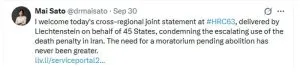
Mai Sato, UN Special Rapporteur on Iran, formally welcomed the joint declaration by the 46 nations. In her public response, she stated: “The necessity of establishing a legal moratorium on the execution of death sentences pending the complete abolition of this penalty is felt more than ever before.”
Her position aligns with her previous warnings regarding state execution trends in Iran. Special Rapporteur Sato has previously pointed out that executions did not abate during nationwide protests or internet shutdowns, but rather intensified in security-related prosecutions. She reiterated her call for an immediate freeze on all executions nationwide.
Escalating International Pressure on Execution Practices
The presentation of this statement at the Human Rights Council forms part of a broader trajectory of international warnings regarding capital punishment in Iran. In 2025, execution numbers reached extraordinary levels, with Amnesty International recording at least 2,159 executions—the highest single-year total recorded in Iran since 1981—a significant portion of which were linked to drug charges.
However, the recent statement by the 46 nations places specific focus on cases involving political protesters, linking capital punishment practices directly to recent socio-political developments.
Information Box | Case Information at a Glance
| Subject | Details |
| Forum / Date | 63rd Session of the UN Human Rights Council — September 30, 2026 |
| Lead Presenter | Representative of Liechtenstein (on behalf of 46 Member States) |
| Key Findings Cited | UN High Commissioner for Human Rights, Special Rapporteur on Iran, Independent Fact-Finding Mission |
| Protester Execution Toll | At least 31 protesters executed post-January protests; dozens more facing imminent execution (including women and minors) |
| Documented Due Process Abuses | Closed-door trials, denial of defense rights, physical torture, enforced disappearances, coerced confessions |
| Key Recommendation | Immediate moratorium on all executions pending full legal abolition of the death penalty |
Legal Review of Capital Cases Based on Domestic Laws
Analyzing these judicial procedures under domestic statutes does not constitute an endorsement of the existing legal framework, but illustrates that even internal statutory mandates are being systematically bypassed.
Relevant Statutory Provisions
- Article 32 of the Constitution: Mandates strictly lawful arrest procedures and written notification of charges.
- Article 35 of the Constitution: Upholds the constitutional right to select legal counsel across all judicial stages.
- Article 37 of the Constitution: Establishes the fundamental presumption of innocence until proven guilty in a competent court.
- Article 38 of the Constitution: Expressly forbids all forms of torture to extract confessions and nullifies coerced statements.
Procedural Violations
The widespread reliance on closed-door hearings, denial of defense lawyers during preliminary investigations, and extraction of confessions under torture directly violate explicit protections codified under domestic law.
Human Rights Violations Highlighted at the UN Council
The systemic application of capital punishment against protesters conflicts directly with international legal instruments:
- Article 3 of the Universal Declaration of Human Rights (UDHR): Guarantees the right to life, liberty, and security of person.
- Article 5 of the Universal Declaration of Human Rights (UDHR): Strictly bans torture and cruel, inhuman, or degrading treatment.
- Articles 9, 10 & 11 of the Universal Declaration of Human Rights (UDHR): Prohibit arbitrary detention and guarantee public hearings by independent tribunals with full defense protections.
- Article 14 of the International Covenant on Civil and Political Rights (ICCPR): Requires comprehensive fair trial standards, equality before the law, and adequate time and facilities for defense.
The joint declaration of the 46 UN member states and Special Rapporteur Mai Sato underscores that capital punishment deployed without fair trial guarantees constitutes an arbitrary deprivation of life, requiring immediate international oversight and a complete cessation of executions.
See also the below articles:
- Tehran Court Hands Down Death Sentences to four Protesters Amid Severe Due Process Violations
- Iran Imposes Extrajudicial Bank and SIM Card Freezes on Journalist Nasrin Hasani
Follow Iran Human Rights Society on social networks:
Telegram /Twitter /Instagram / YouTube / Facebook
Join Iran Human Rights Society on Twitter