
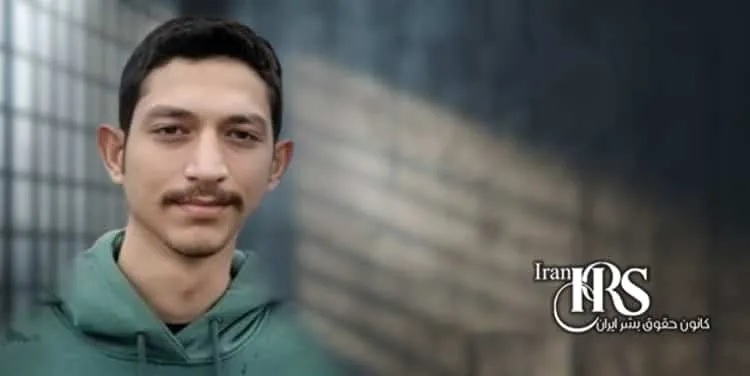
Hafez Forouhi, detained during the 2022 nationwide protests in Iran, issued a statement protesting the illegal extension of his imprisonment beyond the designated sentence and violations of criminal procedure laws in his case.
Iran Human Rights society, Sunday, May 24, 2025 – Hafez Forouhi, a political prisoner arrested during the 2022 nationwide protests, published a note from prison protesting his continued detention after completing his legal sentence. Citing Article 134 of the Islamic Penal Code and Article 131 of the Criminal Procedure Code, he emphasized that issuing two separate sentences for related charges and enforcing both concurrently is a gross violation and infringement of his legal rights.
According to Forouhi, while one sentence was 27 months and the other 24 months, the law mandates only the heavier sentence should be enforced. However, he has been imprisoned for over 28 months. In his note, Forouhi wrote:
“Proper enforcement of the law would have guaranteed my release after 27 months, not 28. This violation is not a mere error but a breach of law and an injustice to my rights.”
He explicitly stated he is not seeking leniency but demands the enforcement of justice and existing law.
The continued unlawful detention of Hafez Forouhi, a political prisoner from Rasht, persists despite his sentence concluding in December 2024. He has protested judicial violations and clear breaches of criminal procedure laws through a note from prison.
Detention During Nationwide Protests

Hafez Forouhi was arrested on January 18, 2023, during anti-government protests in Rasht. Until September 15, 2023, he was held in Lakan Prison, Rasht, without a clear judicial ruling and in legal limbo. No bail was accepted for his temporary release, and his judicial process faced repeated delays and security pressures.
Forouhi’s case was initially processed in two separate courts—first the Revolutionary Court, then the Criminal Court—contrary to Article 134 of the Islamic Penal Code, which mandates unified handling of related charges. Consequently, he was sentenced to 24 and 27 months in two separate cases, though under Article 442, the punishment should have been reduced, and only the heavier sentence (27 months) enforced.
Judicial Obstruction in Case Consolidation
On March 18, 2025, Forouhi’s case was sent for consolidation to the Criminal Court after months of delays. However, as of this report, he remains in prison and in limbo. This delay continues despite his legal sentence ending in December 2024.
It is also noted that the issuing judge, “Iran Aghideh,” simultaneously served in the appeals court, highlighting a conflict of interest and a severe violation of fair trial principles.

Dry Hunger Strike in Protest of Legal Violations
In response to these violations, Hafez Forouhi began a dry hunger strike on January 28, 2025. In a statement, he declared:
“Given the completion of my sentence and the obstruction of my release by security forces and the sentencing officer, I am officially starting a full hunger strike. The responsibility for my health lies with judicial, security, and prison authorities.”
He warned that “five days of a dry hunger strike could lead to death” and added that he has no pre-existing medical conditions and is in full health.
Human Rights Violations in Hafez Forouhi’s Case
Several clear violations of human rights and fair trial principles are evident in Forouhi’s case, conflicting with Iran’s international obligations:
Violation of Article 9 of the ICCPR, which emphasizes the right to personal liberty and security. Continued detention after the legal sentence constitutes arbitrary detention.
Violation of Article 14 of the ICCPR, which mandates a fair, public trial by an impartial court. Failure to consolidate cases, their handling in separate courts, and the same judge serving in both trial and appeals stages violate this principle.
Violation of the separation of powers and judicial independence, due to security institutions’ interference in preventing the prisoner’s legal release.
Violation of Article 10 of the ICCPR, which stresses that prisoners must be treated with human dignity. Keeping Forouhi in limbo, under psychological pressure, and disregarding his right to freedom contravenes this principle.
The continued detention of Hafez Forouhi, despite completing his sentence, symbolizes the ruling dictatorship’s disregard for basic legal and human principles. This case exemplifies arbitrary treatment, legal violations, and ongoing pressure on political prisoners. In such a climate, even the dictatorship’s existing laws have become tools for further repression and injustice.
Follow Iran Human Rights society on social networks:
Telegram /Twitter /Instagram / YouTube / Facebook
Join Iran Human Rights Society on Twitter






Discussion about this post