
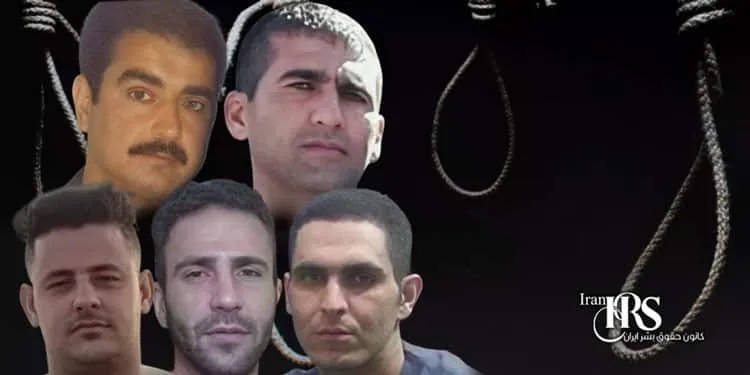
Since the beginning of Khordad (May 22, 2025), at least 8 prisoners have been executed. The number of executions in Ordibehesht 1404 (April-May 2025), with 168 prisoners executed, marks the highest execution rate in recent years.

Iran Human Rights Society, Sunday, 4 Khordad 1404 (May 25, 2025) – Seven prisoners were executed in Shiraz, Zanjan, and Qom prisons. Since the start of Khordad, at least 8 prisoners have been executed. The number of executions in Ordibehesht 1404, with 168 prisoners executed, is the highest in recent years.
Execution of Mohammad Barzegari Beigi and Mohammad Zare Moidi in Adelabad Prison, Shiraz
On the morning of Sunday, 4 Khordad 1404 (May 25, 2025), Mohammad Barzegari Beigi and Mohammad Zare Moidi were executed in Adelabad Prison, Shiraz. Mohammad Barzegari was from Shiraz, and Mohammad Zare Moidi was from Doshman Ziari, a district of Beyza. They were arrested in separate cases on drug-related charges and sentenced to death.
Execution of Homayoun Amjad in Zanjan Prison
On the morning of Saturday, 3 Khordad 1404 (May 24, 2025), Homayoun Amjad was executed in Zanjan Prison. He had previously been arrested on drug-related charges and sentenced to death.
Execution of Alireza Rezaei, Vahid Karimizadeh, Farhad Farhnak, and Mobarak Rahmani in Qom Prison
At dawn on Sunday, 4 Khordad 1404 (May 25, 2025), Alireza Rezaei and Mobarak Rahmani were executed in Qom Prison. Alireza Rezaei, 27, was from Qom and had been arrested and sentenced to death on murder charges.
Mobarak Rahmani, 25, an Afghan national, was arrested 2.5 years ago on murder charges and sentenced to death.
At dawn on Saturday, 3 Khordad 1404 (May 24, 2025), Vahid Karimizadeh and Farhad Farhnak were executed in Qom Prison. Vahid Karimizadeh, 35, from Eslamshahr, Tehran, married and a father of one, had been arrested three years ago on drug-related charges and sentenced to death.
Farhad Farhnak, 25, from Qom, was arrested five years ago on murder charges and sentenced to death.
Inconsistency of the Death Penalty with the Universal Declaration of Human Rights
Article 3 of the Universal Declaration of Human Rights explicitly states: “Everyone has the right to life.” This right is inalienable except in cases of a verdict issued by a competent court for a crime recognized as such under the law. The death penalty, as the ultimate punishment, directly contradicts this article because:
Right to Life: The right to life is a fundamental and inalienable right. The death penalty deprives individuals of this right.
Irreversibility: Once the death penalty is carried out, judicial errors cannot be rectified.
Torture and Inhuman Treatment: Some methods of execution are considered torture and inhuman treatment, which violates the provisions of the Universal Declaration of Human Rights.
Violation of Human Rights Obligations Regarding the Death Penalty
According to Article 6 of the International Covenant on Civil and Political Rights, to which Iran is a signatory, the issuance and execution of the death penalty are permissible only with full guarantees of a fair trial and for the most serious crimes. In many similar cases, lack of transparency, restrictions on the defendant’s legal rights, and rulings issued by courts lacking necessary independence are considered violations of this fundamental human rights principle.
Follow Iran Human Rights society on social networks:
Telegram /Twitter /Instagram / YouTube / Facebook
Join Iran Human Rights Society on Twitter





Discussion about this post