

A request for consolidation of sentences was submitted for these three political prisoners. Based on precise calculations, with sentence consolidation, Mehdi Mirzaei and Hafez Forouhi should have been released by February 2025, and Arman Sabet Sadeghi would have been eligible for parole. However, a new and unexpected seven-year sentence for each was suddenly issued and announced through the Sana system.
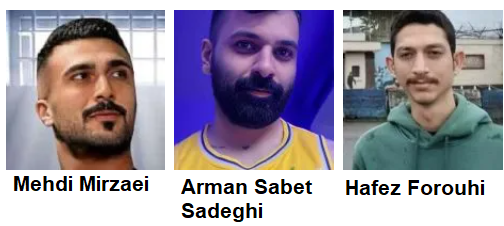
Iran Human Rights Society, June 13, 2025 – Three political prisoners, Arman Sabet Sadeghi, Mehdi Mirzaei, and Hafez Forouhi, arrested during the 2022 nationwide protests, have been sentenced to seven years in prison by Branch 18 of the Gilan Province Appeals Court, despite having served 30 months in detention. This harsh and unlawful ruling comes after expectations that their sentences would be consolidated, potentially leading to shorter terms.
New Heavy Sentence After 30 Months of Imprisonment
According to a source close to the prisoners’ families, the trio has been held in Lakan Prison, Rasht, since their arrest in 2022. Initially, they received sentences ranging from two to three years. A request for sentence consolidation was submitted, which, based on precise calculations, should have led to the release of Mehdi Mirzaei and Hafez Forouhi by February 2025, with Arman Sabet Sadeghi eligible for parole. However, a new and unexpected seven-year sentence for each was issued through the Sana system, bypassing standard consolidation procedures, by Judge Mehrani.
Judicial Violations and Disregard for Fair Trial Principles
Under Iran’s Criminal Procedure Code, sentences for multiple charges within a single case can be consolidated, with the final sentence based on the most severe charge. This is a standard legal practice. However, in this case, not only was this principle ignored, but a significantly harsher sentence was imposed after 30 months of detention. The prisoners’ families have strongly protested this decision, calling for international human rights organizations to intervene and highlight this blatant injustice.
Increased Pressure on 2022 Protesters in Lakan Prison
Political prisoners, particularly those detained during the 2022 protests, have faced intense judicial, security, and physical pressures. Lakan Prison in Rasht is a key facility for holding protesters in Gilan Province, with numerous reports of torture, harsh interrogations, and forced confessions. The new seven-year sentences have raised fears of similar rulings for other protesters, seen as part of a deliberate effort to suppress dissent and deter public participation in protests.
Demands from Families and Human Rights Activists
The families of Arman Sabet Sadeghi, Mehdi Mirzaei, and Hafez Forouhi issued a statement condemning the unlawful and unfair handling of their loved ones’ cases, demanding intervention from international monitoring bodies. They stated:
“When our children should have been released after 30 months in prison, they now face a baseless and inhumane sentence. This clear injustice must stop, and international organizations have a duty to intervene for justice.”
Human Rights Violations in This Case
The issuance of these new sentences constitutes a clear violation of fundamental human rights and fair trial principles, including:
Violation of the prohibition on arbitrary detention (Article 9, ICCPR): Imposing new, unlawful sentences after serving prior terms amounts to arbitrary detention.
Violation of fair trial rights (Article 14, ICCPR): Failure to consolidate sentences and issuing rulings without transparent judicial processes violates the right to a fair trial.
Violation of freedom of expression and peaceful assembly (Articles 19 and 21, ICCPR): Detaining and sentencing individuals solely for participating in peaceful protests infringes on these rights.
Violation of the principle of non bis in idem (double jeopardy): Issuing new sentences after partial completion of prior terms, without consolidation, constitutes double punishment.
The heavy and unlawful sentences against these 2022 protesters reflect the Islamic Republic’s broader policy of systematically suppressing dissent. This undermines judicial integrity and erodes public trust in the judiciary’s independence. Human rights organizations, media, and the global community must urgently address these gross violations and work to prevent their recurrence.
Follow Iran Human Rights Society on social networks:
Telegram /Twitter /Instagram / YouTube / Facebook
Join Iran Human Rights Society on Twitter





Discussion about this post