
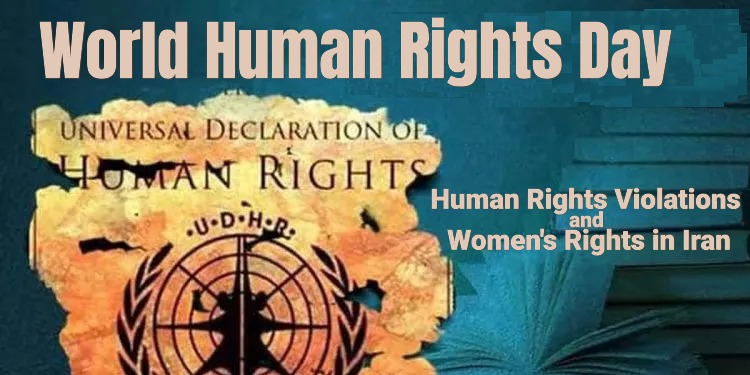
Human rights violations and the suppression of women in Iran have a systematic, institutionalized, and ongoing nature. Governmental institutions at various levels, from the judiciary to security forces, play an effective role in reproducing this suppression.
Iran Human Rights Society, Wednesday, December 10, 2025 – The Universal Declaration of Human Rights was adopted by the United Nations on December 10, 1948, as a response to the atrocities of World War II and the killing of millions of innocent people. This document, for the first time, expressed fundamental human rights such as freedom, justice, equality, and having a dignified life in 30 articles, obligating countries to protect these rights.
The Declaration also carries an important message for the future: creating a just and peaceful world in which all individuals, regardless of race, religion, or nationality, live with dignity and respect.
Ignoring Human Rights in the Ruling Dictatorship

Iran, as a member of the United Nations, is obligated to comply with the provisions of the Universal Declaration of Human Rights, but in practice, many of these principles are ignored by the ruling dictatorship. Severe restrictions on freedom of expression, the activities of journalists and political activists, pressure on religious and ethnic minorities, and widespread discrimination against women and girls are among the major problems.
Discriminatory Laws Curb Women’s Basic Freedoms
The country’s political and judicial structure makes access to justice and equal rights difficult for individuals. Numerous reports from international organizations indicate arbitrary arrests, unfair trials, and torture. These reports show the deep gap between the ruling dictatorship’s official commitments in Iran and the realities on the ground.
World Human Rights Day is an opportunity to draw global attention to these issues and continue efforts to create positive changes. Respect for human rights is not only a legal duty but also the foundation of progress and sustainable development for any society.
Analysis of Human Rights Violations and Restrictions on Women’s Rights
This section of the report aims to provide a precise and comprehensive analysis of the persistent patterns of human rights violations in Iran and their impact on women. The main focus is on the methods through which the government limits women’s freedoms and rights.
- Discriminatory Laws and Legal Restrictions: The ruling dictatorship in Iran uses the legal framework to restrict women’s basic rights. These restrictions include compulsory veiling, limited access to education, occupational restrictions, and limitations on political participation. These laws not only reduce equal opportunities but also turn gender discrimination into an official legal structure.
- Suppression of Women’s Political and Social Activities: Women’s political and social activities are under severe supervision, and activists in the fields of human rights, politics, and culture face threats, arrests, and imprisonment. This suppression creates an atmosphere of fear and silence that limits women’s efforts for social change.
- Restrictions on Access to Information and Media: The government’s strict control over media and the internet limits women’s access to independent and free information. These restrictions not only weaken freedom of expression but also deprive women of important educational and informational resources that are essential for achieving equal rights.
- Structural and Physical Violence Against Women: Violence against women in Iran includes domestic violence, state violence, and security suppression, and is used as a systematic tool to control women. Arbitrary arrests, torture, and psychological pressure are examples of this structural violence that have been widely reported.
- Social and Economic Consequences: The restrictions imposed on women not only reduce their individual freedoms but also have widespread social and economic consequences. Reducing women’s participation in the labor market and politics leads to decreased economic productivity and weakness in social decision-making processes, affecting the entire society.
The ongoing violation of women’s rights in Iran indicates a repressive and dictatorial system that, by utilizing discriminatory laws, social suppression, information control, and structural violence, limits women’s fundamental rights. This situation requires international attention and pressure to support human rights and create fundamental changes in governmental structures.

Methods of Suppressing Women by the Ruling Dictatorship in Iran
A – Unequal Laws Against Women In Iran, women’s rights are not fully respected. Laws related to inheritance, child custody, and divorce rights are often in favor of men and place women in a weak position. In addition, women face many restrictions in work and politics that hinder their equality.
B – Compulsory Hijab and Protests One of the most important methods of controlling women is the compulsion to wear the hijab. This law has been enforced since the time of Khomeini and has always faced opposition from women. Widespread protests show that a large part of society opposes this law.
Hijab and Chastity Law: A Tool for Suppressing Women and Society Compulsory hijab has always been part of the main policies of the ruling dictatorship in Iran. In recent years, with the active presence of women in the nationwide protests of 2019 and 2022, the government has approved harsher laws regarding the hijab.
These laws aim to restrict women and strengthen control over society. Currently, social resistances and fear of uprising and nationwide protests have prevented the regime’s leaders from openly enforcing these harsh laws. This lack of enforcement indicates the weakness of the governmental forces; otherwise, no fundamental change has occurred in the regime leaders’ perspective toward women.
Human Rights Violations with a Focus on Suppressing Women
First – Limiting Women as a Force for Social Change Iranian women have played an important role in protests and social movements in recent years. The resistance of imprisoned women and the high statistics of executions of female fighters show that women have the ability to create change. Also, many young and educated women lost their lives in the nationwide protests of 2019 and 2022. The regime leaders, by increasing severity regarding the hijab, try to reduce women’s role in politics and society and prevent their progress.
Second – Creating a General Atmosphere of Suffocation This law has been approved to create fear and social suppression and reduce any potential opposition. The government, by imposing severe punishments and widespread supervision, tries to prevent citizens from participating in political or social activities, peaceful protests, and even public discussions. The Hijab and Chastity Law, in particular, not only violates women’s fundamental rights but also contradicts the basic principles of human rights, including the right to freedom of choice and the right to freedom of expression.
These laws also conflict with the international commitments of the ruling dictatorship in Iran regarding human rights and are a clear example of the system’s efforts to impose more social control and create a repressive and suffocating environment. In addition to direct effects on women, these laws have caused a general atmosphere of fear in society and reduce the motivation for social and political participation, which in the long term can lead to weakening civil institutions and reducing public trust in the judicial and executive systems.
Third – Increasing the Statistics of Women’s Executions in Prisons In recent years, the rate of women’s executions in Iran has increased dramatically. Many of these executions are the result of unfair laws and the use of forced confessions and torture during interrogations.
From the beginning of the year until now, at least 38 women have been executed, which is one of the highest rates of women’s executions in the past decade. This increase represents the repressive policies of the government against vulnerable groups in society, especially women, and has raised serious international concerns. In many cases, these executions have been carried out in conditions where there was no judicial transparency and the legal rights of the defendants were not respected.
- Lack of Access to Independent Counsel: Many women have not even had the opportunity to choose an independent lawyer or afford one during the trial, and as a result, they have been deprived of effective legal defense. These restrictions practically eliminate the possibility of a fair trial.
- Forced Confessions: Reports indicate that a number of these women were forced to provide confessions under severe physical torture and psychological pressures. These methods are a clear violation of human rights and international laws and indicate systematic abuse of power by the judiciary.
Barriers to Fair Defense
In addition, the increase in women’s executions has destructive effects on families and society and causes increased fear, isolation, and disruption in women’s social life. The international community has repeatedly warned about this situation and demanded the implementation of justice and respect for women’s rights.
Systematic Violation of Women’s Rights in the Ruling Dictatorship in Iran
Issues related to the situation of women in Iran are one of the most complex and controversial areas of social and legal issues in the country. A set of discriminatory laws, authoritarian governmental structures, and patriarchal policy-making approaches have provided the ground for ongoing and organized violation of women’s rights. This violation of rights is observed in various dimensions of women’s individual, social, and political lives and leaves deep consequences.
Human rights violations and the suppression of women in Iran have a systematic, institutionalized, and ongoing nature. Governmental institutions at various levels, from the judiciary to security forces, play an effective role in reproducing this suppression. The result of this repressive structure is the persistent limitation of women’s human rights, intensification of gender discrimination, and creation of serious obstacles in the path of their equal participation in society.
See also the below articles:
- Ehsan Faridi Student Day Message from Death Row and Parents’ Powerful Call Against Execution
- Naib Haji Zadeh Furlough Denial: Daughter’s Surgery Looms While Father Remains Locked in Urmia Prison
Follow Iran Human Rights Society on social networks:
Telegram /Twitter /Instagram / YouTube / Facebook
Join Iran Human Rights Society on Twitter






Discussion about this post