
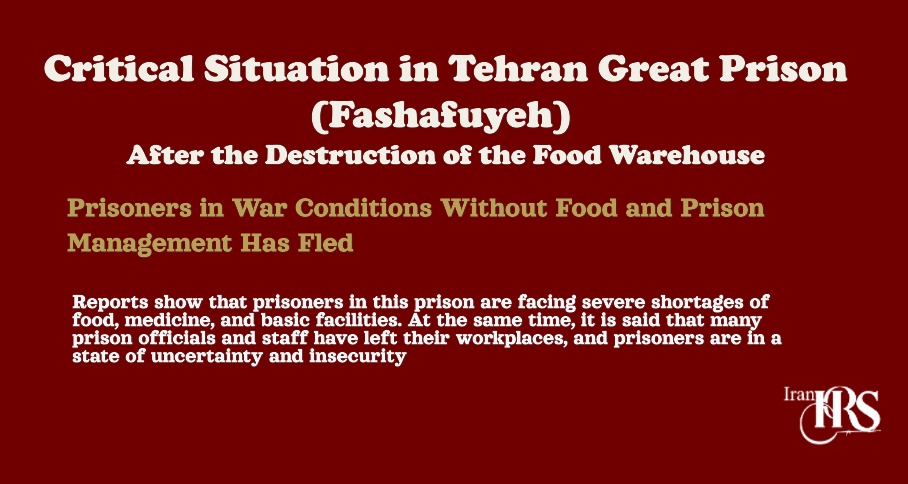
Reports indicate severe food shortages, absence of prison authorities, and uncertainty among prisoners in Tehran Great Prison (Fashafuyeh); experts emphasize the implementation of Resolution 211 and the release of prisoners in wartime conditions
Iran Human Rights Society, Friday, March 6, 2026 – Following recent attacks and the destruction of the food warehouse, the situation in Tehran Great Prison (Fashafuyeh) has reached a critical stage. Reports show that prisoners in this prison are facing severe shortages of food, medicine, and basic facilities. At the same time, it is said that many prison officials and staff have left their workplaces, and prisoners are in a state of uncertainty and insecurity.
Destruction of the Food Warehouse in Tehran Great Prison
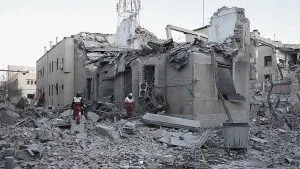
Published reports indicate that during recent attacks, the food warehouse of Tehran Great Prison was targeted and seriously destroyed. As a result of this incident, prisoners’ access to food has been severely reduced.
According to these reports, a large number of prisoners, including recent political detainees, are now facing severe food shortages. The situation in Tehran Great Prison (Fashafuyeh), which houses many prisoners from this complex, has also been described as critical.
Various sources have announced that in Tehran Great Prison (Fashafuyeh), food has been reduced to the minimum possible level, and in most cases, prisoners receive only one meal per day. This situation occurs while the prison’s internal canteens have also stopped their activities.
As a result of the closure of the canteens, prisoners have also lost the possibility of obtaining food or essential items. These conditions have increased concerns about the health of prisoners.
Shortage of Medicine and Unsuitable Hygienic Conditions
In addition to food shortages, reports indicate the absence of medicine and medical facilities. Sick prisoners in Tehran Great Prison (Fashafuyeh) do not have access to their required medications.
Some sources say that prisoners who urgently need medicine are in difficult conditions and access to medical services has become very limited.
Published reports also point to the unsuitable hygienic situation in Tehran Great Prison (Fashafuyeh). According to these reports, water shortages, limited hygienic facilities, and high prisoner density have created serious problems.
In such conditions, prisoners in Tehran Great Prison (Fashafuyeh) face serious risks to their health.
Flight or Absence of Prison Authorities and Prisoners’ Uncertainty
One of the main concerns regarding the situation in Tehran Great Prison is the absence of management and the reduced presence of prison staff. Reports indicate that after the recent attacks, many prison officials and staff have left their workplaces.
As a result of this situation, prisoners in Tehran Great Prison (Fashafuyeh) are facing serious uncertainty. The absence of prison officials has caused many routine prison affairs to stop.
Some reports show that following recent explosions, prisoners heard several loud explosion sounds. It is said that during these attacks, the windows of the buildings were broken and some walls were damaged.
Following this situation, prisoners left their wards, but according to various sources, the prison guards dealt with them harshly and returned them to the wards.
These events have caused increased concern about the security situation in Tehran Great Prison (Fashafuyeh).
The Necessity of Implementing Resolution 211 in Wartime Conditions
Legal experts emphasize that in wartime conditions, Resolution No. 211 of the Supreme Judicial Council must be implemented. This resolution, approved in 1365 (1986–1987 Gregorian), is dedicated to emergency situations resulting from war.
According to this resolution, the Judiciary is obliged to take necessary measures to preserve the lives of prisoners. These measures can include converting bail, granting conditional release, accepting bail or suretyship, and transferring prisoners to safe locations.
In accordance with this regulation, in emergency conditions, prosecutors can release low-risk prisoners until the war situation is resolved.
Experts say that given the critical situation in Tehran Great Prison (Fashafuyeh), the implementation of this resolution is essential to prevent further risks.
According to them, in wartime conditions, continuing to detain prisoners without providing security and basic facilities can have serious human consequences.
Human Rights Violations in the Situation of Tehran Great Prison
The reported situation in Tehran Great Prison may be in conflict with fundamental principles of human rights. According to international standards, even in wartime conditions, the rights of prisoners must be respected.
- Violation of the right to life – Article 3 of the Universal Declaration of Human Rights: Shortage of food, medicine, and unsafe conditions can endanger the lives of prisoners.
- Violation of the right to health – Article 12 of the International Covenant on Economic, Social and Cultural Rights: Deprivation of medical services and medicine threatens the health of prisoners.
- Violation of the right to humane conditions of detention – Mandela Rules: Shortage of food, water, and hygienic facilities is contrary to international standards.
- Violation of the obligation to protect prisoners in emergency situations – Resolution 211 of the Supreme Judicial Council: Failure to implement necessary measures to protect prisoners in wartime conditions can be considered a violation of legal obligations.
Given the existing conditions in Tehran Great Prison (Fashafuyeh), concerns about the health and security of prisoners have increased significantly.
See also the below articles:
- Missile Attack on Evin Prison Wall Sparks Urgent Safety Concerns
- Call for Gatherings in Front of Prisons, for the Release of Prisoners
Follow Iran Human Rights Society on social networks:
Telegram /Twitter /Instagram / YouTube / Facebook
Join Iran Human Rights Society on Twitter





Discussion about this post