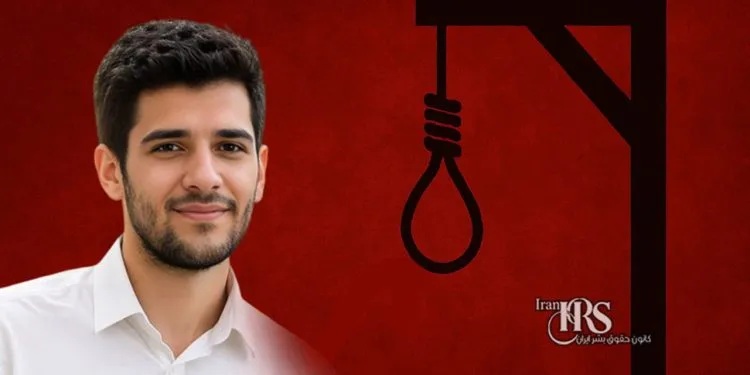
Amirali Mirjafari, one of those arrested in the protests of 2025-2026, was executed without access to a lawyer of his choice and in an ambiguous process; reports indicate pressure for forced confessions.
Iran Human Rights Society, Tuesday, 21 April 2026– The execution of Amirali Mirjafari, one of those arrested in the nationwide protests of 2025-2026, has taken place in conditions where reports indicate the absence of fair trial, lack of a lawyer of choice, and haste in carrying out the sentence. This execution, coinciding with the increase in the issuance of heavy sentences in a wartime atmosphere, has intensified concerns about judicial processes.
How was Amirali Mirjafari executed?

According to the published report, Amirali Mirjafari has been executed as one of those arrested in the protests of 2025-2026. This sentence was carried out while, according to sources, the process of handling his case was done hastily and without fully going through the legal stages. The main charge against this prisoner has been stated as participation in the protests, but subsequently efforts have been made to provide the ground for carrying out the execution sentence by attributing charges such as connection with Israel and America. This change in the type of charge attribution has taken place in conditions where the security atmosphere has been intensified.
Issuance of the sentence based on forced confessions; lack of legal documents in the case
The charges raised against him are mainly based on confessions that were obtained during detention under pressure and torture and lack legal validity from a legal perspective. Based on these charges, he has been accused of “setting fire to the Jame Mosque of Gholhak” and “leading the protests”; however, the judicial authorities have not provided any reliable document or evidence to the court to prove these claims. Ultimately, the issued verdict was also not based on objective evidence, but solely on the basis of those same forced confessions; an issue that raises serious questions about the validity and legitimacy of the process of handling this case.
Has the legal process been observed in this case?
Reports show that in Amirali Mirjafari’s case, the legal rail of trial has not been observed. Lack of transparency in the handling process, quick execution of the sentence, and lack of sufficient notification are among the issues raised in this case. It also appears that this prisoner has been deprived of access to a lawyer of his choice; an issue that is considered one of the basic principles of fair trial. The lack of the possibility of effective defense has faced the handling process with serious ambiguities.
What has been the role of torture in obtaining confessions?
Based on available information, pressures have been applied in the process of arrest and interrogation to obtain forced confessions. The use of this type of confession in judicial cases has always been criticized by human rights institutions. Forced confessions, especially in conditions where they have been obtained under pressure or torture, have no legal validity, but in some cases they are used as the basis for issuing sentences.
What is the connection of this execution with the wartime atmosphere and new judicial policies?
This execution has taken place in conditions where, simultaneously with the intensification of the wartime atmosphere, the process of handling cases has also changed. Judicial authorities had previously emphasized accelerating the review of cases and removing usual stages. A few days ago, Mohseni Eje’i had issued an order to accelerate the handling of cases and remove legal rails; an action that, according to observers, has paved the way for the formation of hasty courts. This process can lead to the quick issuance of heavy sentences, including execution.
Ambiguity in the status of other accused in the case
In the same report, reference has been made to the conviction of 22 other people in various cases, but no information has been provided about their names, charges, or the duration of their sentences. This lack of transparency has increased concerns about the status of other detainees. Observers believe that the lack of accurate information can prevent legal follow-up and informing about these cases.
Is the process of executions on the rise?
The increase in the implementation of execution sentences in recent conditions has become one of the topics of attention. Especially in cases related to protests, the quick issuance and implementation of sentences has been accompanied by widespread concerns. In this framework, the use of wartime conditions to justify these sentences has been raised as one of the influencing factors; an issue that has been criticized by human rights institutions.
Violation of the principles of fair trial in Amirali Mirjafari’s case
The execution of Amirali Mirjafari in conditions where it was carried out without going through the legal process, without access to a lawyer, and relying on forced confessions, indicates a serious violation of fundamental rights.
Violation of the prohibition of torture – Article 5 of the Universal Declaration of Human Rights: Applying pressure to obtain forced confessions is an example of inhuman behavior and violates this principle.
Violation of the right to life – Article 3 of the Universal Declaration of Human Rights: Carrying out the execution sentence without a fair trial violates the fundamental right to life.
Violation of the right to fair trial – Article 10 of the Universal Declaration of Human Rights: Lack of a lawyer of choice and failure to go through the legal process distorts the principles of fair trial.
Violation of the principle of presumption of innocence – Article 11 of the Universal Declaration of Human Rights: Using forced confessions and lack of independent handling calls the principle of presumption of innocence into question.
See also the below articles:
- Mohseni Eje’i and the order for “extraordinary proceedings”; Intensification of repression and hasty executions in the judicial system
- One Year After Execution, Family Still Searches for Hamid Hossein-Nejad Heidranlou Burial Site
Follow Iran Human Rights Society on social networks:
Telegram /Twitter /Instagram / YouTube / Facebook
Join Iran Human Rights Society on Twitter