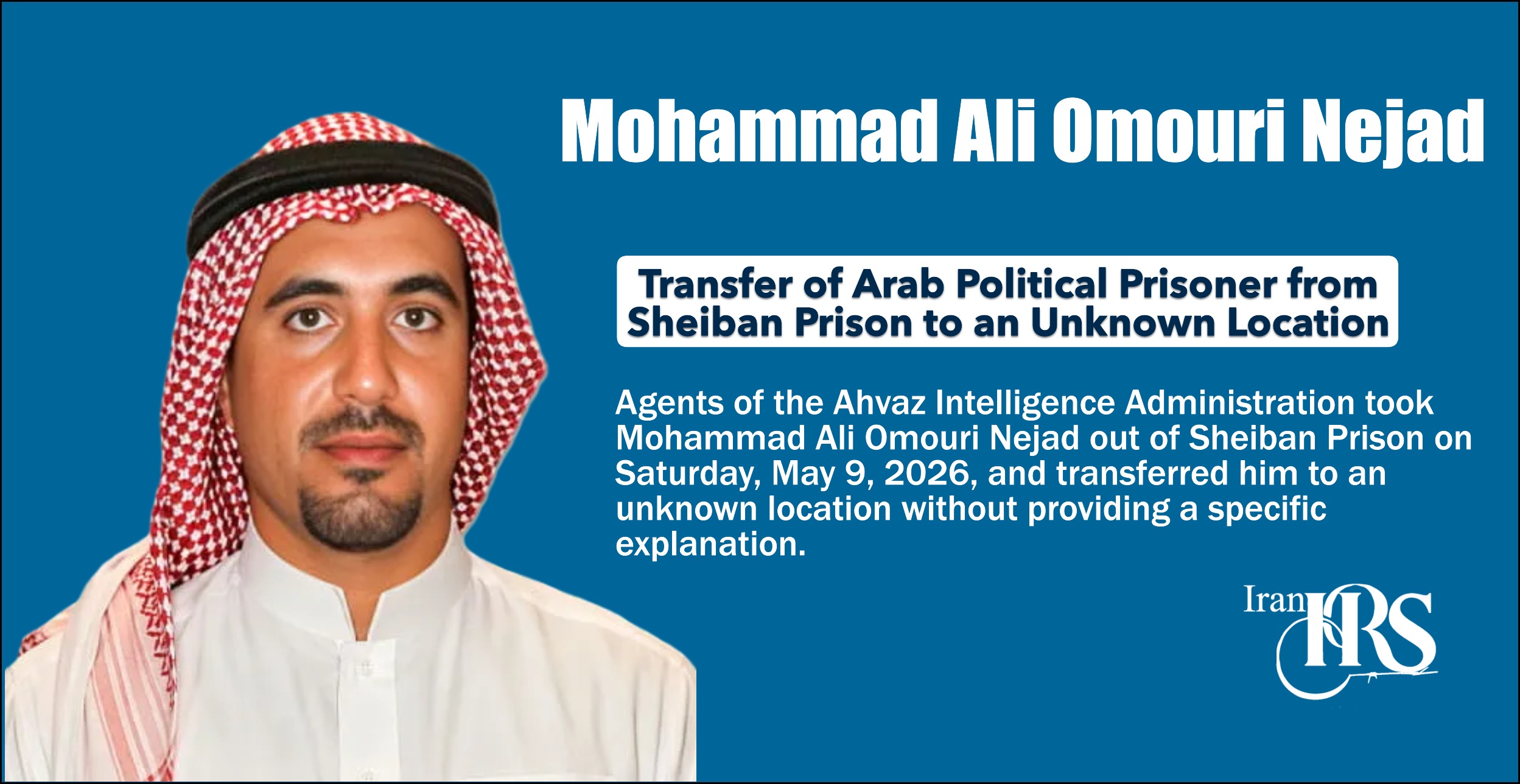
Mohammad Ali Omouri Nejad, a political prisoner sentenced to life imprisonment, was transferred by security forces from Sheiban Prison in Ahvaz to an unknown location about ten days ago, and there is still no information about his situation.
Iran Human Rights Society, Monday, May 18, 2026 – Mohammad Ali Omouri Nejad, a political prisoner held in Sheiban Prison in Ahvaz, was taken out of this prison by agents of the Intelligence Administration about ten days ago and transferred to an unknown location. Despite follow-ups by his family, no information has yet been published about his place of detention, physical condition, or circumstances, and this lack of news has created widespread concerns about the health and safety of this political prisoner.
How Did Mohammad Ali Omouri Nejad Disappear?

According to published reports, agents of the Ahvaz Intelligence Administration took Mohammad Ali Omouri Nejad out of Sheiban Prison on Saturday, May 9, 2026, and transferred him to an unknown location without providing a specific explanation.
The family of this political prisoner say that since his transfer until now, they have not succeeded in receiving any official information about his place of detention or his condition. According to those close to Mohammad Ali Omouri Nejad, repeated visits by the family to judicial and security institutions have also remained unanswered.
Human rights activists have warned that the sudden transfer of political prisoners to unknown locations, especially in security cases, can be a sign of the beginning of a new round of pressure, interrogation, or the imposition of more severe restrictions.
Concerns About the Health of Mohammad Ali Omouri Nejad
The lack of news about Mohammad Ali Omouri Nejad’s condition has increased concerns at a time when he has faced serious physical problems in recent years. This political prisoner suffers from severe tooth decay, chronic gum swelling, chronic sinusitis, and severe weakness in vision. There have also been reports published about his untreated internal diseases that threaten his general health.
Mohammad Ali Omouri Nejad’s family has repeatedly announced that the prison’s medical facilities have not been responsive to his condition and that doctors outside the prison have also deemed the continuation of specialized treatment necessary. Human rights activists say that transferring him to an unknown location in a condition where he requires continuous medical care can put his health in serious danger.
Long History of Imprisonment and Deprivation of Basic Rights
Mohammad Ali Omouri Nejad was arrested in Bahman 1389 on the charge of “enmity against God through acting against national security.” After his arrest, he was initially sentenced to death, but this sentence was later reduced to life imprisonment with one degree of mitigation.
He has been held in various prisons over the past years, including Karun Prison and Sheiban Prison in Ahvaz. Human rights sources have repeatedly reported during this period on the imposition of pressure, long-term solitary confinement, restrictions on contact with family, and deprivation of medical services in his case.
Mohammad Ali Omouri Nejad had not used even one day of furlough until Azar 1404. He was finally sent on medical furlough for the first time after 15 years of imprisonment with a heavy bail of 12 billion tomans; an issue that human rights activists have described as a sign of systematic pressure on Arab political prisoners.
Reports of Torture in Security Detention Centers

In Ordibehesht 1400, there were also reports published about the severe torture of Mohammad Ali Omouri Nejad. According to these reports, he, along with two other prisoners named Mokhtar Alboshokeh and Qasem Sanjari, had been subjected to torture for 19 days in secret detention centers of the Ministry of Intelligence.
According to human rights sources, these three prisoners were transferred to the infirmary of Sheiban Prison in poor condition after enduring physical and psychological torture.
Reports indicate that the effects of those tortures still remain on Mohammad Ali Omouri Nejad’s physical and mental condition, and part of his current health problems dates back to that period.
Human rights activists believe that the recent transfer of this political prisoner to an unknown location, along with the history of torture and deprivation of treatment, has increased concerns about the possibility of new pressures being applied against him.
Violation of Human Rights; Enforced Disappearance and Deprivation of Treatment of Political Prisoner
The case of Mohammad Ali Omouri Nejad is an example of enforced disappearance, deprivation of treatment, and continuous security pressure against political prisoners in Iran.
Violated Articles:
- Violation of the right to liberty and personal security – Article 9 of the Universal Declaration of Human Rights: Transferring the prisoner to an unknown location and the family’s lack of information about the place of detention and his condition is an instance of enforced disappearance and violation of personal security.
- Violation of the right to access to treatment – Article 25 of the Universal Declaration of Human Rights: Long-term deprivation of effective medical services and transferring a sick prisoner without transparency about his medical condition violates the right to enjoy health and appropriate treatment.
- Violation of the prohibition of torture and inhuman treatment – Article 5 of the Universal Declaration of Human Rights: Reports related to torture in security detention centers and detention in inappropriate conditions are instances of inhuman and degrading treatment.
- Violation of the right to communication with family – Mandela Rules of the United Nations: Keeping the family uninformed about the place of detention and the prisoner’s condition violates international standards for the treatment of prisoners and the right to communication with family.
See also the below articles:
- Golrokh Iraei Letter to PEN America: We Write Even If Chained
- Arshia Qeysarbigi Faces Torture and Moharebeh Charges in Iran
Follow Iran Human Rights Society on social networks:
Telegram /Twitter /Instagram / YouTube / Facebook
Join Iran Human Rights Society on Twitter