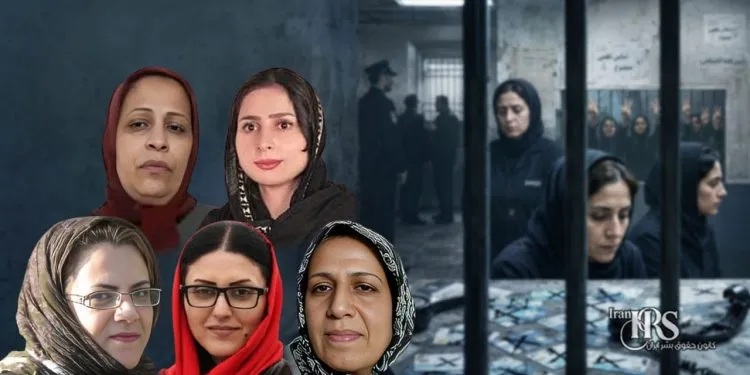
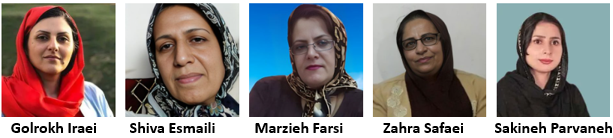
Golrokh Iraei, Zahra Safaei, Marzieh Farsi, Shiva Esmaili and Sakineh Parvaneh, five female political prisoners in Evin Prison, after participating in the “Tuesdays No to Execution” campaign and chanting slogans against execution sentences, have faced punitive deprivation of telephone contact; a restriction that has been applied in continuation of extensive pressures on female political prisoners.
Iran Human Rights Society, Monday, May 25, 2026- Reports published from Evin Prison indicate that five female political prisoners, including Golrokh Iraei, Zahra Safaei, Marzieh Farsi, Shiva Esmaili and Sakineh Parvaneh, have been punitively deprived of the right to use the prison telephone since yesterday. According to received information, prison officials have invalidated the telephone cards of these prisoners; an action that has been taken due to their participation in the “Tuesdays No to Execution” campaign and chanting slogans against the implementation of execution sentences. Human rights activists say that deprivation of contact with family and lawyer has turned into a tool for suppressing civil protests of political prisoners.
Invalidation of Telephone Cards of Female Political Prisoners
According to published reports, Golrokh Iraei, Zahra Safaei, Marzieh Farsi, Shiva Esmaili and Sakineh Parvaneh have lost the possibility of using the prison telephone since yesterday. Informed sources say that prison officials have invalidated the telephone cards of these prisoners and this restriction still continues.
The reason for imposing this punishment has been stated as the participation of these female prisoners in the “Tuesdays No to Execution” campaign and protesting against the implementation of execution sentences in Iran. These political prisoners had chanted slogans against execution in the prison yard; an action that faced a punitive reaction from prison officials.
Human rights activists say that the use of communication deprivations, including cutting off telephone contact, has become one of the common methods of pressure on political prisoners in recent years.
Continuation of Deprivation of Visits with Family and Lawyers
These five political prisoners had also previously been deprived of the right to in-person visits with their family and lawyers. According to reports, this restriction still continues and so far no clear explanation has been provided about the reason for its continuation.
Human rights activists have warned that simultaneous deprivation of visits and telephone contact puts severe psychological pressure on prisoners and their families. According to these activists, preventing the prisoner’s communication with family and lawyer, in addition to psychological effects, also limits the right to effective defense and access to legal support.
Pressure on Female Political Prisoners in Evin
Recent reports show that pressure on female political prisoners in Evin Prison has increased in the past months. Previously, in the third week of Ordibehesht 1405, reports about the intensification of pressure on female political prisoners had also been published.
According to these reports, Zahra Safaei, Forough Taghipour, Marzieh Farsi, Elahe Fouladi, Arghavan Falahi, Shiva Esmaili and Golrokh Iraei had faced three weeks of deprivation of visits due to participation in the “Tuesdays No to Execution” campaign.
After that, due to their presence again in this protest ceremony, another three weeks of deprivation was considered for them. Human rights activists say that even dozens of other prisoners who had merely been present in the ward yard or had witnessed the holding of this ceremony, have faced disciplinary punishments.
“Tuesdays No to Execution” Campaign; Civil Protest in Prison
The “Tuesdays No to Execution” campaign has turned into one of the symbols of political prisoners’ protest against the increase in the implementation of execution sentences in Iran in recent months. Participating prisoners in this campaign usually announce their opposition to the death penalty by chanting slogans, gathering in the prison yard or sitting in protest.
Human rights activists say that the reaction of prison officials to these protests has often been accompanied by increased pressure, deprivation of contact, exile, transfer to solitary confinement or deprivation of visits. According to them, punitive dealing with prisoners who protest against execution is indicative of the efforts of security and judicial institutions to silence any voice of opposition even in the prison space.
Repetition of Similar Restrictions in Qarchak Prison
Similar reports had also been published from Qarchak Varamin Prison in the past months. According to these reports, a group of female political prisoners in Qarchak had also faced communication and punitive restrictions after protesting prison conditions or participating in protest gatherings.
Human rights activists say that depriving a group of prisoners of rights and basic facilities, without providing a clear explanation, is considered a kind of collective punishment. According to them, this trend has caused an increase in the space of distrust, psychological insecurity and tension in prisons.
Increase in Pressure Simultaneous with the Wave of Executions
The protest of female political prisoners in Evin takes place in conditions where the number of executions in Iran has increased in recent months. Human rights institutions have repeatedly warned that the extensive use of the death penalty, especially in political and security cases, has turned into a tool for creating an atmosphere of fear and social control.
Civil activists say that the “Tuesdays No to Execution” campaign is a reaction to this increasing trend of executions and the effort of prisoners to convey their voice of protest outside the prison.
Human Rights Violation; Communication Deprivation and Collective Punishment
Dealing with female political prisoners in Evin has been described by human rights institutions as an example of violation of the rights of political prisoners.
Violated Articles:
- Violation of the right to communication with family and lawyer – Minimum principles of treatment of prisoners: Invalidating telephone cards and deprivation of visits violates the right of prisoners to communicate with family and their lawyers.
- Violation of freedom of expression and peaceful protest – Articles 19 and 20 of the Universal Declaration of Human Rights: Punishing prisoners due to protesting against execution and participating in the “Tuesdays No to Execution” campaign violates the right to freedom of expression.
- Violation of the prohibition of degrading treatment – Article 5 of the Universal Declaration of Human Rights: Imposing punitive restrictions and psychological pressure on political prisoners can be an example of inhuman and degrading treatment.
- Violation of the right to fair trial and access to legal counsel – Article 10 of the Universal Declaration of Human Rights: Depriving prisoners of contact and visits with lawyers limits the right to defense and access to legal support.
See also the below articles:
- Execution of Political Prisoner Abbas Akbari After Non-Transparent Trial
- Ali Ajarlou Held in Chubindar Prison: Five Months of No News and Heavy Threats
Follow Iran Human Rights Society on social networks:
Telegram /Twitter /Instagram / YouTube / Facebook
Join Iran Human Rights Society on Twitter