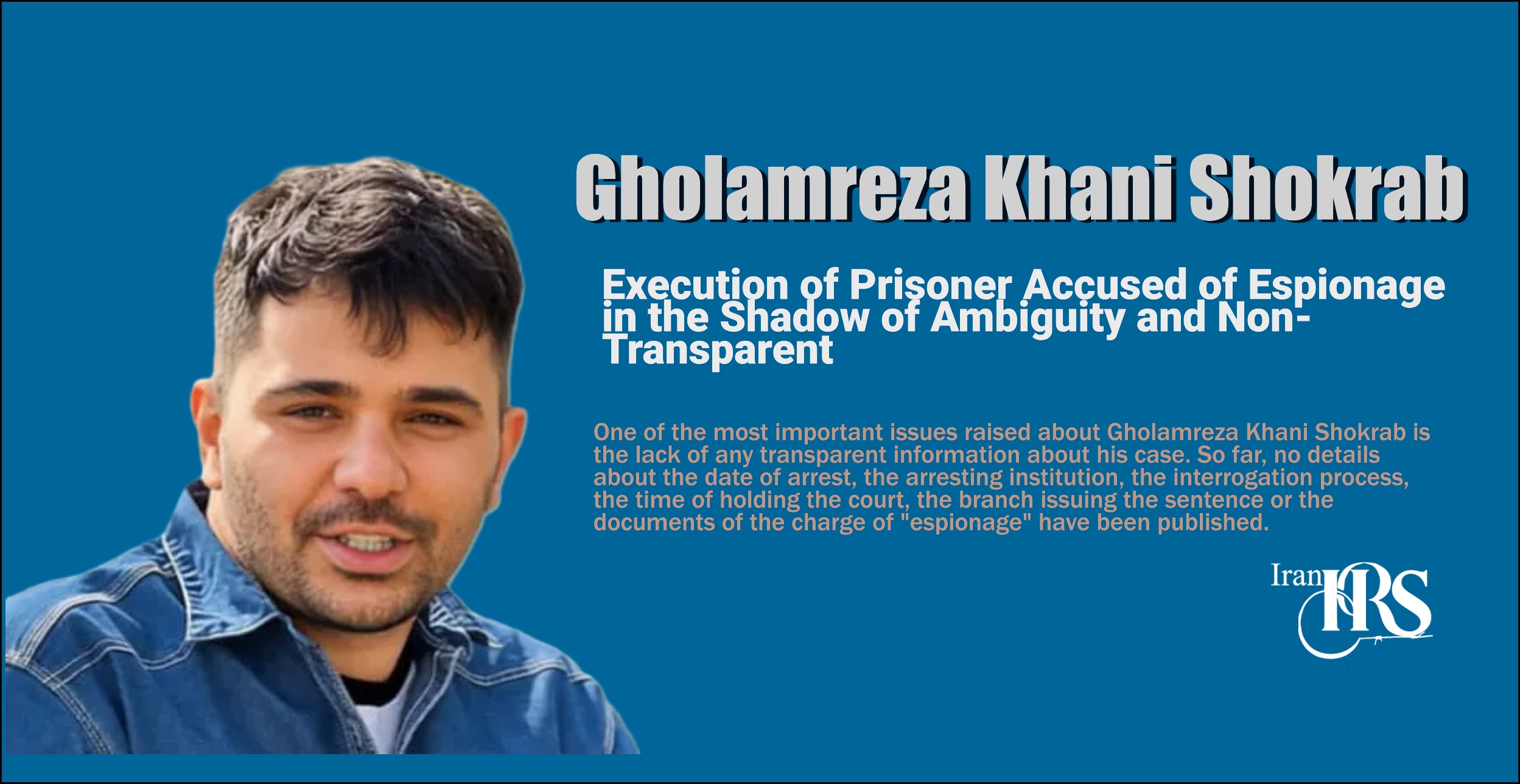
Gholamreza Khani Shokrab, a prisoner sentenced to execution with the charge of “espionage”, was executed this morning; while so far no transparent information about the arrest process, court, case documents and his access to an independent lawyer has been published.
Iran Human Rights Society, Tuesday May 26, 2026 – Mizan News Agency, affiliated with the Judiciary, announced this morning the implementation of the execution sentence of Gholamreza Khani Shokrab and stated his charge as “espionage”. This prisoner had previously been transferred from Evin Prison to Qezelhesar Prison in Karaj; a transfer that was considered by human rights institutions as a sign of the imminent implementation of the sentence. However, the extensive ambiguity about the details of the case, the trial process and the legal status of Gholamreza Khani Shokrab has created many concerns about the way of judicial handling of his case.

Transfer to Qezelhesar Before the Implementation of the Sentence
Gholamreza Khani Shokrab was transferred from Evin Prison to Qezelhesar Prison in Karaj on Saturday May 16, 2026. Human rights sources at that time had warned that his transfer to Qezelhesar, while there is no transparent notification about his case, could be a sign of the imminent implementation of the execution sentence.
Finally, this morning Mizan News Agency announced that the execution sentence of this prisoner has been carried out. Human rights activists say that the sudden transfer of political and security prisoners to Qezelhesar Prison has in many cases been a prelude to the implementation of execution sentences.
Extensive Ambiguity About the Case
One of the most important issues raised about Gholamreza Khani Shokrab is the lack of any transparent information about his case. So far, no details about the date of arrest, the arresting institution, the interrogation process, the time of holding the court, the branch issuing the sentence or the documents of the charge of “espionage” have been published.
It is also not clear whether Gholamreza Khani Shokrab had access to a chosen and independent lawyer during the interrogation and judicial proceedings or not. Human rights sources say that his court was held in a completely secure space and in a closed manner and no report of the trial process has been made available.
According to these sources, keeping the process of security cases secret, especially cases related to the charge of “espionage”, has become a fixed procedure in the judicial system of the Islamic Republic in recent years.
Lack of Transparency in the Trial Process
Human rights activists emphasize that the case of Gholamreza Khani Shokrab is an example of non-transparent procedures in the security courts of the Islamic Republic. According to them, in such cases, defendants are often deprived of the most basic legal rights, including free access to a lawyer, notification of case documents and a public trial.
These activists say that the trial process in the case of Gholamreza Khani Shokrab was also carried out outside the usual and legal track of proceedings and the information related to the case has been practically kept hidden from public opinion. They warn that the lack of judicial transparency eliminates the possibility of independent monitoring of the trial process and provides the ground for issuing heavy sentences without accountability.
Concern About Forced Confessions
Human rights institutions have repeatedly announced that in many security cases and cases related to the charge of “espionage”, heavy sentences are issued based on forced confessions. According to reports published in past years, a number of security defendants during detention have been subjected to severe psychological and physical pressures, long-term solitary confinement and torture in order to confess against themselves.
Human rights activists say that the lack of any independent information about the case of Gholamreza Khani Shokrab strengthens the possibility of repeating this same pattern. According to them, in circumstances where the interrogation and trial process has remained completely confidential, it is not possible to be sure about the way confessions were obtained or the validity of the case documents.
At the same time, human rights organizations have repeatedly warned about the extensive use of charges such as “espionage” and “acting against national security” to intensify repression. According to these institutions, such charges often have vague definitions and in a security atmosphere, there is no possibility of independent and impartial examination of them.
Legal activists believe that in many of these cases, security institutions play the main role in the arrest process, interrogation and directing the judicial process and courts do not have sufficient independence for impartial handling.
Human Rights Violation; Execution After a Non-Transparent Process
The case of Gholamreza Khani Shokrab has been described by human rights institutions as an example of extensive violation of the rights of defendants in security cases.
Violated Articles:
- Violation of the right to a fair trial – Article 10 of the Universal Declaration of Human Rights: Holding a closed court and lack of transparency about the trial process violates the principles of fair trial.
- Violation of the right to access to a lawyer – Fundamental principles of fair trial: Ambiguity about Gholamreza Khani Shokrab’s access to a chosen lawyer has increased concerns about his deprivation of the right to effective defense.
- Violation of the prohibition of torture – Article 5 of the Universal Declaration of Human Rights: The possibility of using pressure and forced confessions in the case process is an example of inhuman behavior and violates the prohibition of torture.
- Violation of the right to life – Article 3 of the Universal Declaration of Human Rights: Implementing the execution sentence after a security and non-transparent process is considered a violation of the fundamental right to life.
See also the below articles:
- Punitive Telephone Deprivation Hits Evin Prison Women Over Anti-Execution Protest
- Execution of Political Prisoner Abbas Akbari After Non-Transparent Trial
Follow Iran Human Rights Society on social networks:
Telegram /Twitter /Instagram / YouTube / Facebook
Join Iran Human Rights Society on Twitter