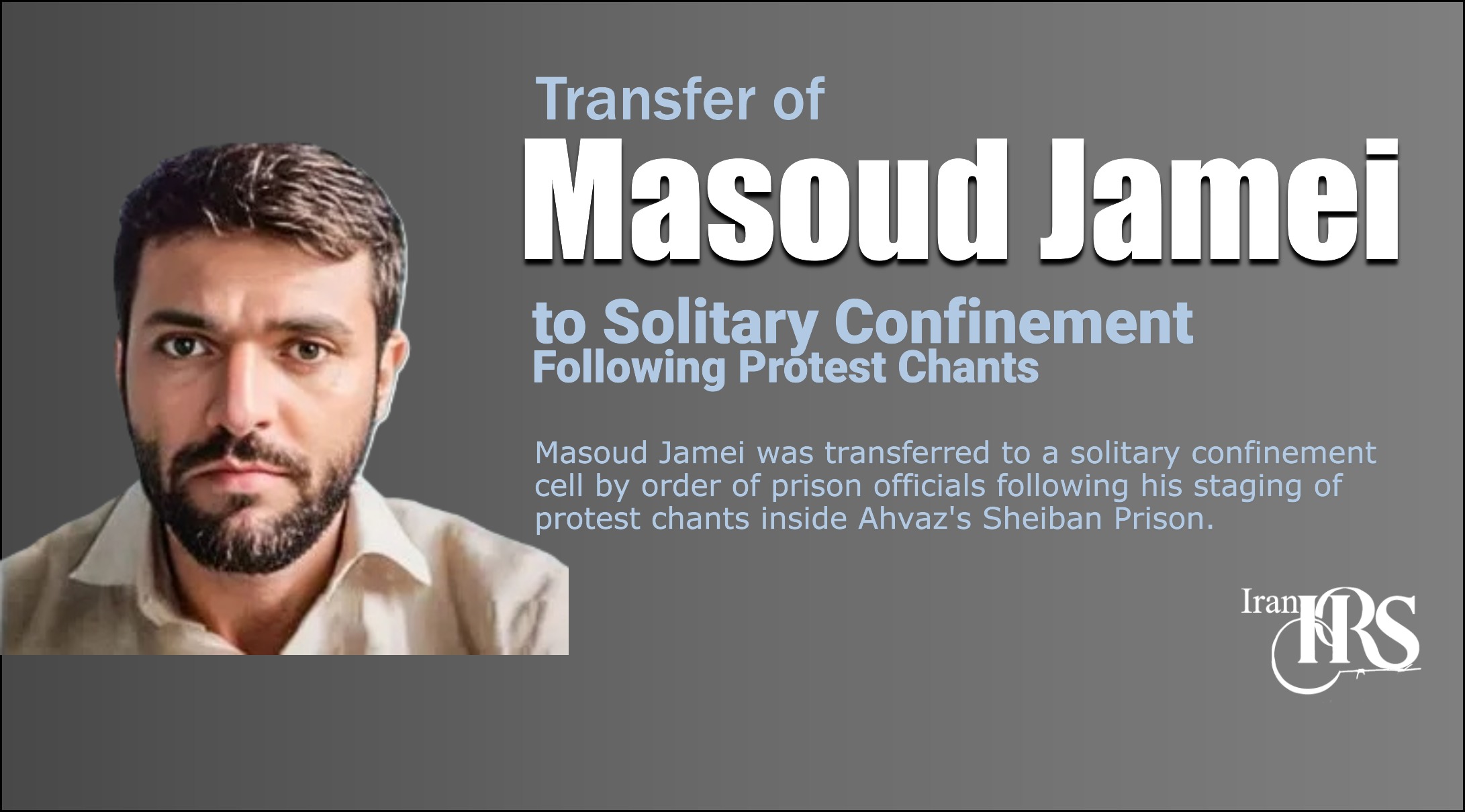
Received reports state that Masoud Jamei, a political prisoner sentenced to double death penalties, has been transferred to solitary confinement after chanting protest slogans inside Ahvaz’s Sheiban Prison. He is currently being held under harsh conditions, lacking access to air conditioning amidst the intense summer heat of Ahvaz. Furthermore, sources report that his head was shaved and he has been subjected to torture with the explicit intent of degradation.
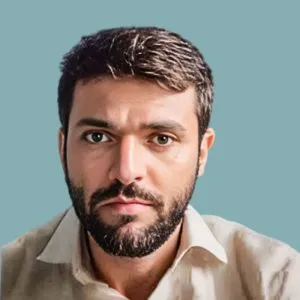
Iran Human Rights Society, Friday, July 17, 2026 – News filtering out of Sheiban Prison in Ahvaz reveals that Masoud Jamei, a political prisoner facing two death sentences, was moved to a solitary confinement cell following a vocal protest inside the facility. Informed sources state that he is being held in a cell completely stripped of cooling systems during Khuzestan’s grueling summer heat. To break his morale, guards have reportedly shaved his head and subjected him to severe physical and psychological torture.
Transfer to Solitary Confinement Following Protest Chants
According to received reports, Masoud Jamei was transferred to a solitary confinement cell by order of prison officials following his staging of protest chants inside Ahvaz’s Sheiban Prison.
Informed sources state that this measure was taken with the explicit purpose of punishing him, and the conditions of his detention in solitary confinement are reported to be extremely harsh. According to these sources, coinciding with rising temperatures across Khuzestan province, this political prisoner is being held in a cell completely devoid of any cooling system—a situation that has redoubled concerns regarding his physical health.
Information Box | Political Prisoner Masoud Jamei
| Title | Information |
| Name | Masoud Jamei |
| Status | Political Prisoner / Death-Row Detainee |
| Location | Sheiban Prison, Ahvaz |
| Current Status | Transferred to solitary confinement following protest chants |
| Recent Violations | Deprived of air conditioning, subjected to forced head shaving and alleged torture |
| Medical Condition | Stomach cancer, liver and kidney failure, chronic high blood pressure, internal infection |
| Date of Arrest | August 1, 2023 (10 Mordad 1402) |
| Sentence | Double death penalty and one year of discretionary imprisonment (Habs-e Ta’ziri) |
| Date of Verdict Notification | July 11, 2025 (20 Tir 1404) |
| Primary Concern | High risk of fatal medical complications due to punitive solitary confinement |
Reports of Degrading Treatment and Torture
Sources close to the case report that immediately following Jamei’s transfer to the solitary block, prison guards forcibly shaved his head—a well-documented tactic used by penal authorities to systematically humiliate political dissidents.
It is further alleged that he has been subjected to rigorous physical abuses during this isolation. While these reports cannot be independently verified due to the strict media blackout imposed on Sheiban Prison, human rights advocates warn that employing prolonged solitary confinement as a punitive tool against critically ill prisoners can result in irreversible physical and mental trauma.
Critical Health Condition of Masoud Jamei
Even prior to this recent punitive transfer, Jamei’s medical profile was classified as critical.
Medical documents disclose that he suffers from malignant stomach cancer, severe internal infections, chronic liver and kidney failure, fatty liver disease, and severe neurological headaches compounded by high blood pressure. Extended periods of interrogation, poor prison nutrition, and systemic medical neglect have drastically accelerated his pathology over the past year.
Systematic Denial of Medical Furlough
Despite repeated warnings by medical personnel regarding his deteriorating state, external hospital transfers have been repeatedly blocked.
The internal infirmary at Sheiban Prison completely lacks the specialized oncology and urology equipment required to manage Jamei’s conditions. However, the Ahvaz Prosecutor’s Office, acting on directives from security agencies, has consistently denied all requests for medical furlough or hospital transfers, which rights groups classify as a deliberate slow-killing policy.
Targeting of the Jamei Family
Masoud Jamei, an oil well security guard, married, and a father of four, was violently arrested by intelligence forces on August 1, 2023. Following a prolonged period of incommunicado detention and interrogation at the Ministry of Intelligence detention center in Khuzestan, he was moved to Sheiban Prison.
The state’s pressure extended to his family in the winter of 2024, when his wife, Zainab Hezbapour, and their three daughters—Nahid, Dalal, and Roghayeh Jamei—were put on trial before the Revolutionary Court of Bavi County. They faced vague, overarching national security charges, including “communicating with opposition groups to disrupt national security” and alleged membership in the Mojahedin organization.
Double Death Sentence Issued
On July 11, 2025, Branch 1 of the Revolutionary Court of Ahvaz, presided over by Judge Adibimehr, officially served Jamei a verdict of two death sentences alongside a consecutive one-year discretionary prison term. The finalization of this capital sentence, combined with his placement in a non-cooled solitary cell under Khuzestan’s extreme summer temperatures, has triggered immense anxiety among rights watchdogs regarding his immediate survival.
Legal Review of the Case Based on Domestic Laws
Introduction
While Iran’s security laws and Revolutionary Court procedures are heavily criticized by international jurists for failing to meet standard judicial prerequisites, the actions taken against Masoud Jamei violate the explicit text of Iran’s own domestic statutes. Prison administrators, prosecutors, and security agents remain legally bound by the state’s penal codes and internal prison bylaws regarding the treatment of critically ill inmates and the absolute prohibition of degrading treatment.
Legal Ambiguities
The severe punitive actions taken against Masoud Jamei for exercising basic verbal dissent raise serious statutory issues. It remains legally impermissible to impose physical punishments (such as head shaving) or to withhold vital climate control and medical care under the guise of internal prison discipline.
Related Legal Articles
- Article 22 of the Constitution: Guarantees the absolute protection of the life, dignity, property, and rights of all individuals from arbitrary violations.
- Article 38 of the Constitution: Imposes a strict, non-negotiable ban on all forms of torture or physical/mental coercion.
- Article 39 of the Constitution: Explicitly forbids any act that degrades the honor, dignity, or bodily integrity of individuals who have been arrested, detained, or imprisoned.
- Executive Regulations of the State Prisons Organization: Mandates that solitary confinement may only be used under precise, documented disciplinary frameworks for strictly limited duration, explicitly requiring continuous medical oversight and the absolute preservation of human dignity. It further commands the immediate transfer of critically ill inmates to specialized external clinics when internal facilities are inadequate.
Documented Violations of Domestic Law
- Imposing punitive solitary confinement as a direct retaliation for verbal dissent.
- Utilizing degrading physical measures (forced head shaving) aimed at psychological humiliation.
- Subjecting a diagnosed cancer patient to extreme heat exhaustion, violating the state’s duty of care.
- Deliberately withholding specialized medical treatment despite documented organ failures.
Human Rights Violations in the Case of Masoud Jamei
The treatment of Masoud Jamei represents a severe accumulation of human rights abuses. Holding a prisoner diagnosed with malignant cancer and kidney failure in a cell lacking basic ventilation in extreme heat constitutes a clear form of cruel, inhuman, and degrading treatment. Under international human rights law, states bear an absolute obligation to guarantee the physical security and health of all persons under their custody, regardless of their legal convictions.
Related International Covenants
- Article 7 of the International Covenant on Civil and Political Rights (ICCPR): Absolute, non-derogable prohibition of torture or cruel, inhuman, or degrading treatment or punishment.
- Article 10 of the ICCPR: Directs that all persons deprived of their liberty shall be treated with humanity and with respect for the inherent dignity of the human person.
- The Nelson Mandela Rules (Rules 1, 24, 27, and 43): Explicitly states that the provision of healthcare for prisoners is a state responsibility, requiring identical standards of care available in the outside community. It strictly bans the use of solitary confinement for prisoners with severe physical or mental disabilities that would be exacerbated by such isolation.
- Articles 3 and 5 of the Universal Declaration of Human Rights: Protects the absolute right to personal security and condemns any form of degrading punishment.
Key Human Rights Breaches
- The deployment of prolonged solitary isolation as an arbitrary tool to suppress freedom of expression.
- The execution of physical acts (shaving of the head) specifically designed to humiliate a political prisoner.
- The deliberate exposure of an endangered oncology patient to lifethreatening environmental conditions.
- The denial of necessary medical access, turning a prison sentence into an extrajudicial execution via medical neglect.
See also the below articles:
- Adel-Abad Prison: Critical Situation and Increased Pressure in Shiraz
- Tehran Prosecutor Announces Continued Execution of Death Sentences for Detainees
Follow Iran Human Rights Society on social networks:
Telegram /Twitter /Instagram / YouTube / Facebook
Join Iran Human Rights Society on Twitter