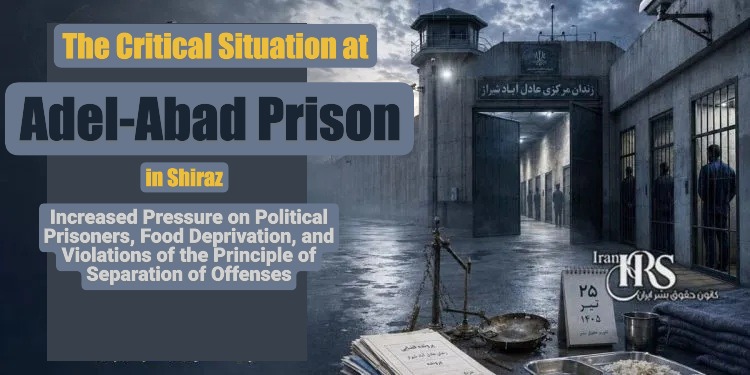
New reports received from Adel-Abad Prison in Shiraz reveal a worrying escalation of pressure on prisoners, severe food shortages, dismal living conditions, psychological stress, and the persistent violation of the principle of separation of offenses. According to these details, political prisoners in the high-security Unit 14 are being held alongside members of ISIS, while simultaneously grappling with acute nutritional, hygienic, and communication deprivations.This report evaluates the current situation, provides a breakdown of the prison’s operational structure, and reviews the facility’s security record.
Iran Human Rights Society, Thursday, July 16, 2026 — Fresh reports received by the Iran Human Rights Society from Adel-Abad Prison in Shiraz indicate an escalation of pressure on prisoners, acute food shortages, substandard living conditions, and the ongoing violation of the principle of separation of offenses. According to these reports, political prisoners in High-Security Ward 14 are being held alongside ISIS members, while simultaneously facing severe livelihood, hygiene, and communication restrictions. This report reviews the current state of the prison, alongside its security structure and administrative history.
Information Box | Adel-Abad Prison in Shiraz
| Title | Information |
| Name of Prison | Adel-Abad Prison, Shiraz |
| Date of Report | July 2026 |
| Reported Ward | Unit 14 Security Ward (Political Prisoners’ Ward) |
| Number of Political Prisoners | 44 individuals |
| Separation of Offenses Status | Violations reported; political prisoners are held alongside ISIS members |
| Head of the Prison | Ruhollah Rezaei Dana |
| Prosecutor | Mirhaji |
| Primary Reported Issues | Severe food shortages, low nutritional quality, overpriced commissary goods, psychological pressure |
| Nutritional Status | Food rations distributed for ~50 prisoners are reportedly only sufficient for about 25 |
| Prison Commissary Status | Low-quality, highly overpriced items; prisoners are forced to self-fund basic nutrition |
| Main Concerns of Prisoners | Continued violation of the separation of offenses, mental toll, degrading conditions, lack of basic amenities |
| Historical Precedent | Criticized internationally for punitive solitary units (Ebrat/Ershad), overcrowding, lack of medical care, and torture |
| Related Legal Framework | Articles 22, 29, 34, 38, and 39 of the Constitution; Executive Regulations of the Prisons Organization |
New Report from Security Unit 14 at Adel-Abad Prison
According to fresh reports obtained by the Iran human rights Society, 44 political prisoners are currently held in Unit 14, the designated security ward of Shiraz’s Adel-Abad Prison.
Informed sources state that these political detainees are being housed directly alongside individuals convicted of or facing charges related to ISIS (Islamic State). Activists and legal experts view this as a blatant violation of the principle of the separation of offenses. According to the executive regulations of Iran’s Prisons Organization, inmates must be categorized and housed separately based on the nature of their crime, legal status, and case type. However, reports verify that this standard is actively ignored in Unit 14.
Food Deprivations: Inmates Surviving on Half Rations
The incoming reports indicate a drastic deterioration in nutritional provisions at the facility.
Sources within the prison state that the volume of food prepared and distributed to Unit 14 is grossly insufficient. Rations meant to feed roughly 50 individuals are barely enough to sustain 25, leaving a significant portion of the inmates to suffer from hunger on a daily basis.
In addition to the quantitative scarcity, the quality of the prison-provided meals is reportedly abysmal. To survive, many prisoners are forced to purchase raw ingredients from the prison commissary at their own expense and prepare meals themselves. However, the commissary items are of poor quality and sold at prices far higher than standard market rates outside. This practice places an immense financial burden on the families of inmates, many of whom are already struggling under difficult economic circumstances.
Psychological Coercion and the Role of Judicial Officials
Beyond physical and material deprivations, prisoners have reported being subjected to systematic psychological pressure.
The reports identify Ruhollah Rezaei Dana (the Head of Adel-Abad Prison) and Mirhaji (the Prosecutor and head of senten
ce implementation) as the primary officials responsible for orchestrating these high-stress conditions. Sources note that the atmosphere is deliberately kept highly volatile, leaving inmates in a state of constant anxiety over sudden punitive transfers, unannounced cell raids, implementation of sentences, and arbitrary denial of basic administrative requests.
Adel-Abad: One of Iran’s Most Heavily Secured Facilities
Over the past several decades, Adel-Abad Prison in Shiraz has gained notoriety as one of the most highly secured and fortified detention centers in Iran.
Built over half a century ago, the prison was originally engineered to house a specific, limited number of inmates. Over time, however, the facility’s population has ballooned to several times its nominal capacity. The gradual expansion of various wards, the addition of isolated security zones, and the influx of political dissidents, national security detainees, death-row inmates, and violent offenders have turned the prison into a highly congested and complex fortress.
Unit 14: The Concentration of Dissidents
Following the implementation of a directive concerning the classification of prisoners in 2016, Security Unit 14 was designated as the primary wing for political and security-related detainees.
Separated from the rest of the prison by reinforced walls and dedicated security gates, this ward has faced strict access controls and unique disciplinary rules. Although the establishment of this wing was theoretically intended to fulfill the legal mandate of separating different classes of offenders, recent updates prove that this principle has been discarded. The integration of political dissidents with high-risk individuals linked to ISIS has triggered severe security and physical safety concerns for the political prisoners inside.
Historical Precedents of Mismanagement

Reports regarding the conditions under the administration of Ruhollah Rezaei Dana—who assumed leadership of Adel-Abad in June 2020—have consistently drawn international condemnation.
In recent years, human rights monitoring bodies have flagged numerous violations within the facility, including the rapid implementation of death sentences, physical assaults against inmates by guard staff, denial of necessary medical treatment, unhygienic facilities, and the systematic use of punitive wards to break the spirits of protesting prisoners.
The Legacy of the “Ebrat” and “Ershad” Punitive Wards
In addition to the current crisis in Unit 14, Adel-Abad has a long history of utilizing extreme punitive spaces, most notably the “Ebrat” (Admonition) and “Ershad” (Guidance) wards.
According to historical records, inmates transferred to these specialized punishment units were stripped of all basic rights, including telephone privileges, family visitations, fresh air yard access, and basic hygiene. Reports document a systematic denial of clean drinking water, adequate heating or cooling, and medical attention in these wards. While some of these details date back to previous years, they underscore a long-term, entrenched pattern of abuse and structural neglect within the facility.
Overcrowding and Structural Decay
While Adel-Abad has undergone physical expansions, the rate of incarcerations has consistently outpaced the prison’s structural limits.
Past studies indicate that several wards operate at multiple times their intended capacity. In many communal cells, the number of prisoners vastly exceeds the available beds, forcing inmates to sleep on concrete floors, in hallways, or near communal toilets. This persistent congestion severely limits access to sanitation, fresh water, and basic breathing space—problems that directly fuel the current feeding crisis and the breakdown of safety protocols.
Legal Review of the Case Based on Domestic Laws
Introduction
Before examining the domestic legal implications, it must be stated that the judicial and penal frameworks governing political and security detainees in Iran have been widely condemned by international bodies for violating the right to safety, the prohibition of torture, and the minimum standards for the treatment of prisoners. However, even when measured strictly against Iran’s own domestic statutes, the Prisons Organization and local judicial authorities are legally bound to uphold the dignity, security, and physical health of all incarcerated individuals.
Legal Ambiguities
The current reports emerging from Adel-Abad raise profound legal questions regarding the housing of political dissidents in close proximity to violent extremists, the deliberate under-rationing of food, the artificial inflation of commissary prices, and the deployment of psychological harassment. If verified, these conditions directly challenge the state’s compliance with its own penal codes, the legal mandate to classify prisoners, and its duty of care toward individuals in state custody.
Related Legal Articles
- Article 22 of the Constitution: Establishes the absolute inviolability of the life, property, rights, and dignity of all persons.
- Article 29 of the Constitution: Guarantees the right to health and medical care.
- Article 34 of the Constitution: Protects the right of all citizens to seek justice through competent, impartial courts.
- Article 38 of the Constitution: Prohibits all forms of torture, physical or psychological coercion, and forced extraction of confessions.
- Article 39 of the Constitution: Strictly forbids any assault on the honor, dignity, or rights of arrested or imprisoned individuals.
- Executive Regulations of the Prisons Organization: Mandates the strict separation and classification of prisoners based on offense category, the provision of adequate and nutritious food, access to proper healthcare, and the safeguarding of prisoners’ physical safety.
Potential Violations of Law
- Housing non-violent political prisoners alongside individuals charged with violent extremist offenses (violating the separation of offenses).
- Failing to provide adequate food rations, leading to hunger and malnutrition.
- Exploiting prisoners financially by charging inflated prices for basic survival goods.
- Subjecting inmates to ongoing psychological intimidation and hostile prison management.
- Failing to provide secure and sanitary living environments.
Human Rights Violations at Adel-Abad Prison
The current situation inside Shiraz’s Adel-Abad Prison represents a severe breach of international human rights treaties.
Housings political prisoners directly alongside individuals linked to ISIS poses an active, immediate threat to the physical safety and psychological well-being of the detainees. When coupled with the systematic withholding of sufficient nutrition, extortionate pricing for basic food, and calculated mental harassment, these practices constitute a form of cruel, inhuman, and degrading treatment.
Under international law, states bear an absolute and non-delegable responsibility to ensure that all persons deprived of their liberty are treated with humanity, afforded adequate sustenance, protected from violence, and provided with safe and dignified conditions.
Related Human Rights Articles
- Article 3 of the Universal Declaration of Human Rights: The right to life, liberty, and security of person.
- Article 5 of the Universal Declaration of Human Rights: Absolute prohibition of torture, or cruel, inhuman, or degrading treatment or punishment.
- Article 9 of the Universal Declaration of Human Rights: Prohibition of arbitrary detention and confinement.
- Article 10 of the Universal Declaration of Human Rights: The right to a fair and impartial hearing.
- Article 10 of the International Covenant on Civil and Political Rights (ICCPR): Mandates that all persons deprived of their liberty shall be treated with humanity and with respect for the inherent dignity of the human person.
- The Nelson Mandela Rules (UN Standard Minimum Rules for the Treatment of Prisoners): Requires the strict classification of prisoners to ensure safety, the provision of sufficient food of wholesome nutritional value, clean drinking water, adequate sanitation, and the protection of the physical and mental health of all inmates.
Call for an Urgent International Investigation and Inspection of Adel-Abad Prison
In light of the highly alarming reports emerging from Adel-Abad Prison—most notably the intentional mixing of political prisoners with ISIS members, severe food shortages, overpriced basic goods, and psychological warfare—there is an urgent and undeniable need for an independent, neutral, and comprehensive international inspection of the facility.
We urgently call upon:
- The UN Special Rapporteur on the situation of human rights in Iran
- The UN Special Rapporteur on torture and other cruel, inhuman, or degrading treatment or punishment
- The UN Special Rapporteur on the right to health
- The International Committee of the Red Cross (ICRC)
- International human rights advocacy organizations
These bodies must coordinate efforts to pressure the government of the Islamic Republic of Iran to permit immediate, unhindered, and private access to Adel-Abad Prison. International observers must be allowed to conduct confidential interviews with the inmates of Security Unit 14, evaluate the nutritional and medical provisions, examine the overall sanitary conditions, and verify the implementation of the principle of separation of offenses.
Transparency, independent international oversight, and legal accountability are the only viable means to protect human dignity and halt further human rights abuses within Iran’s penitentiary system.
See also the below articles:
- Tehran Prosecutor Announces Continued Execution of Death Sentences for Detainees
- Ghezel Hesar Death Row Strike: 1,500 Inmates Protest Executions in Day Three
Follow Iran Human Rights Society on social networks:
Telegram /Twitter /Instagram / YouTube / Facebook
Join Iran Human Rights Society on Twitter