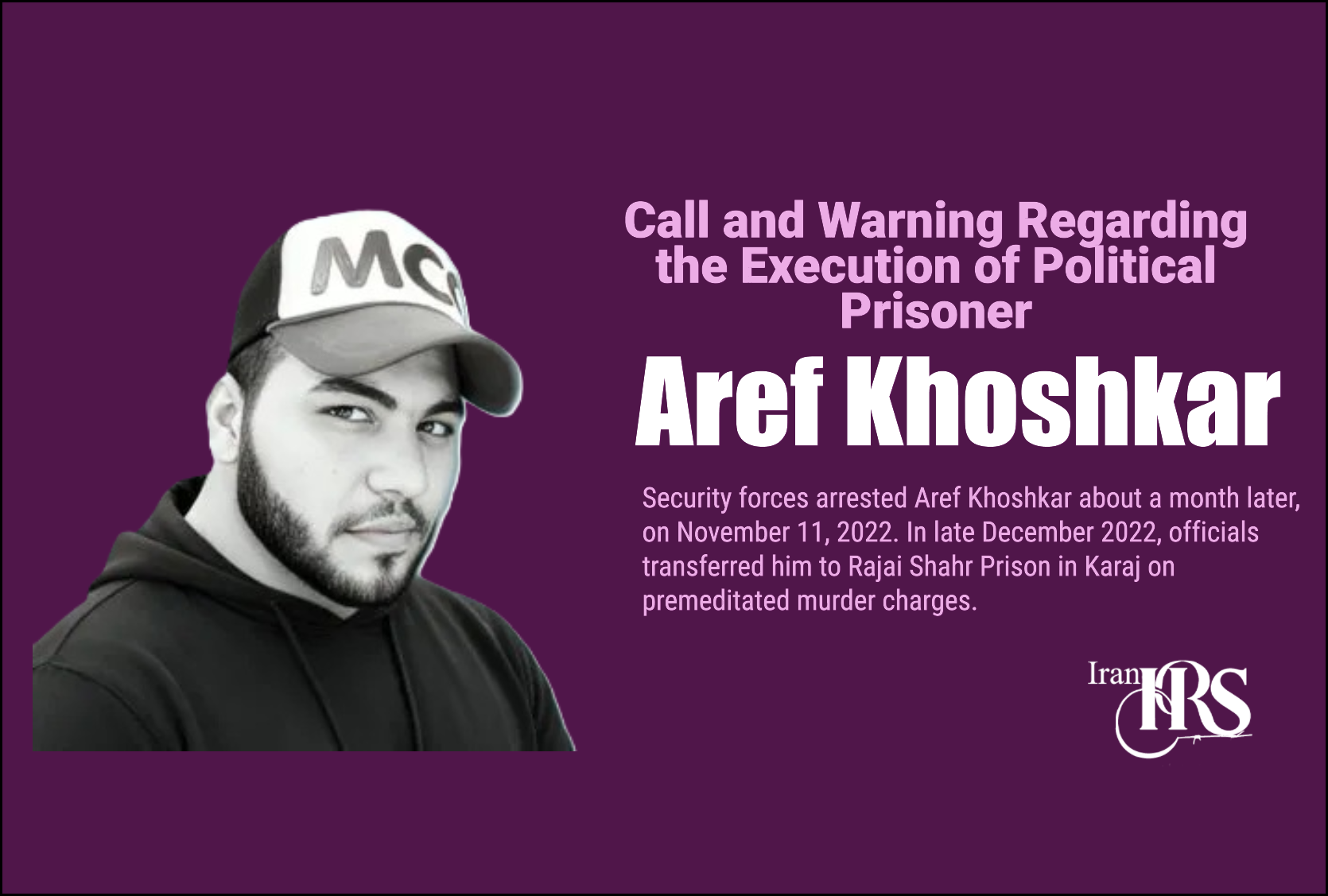
Aref Khoshkar is one of the detainees of the 2022 nationwide protests who has been sentenced to death on charges of murdering a member of the Basij forces.

Iran human rights Society, Tuesday, July 14, 2026 – Following the transfer of Aref Khoshkar, a political prisoner sentenced to death, to a solitary confinement cell in Ghezel Hesar Prison in Karaj, concerns have escalated regarding the imminent execution of his death
sentence. According to received information, this prisoner, who is currently held in Unit 3 of Ghezel Hesar Prison, was transferred to a “suite” or solitary confinement cell on July 9, 2026, and informed sources have warned of the possibility of carrying out his death sentence in the coming days.
Aref Khoshkar is one of the detainees of the 2022 nationwide protests who has been sentenced to death on charges of murdering a member of the Basij forces. Expressing concern over his situation, his family and relatives have called for the urgent attention of human rights organizations and public opinion to this prisoner’s case.
Arrest of Aref Khoshkar and Case Proceedings
According to available information, on the afternoon of Saturday, October 9, 2022, coinciding with popular protests in the Fallah neighborhood of Tehran, a member of the Basij named Salman Amir-Ahmadi was killed during the events of that day. Published reports indicate that Aref Khoshkar was arrested about a month later, on November 11, 2022, and in late December of the same year, he was transferred to Rajai Shahr Prison in Karaj on charges of premeditated murder.
According to informed sources, after the closure of Rajai Shahr Prison, he was transferred along with a number of prisoners to Ghezel Hesar Prison and is now being held in Unit 3 of this prison.
Allegation of Forced Confession Under Torture
According to received information, Aref Khoshkar was subjected to severe physical and mental pressure during his detention and was tortured to extract confessions against himself. It is also reported that security agents pressured Aref Khoshkar to accept responsibility for the murder of a government force by arresting his younger brother and threatening him with sexual assault.
Sources close to the case have emphasized that the confessions attributed to this prisoner were obtained under such conditions and under severe security pressure, and lack legal validity.
Ambiguity in Judicial Proceedings and Access to a Lawyer
According to published information, Aref Khoshkar’s lawyer was court-appointed, and his family was constantly encouraged not to publicize his case.
Informed sources have also stated that this prisoner was sentenced to the death penalty without enjoying an effective defense, without free access to his chosen lawyer, and without a public hearing. According to these sources, he did not even have the opportunity to effectively defend himself during the judicial proceedings.
Increased Concerns After Transfer to Solitary Confinement
The transfer of Aref Khoshkar to a solitary confinement cell in Ghezel Hesar Prison has increased concerns regarding the imminent execution of his death sentence. In Iranian prisons, transferring death-row prisoners to solitary confinement is usually considered one of the stages prior to carrying out the sentence; however, judicial officials or prison authorities have not yet released any official information regarding this prisoner’s status.
In this regard, human rights activists and the family of this prisoner have called for widespread information-sharing about his situation and immediate action to prevent the execution of the death sentence.
Legal Review of the Case Based on Domestic Laws
Introduction
Before carrying out a legal review of this case, it must be noted that many of the criminal laws under the ruling dictatorship, especially in political, security, and protest-related cases, have been criticized by international human rights organizations for violating fair trial principles, the right to liberty, the prohibition of torture, and fundamental civic rights. Nevertheless, even under these domestic laws, security agents and judicial authorities are obligated to observe legal formalities, preserve the dignity of the accused, prohibit all forms of torture, respect the right to defense, grant access to a lawyer, and observe the principles of a fair trial.
Legal Ambiguities of the Case
In the case of Aref Khoshkar, published reports regarding his arrest after the 2022 protests, allegations of torture to extract confessions, threats of sexual assault against his brother, forced confessions, lack of effective access to a chosen lawyer, use of a court-appointed lawyer, ambiguity in the judicial proceedings, and his transfer to solitary confinement prior to the potential execution of his death sentence are among the most significant legal ambiguities in this case. Furthermore, how the defendant’s right to defense was respected during the preliminary investigation phase, the validity of the confessions obtained, and the manner of oversight of security agents’ performance are other issues requiring independent, transparent, and impartial investigation.
Related Legal Articles
- Article 22 of the Constitution: Inviolability of the life, property, rights, and dignity of individuals.
- Article 32 of the Constitution: Prohibition of arrest outside legal formalities.
- Article 34 of the Constitution: The right to seek justice.
- Article 35 of the Constitution: The right to choose a lawyer.
- Article 37 of the Constitution: The presumption of innocence.
- Article 38 of the Constitution: Prohibition of torture to extract confessions.
- Article 39 of the Constitution: Prohibition of violating the dignity of detainees.
- Various articles of the Code of Criminal Procedure: Guaranteeing the right to defense, access to a lawyer, prohibition of relying on confessions obtained under duress, and compliance with legal formalities in criminal proceedings.
Violations of Law
- Arrest in connection with popular protests.
- Allegations of torture to extract confessions.
- Threatening a family member to pressure the accused.
- Extracting forced confessions.
- Ambiguity in effective access to a chosen lawyer.
- Ambiguity in the process of holding trial sessions.
- Transfer to solitary confinement prior to the potential execution of the death sentence.
Human Rights Violations in the Case of Aref Khoshkar
From a human rights perspective, the case of Aref Khoshkar raises serious concerns regarding the right to a fair trial, the prohibition of torture, the validity of confessions obtained under pressure, the right to a chosen lawyer, and the right to life.
Published reports concerning torture, threats of sexual assault against his brother to force him to confess, restrictions on exercising his right to defense, and his transfer to solitary confinement on the verge of the potential execution of the death sentence, if true, could conflict with the international obligations of the Islamic Republic of Iran regarding the protection of the rights of the accused. Human rights organizations have repeatedly emphasized that any allegations of torture, forced confessions, and violations of fair trial principles must be investigated by an independent, impartial, and effective body, and that the execution of any death sentence must be halted until a complete review of these allegations is conducted.
Related Human Rights Articles
- Article 3 of the Universal Declaration of Human Rights: The right to life, liberty, and security of person.
- Article 5 of the Universal Declaration of Human Rights: Prohibition of torture and cruel, inhuman, or degrading treatment or punishment.
- Article 9 of the Universal Declaration of Human Rights: Prohibition of arbitrary arrest.
- Article 10 of the Universal Declaration of Human Rights: The right to a fair and public trial.
- Article 14 of the International Covenant on Civil and Political Rights: The right to a fair trial, the right to defense, and access to a lawyer.
- Article 6 of the International Covenant on Civil and Political Rights: Protection of the right to life and the necessity of fully respecting trial guarantees in cases resulting in the death penalty.
- The Nelson Mandela Rules: Preserving human dignity, prohibiting torture, and protecting the physical and mental health of individuals deprived of their liberty.
Call to the International Community to Prevent the Execution of Aref Khoshkar’s Death Sentence
In light of reports regarding the transfer of Aref Khoshkar to solitary confinement and rising concerns over the imminent execution of his death sentence, the UN Special Rapporteur on the situation of human rights in Iran, the Special Rapporteur on extrajudicial, summary or
arbitrary executions, the Special Rapporteur on torture, the Office of the UN High Commissioner for Human Rights, the Working Group on Arbitrary Detention, the European Union, governments committed to supporting human rights, Amnesty International, and other international human rights organizations are urged to use all legal, political, and diplomatic capacities to immediately halt the execution of Aref Khoshkar’s death sentence and guarantee his right to a fair trial.
These bodies are also requested to prevent the execution of a sentence that raises serious legal and human rights ambiguities by continuously monitoring the proceedings of this case and following up on allegations related to torture, forced confessions, and violations of defense rights.
See also the below articles:
- Ghezel Hesar Prison: Inmates launch Hunger Strike Over Resumed Executions
- Evin Prison: Healthcare Crisis and Rising Pressure on the Women’s Ward
Follow Iran Human Rights Society on social networks:
Telegram /Twitter /Instagram / YouTube / Facebook
Join Iran Human Rights Society on Twitter