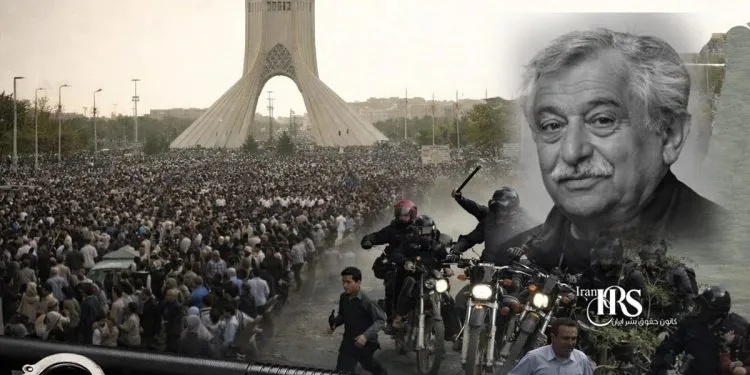
In the judiciary of Fars Province, initial reports that contained precise details about rape, sexual abuse, and the role of Houshang Fahandezh and his accomplices were either archived or invalidated with the label “unreal report.”
Houshang Fahandezh how did he become a symbol of suppression and violence in the 2009 Shiraz protests?
Iran Human Rights Society, Saturday June 20, 2026 – In the years after the widespread popular protests against the results of the 2009 presidential election, numerous reports were published about methods of suppression, extrajudicial arrests, and widespread violation of citizens’ rights in various cities of Iran. Among these reports, what happened in Shiraz by thugs and hooligans under the leadership of Houshang Fahandezh, due to its hidden dimensions, organized nature, and the level of violence applied, holds a special and concerning position; especially the use of private places as unofficial detention centers and the occurrence of systematic rape and sexual abuse against detained women.
In which areas were the 2009 protests in Shiraz concentrated?
During the 2009 protests, Mollasadra Street, Golestan Boulevard, the Hafeziyeh area, and adjacent areas to Shiraz University had become the main centers of popular gatherings, especially students. The proximity of these areas to the faculties of Shiraz University, especially the Faculty of Literature and Humanities, caused a significant portion of the protesters to consist of youths and students.
To control these protests, in addition to various units of the law enforcement force, Basij and IRGC forces also entered the scene extensively. Special unit forces and relief unit forces were stationed in some police stations of the city, including one of the police stations in the Saadi area of Shiraz, and these places had become locations for rest, organization, shift change, and logistical support for them.
Around this police station, two large garages were used as unofficial support centers for Basij and IRGC forces. These two garages, one in direct vicinity of the police station and the other near Bagh-e Delgosha, belonged to Houshang Fahandezh Saadi and Hamid Fahandezh Saadi. Although the official ownership of both places was registered in the name of these individuals, the practical and daily management of them was mostly in the hands of Houshang Fahandezh Saadi.
How did the garages belonging to the Fahandezhs turn into unofficial detention centers?
In the days and nights when the number of detainees had increased sharply, the capacity of official detention centers was not responsive. In such conditions, Basij and IRGC forces took action to transfer part of the detainees, especially those they had arrested themselves, to these same garages.
These transfers were often carried out with vehicles belonging to security institutions; vehicles that in many cases had personal license plates so that tracking them would be difficult. Detainees were transferred to these places without official registration, without filing a case, and without informing families, and sometimes for one or two nights, and in some cases more, were held there.
These unofficial detention centers effectively operated outside any judicial or administrative supervision. There was no specific mechanism for registering the identity of detainees, and the direct responsibility for these individuals was not on the law enforcement force, but in the hands of Basij and IRGC forces stationed there.
In what conditions were the detained women held in the unofficial detention centers of Shiraz?
Among the detainees, a considerable number of women, especially students, were seen. These women, after arrest in the streets or around the university, were transferred to the same garages belonging to the Fahandezhs. The conditions of their detention have been described as extremely inhuman: closed spaces, lacking sanitary facilities, without the possibility of contact with family, and in a space filled with threat and intimidation.
Based on collected information, the detained women were often held at nights in the basement of one of these garages; a place that not only lacked any detention standards but effectively turned into a scene for committing serious crimes.
What do the reports say about organized rape and sexual abuse in Shiraz detention centers?
Reports indicate that during the detention of detained women in these garages, rape and sexual abuse occurred repeatedly and in an organized manner. Victims have stated that they were first assaulted by an individual whom other agents addressed with the title “Haji.” Examinations conducted show that this individual was the same Houshang Fahandezh Saadi.
After that, two of the janitors working in the garage also played a role in these rapes. These two individuals, who were present as service and guard forces in the place, according to the victims, committed rape with severe and repeated violence. The intensity of the applied violence was to the extent that at least three of the women suffered serious physical injuries and needed immediate medical treatment.
These rapes by Houshang Fahandezh and his accomplices were not carried out accidentally but in a completely controlled space and with the full knowledge of other agents present in the place. No effort was made to prevent these acts, and the atmosphere prevailing in the garages had created a space of complete immunity for the perpetrators.
How was filming and threat used to silence the victims?
One of the horrific dimensions of these crimes was the systematic use of filming and photography of the victims during the rape. According to testimonies, the perpetrators, by recording images, threatened the victims that if they revealed or pursued the matter, these images would be published in virtual space.
In addition, the women were told that any complaint or informing would face severe reaction from security and judicial institutions, and not only themselves but also their families would be put under pressure. These threats, along with the psychological conditions resulting from rape, forced many victims into silence.
Why did the victims not have the possibility of effective judicial pursuit?
Based on available information, the victims have repeatedly emphasized that Houshang Fahandezh Saadi had direct connections with judicial authorities, and this very issue was the main factor in his and other perpetrators’ feeling of complete immunity. The perception that complaining against such individuals is not only fruitless but also dangerous played an important role in preventing official pursuit of these crimes.
In cases where efforts were made to register and report these events, the response of the responsible bodies was not handling the main accusations against Houshang Fahandezh and his accomplices, but dealing with the reporters. Some reports were called “fabricated” and pursuing the matter was entrusted to institutions that themselves were under suspicion of accusation.
What pattern of organized human rights violation does this case show?
What is depicted in these reports is not merely a set of individual violations but shows a repeatable pattern of organized human rights violation: use of private places as secret detention centers, elimination of judicial supervision, application of sexual violence as a tool of suppression, threatening victims with security and media tools, and finally creating complete immunity for perpetrators through connection with the power structure.
This pattern has not only seriously violated the human dignity of the victims but has also destroyed public trust in any justice mechanism. The clear message of this process is that in such a structure, revealing the truth is costly and silence is considered the only way to survive.
What factors played a role in closing and hiding the case?
After the disclosure of the existence of unofficial detention centers, illegal detention of protesters, and numerous reports of rape and sexual abuse of detained women by thugs and hooligans under the leadership of Houshang Fahandezh, the reaction of the power structure in Fars Province was not centered on transparency and accountability but on crisis control, information containment, and preventing the spread of disclosure.
Evidence and existing reports show that at this stage, a kind of alignment and coordination was formed between religious, security, law enforcement, and judicial institutions of the province to close the case in the shortest possible time.
Instead of forming an independent and impartial investigation board to examine the raised claims, handling the matter was effectively entrusted to the same institutions that either directly played a role in managing the unofficial detention centers or had close connections with the accused individuals in this case.
This method of handling blocked the path of any fair pursuit from the very beginning, and its result was turning a heavy human rights violation case into a security and “confidential” matter that should be kept away from public opinion as soon as possible.
In this process, Houshang Fahandezh Saadi and Hamid Fahandezh Saadi, whose names were raised as owners of places that were used for illegal detention of detainees, were not only not summoned or interrogated but enjoyed open and covert support from influential authorities of the province.
Reports indicate that these individuals were introduced as “trusted” and “trusted figures” and any reference to their role was quickly rejected as an attempt to “destroy valuable forces” or “blackening.”
How were the testimonies of victims discredited and the disclosers put under pressure?
At the same time, the main focus of the responsible bodies was not on supporting the victims of rape and sexual abuse but on discrediting the testimonies, creating doubt in the narratives, and applying psychological and security pressure on the informed.
Victims and their families, due to direct and indirect threats, were prevented from official pursuit of the case, and an atmosphere of intimidation was formed in such a way that any referral to judicial authorities was accompanied by fear of heavier consequences.
At the provincial management level, the role of senior officials is especially noteworthy. Reports show that from the Friday prayer leader of Shiraz, Asadollah Imani, to Gholamhossein Gheibparvar, the then commander of Fajar IRGC of Fars Province, and Ali Movayedi, the then commander of the law enforcement force of the province, all in the framework of unofficial meetings and intra-structural coordinations emphasized the necessity of “quickly closing the matter.”
It has also been reported that Jaber Banshi, the then prosecutor of Shiraz, played a role in hiding these events and applying pressure on the victims.
In continuation of this process, initial reports that contained precise details about rape, sexual abuse, and the role of Houshang Fahandezh and his accomplices were either archived or invalidated with the label “unreal report.”
Disclosers and individuals who tried to pursue the matter through legal channels faced threats of judicial pursuit, administrative rebuke, or removal from job positions. These confrontations sent a clear message to other informed people: silence is the only safe option.
Why was the Houshang Fahandezh case closed without public trial?
The quick closing of the case without issuing even one public indictment or holding a trial for Houshang Fahandezh indicates the well-known pattern of structural immunity for influential individuals; a pattern in which access to political and security power creates a shield against judicial accountability.
In this framework, not only the direct perpetrators of rape and sexual abuse remained immune from punishment but also the possibility of officially recording these crimes was eliminated.
The result of this coordinated cover-up was the stabilization of a cycle of impunity in which victims were marginalized, the truth was buried, and public trust was damaged more than before.
A case that could have become a turning point in disclosing illegal detention centers and systematic violence against protesters was quickly closed with direct and indirect intervention of the province’s leaders; a closing that was not the end of the story but the beginning of an imposed silence on one of the darkest chapters of suppression in Fars Province by thugs and hooligans under the leadership of the Fahandezhs and the like.
Why is registering and documenting these crimes important for future justice?
Despite the passage of years since the occurrence of these events, the importance of accurately registering names, places, times, and methods of committing these crimes still stands.
In conditions where the possibility of fair handling inside the country does not exist, these documents can serve as the basis for legal pursuit of perpetrators in competent international authorities in the future.
Human rights experts emphasize that precise documentation, even if it does not lead to justice today, will prevent forgetting and distorting the truth; a truth whose victims still live with its physical and psychological consequences and a society that has paid a heavy price for it with forced silence.
Legal examination of the case based on domestic laws
Legal ambiguities of the case
The case of Houshang Fahandezh and the unofficial detention centers of Shiraz faces extensive legal ambiguities. First, holding citizens in garages and private places, outside the official structure of registered prisons and detention centers, lacks any legal basis. According to domestic laws, arresting individuals must only take place in legal places and under the supervision of the judiciary.
On the other hand, so far no independent, public, and impartial investigation has been conducted about claims related to rape, torture, and extrajudicial arrests, and the identity of the main perpetrators of these events has never been officially handled judicially. Also, closing the case without holding a public trial and without hearing the testimonies of victims creates serious questions about the independence and impartiality of the judicial process.
Related legal provisions
Article 22 of the Constitution: The life, property, rights, housing, and dignity of persons are immune from assault except in cases where the law permits.
Article 32 of the Constitution: No one can be arrested except by order and in the manner specified by law.
Article 35 of the Constitution: In all courts, the parties to the dispute have the right to choose a lawyer for themselves.
Article 38 of the Constitution: Any torture for obtaining confession or gaining information is prohibited and such confession lacks value and validity.
Article 39 of the Constitution: Violating the honor and dignity of arrested, imprisoned, or exiled individuals is prohibited.
Articles 570 and 578 of the Islamic Penal Code: Depriving individuals of legal rights and applying torture by government agents is considered a crime.
Instances of law violation
Creating and using unofficial detention centers outside legal supervision.

Arbitrary arrest of protesters without official registration and informing families.
Holding detainees in inhuman conditions lacking legal standards.
Applying torture, sexual violence, and humiliating behaviors against detainees.
Preventing victims from access to effective trial and independent investigations.
Closing the case without transparent and impartial handling.
Flagrant violation of human rights in the unofficial detention centers of Shiraz; Arbitrary arrest, torture, and organized sexual rape
It shows flagrant and organized violation of fundamental human rights. Arbitrary arrests, torture, sexual rape, temporary disappearance, and impunity of perpetrators from punishment are among the most important issues raised in this case.
Violated provisions
Violation of the right to liberty and personal security – Article 3 of the Universal Declaration of Human Rights: Transferring citizens to secret detention centers and holding them without legal basis has violated the right to individual liberty and security.
Prohibition of arbitrary arrest – Article 9 of the Universal Declaration of Human Rights: Arresting protesters without official registration, without informing families, and outside judicial supervision is an example of arbitrary arrest.
Prohibition of torture and inhuman behaviors – Article 5 of the Universal Declaration of Human Rights and the Convention against Torture: Numerous reports of torture, rape, and sexual abuse against detainees are clear examples of inhuman and degrading behaviors.
The right to a fair trial – Article 10 of the Universal Declaration of Human Rights: Failure to conduct independent investigations, depriving victims of access to justice, and closing the case without judicial handling violates the principles of fair trial.
The right to human dignity – Article 1 of the Universal Declaration of Human Rights: Using sexual violence as a tool of suppression is a clear violation of the dignity and status of the victims.
The right to effective remedy – Article 8 of the Universal Declaration of Human Rights: Victims remaining deprived of access to justice and remedy has strengthened the cycle of impunity from punishment.
Human rights activists believe that what happened in the unofficial detention centers of Shiraz was not an isolated event but part of a widespread pattern of suppression and organized violation of human rights during popular protests; a pattern whose danger of repetition still stands without accountability of its perpetrators.
See also the below articles:
- Kut Abdollah Arrests: Security Forces Target 29 Sunni Citizens in Ahvaz
- Zolfaqar Yazdandoost Faces Scabies in Gonbad-e Kavus Prison Crisis
Follow Iran Human Rights Society on social networks:
Telegram /Twitter /Instagram / YouTube / Facebook
Join Iran Human Rights Society on Twitter