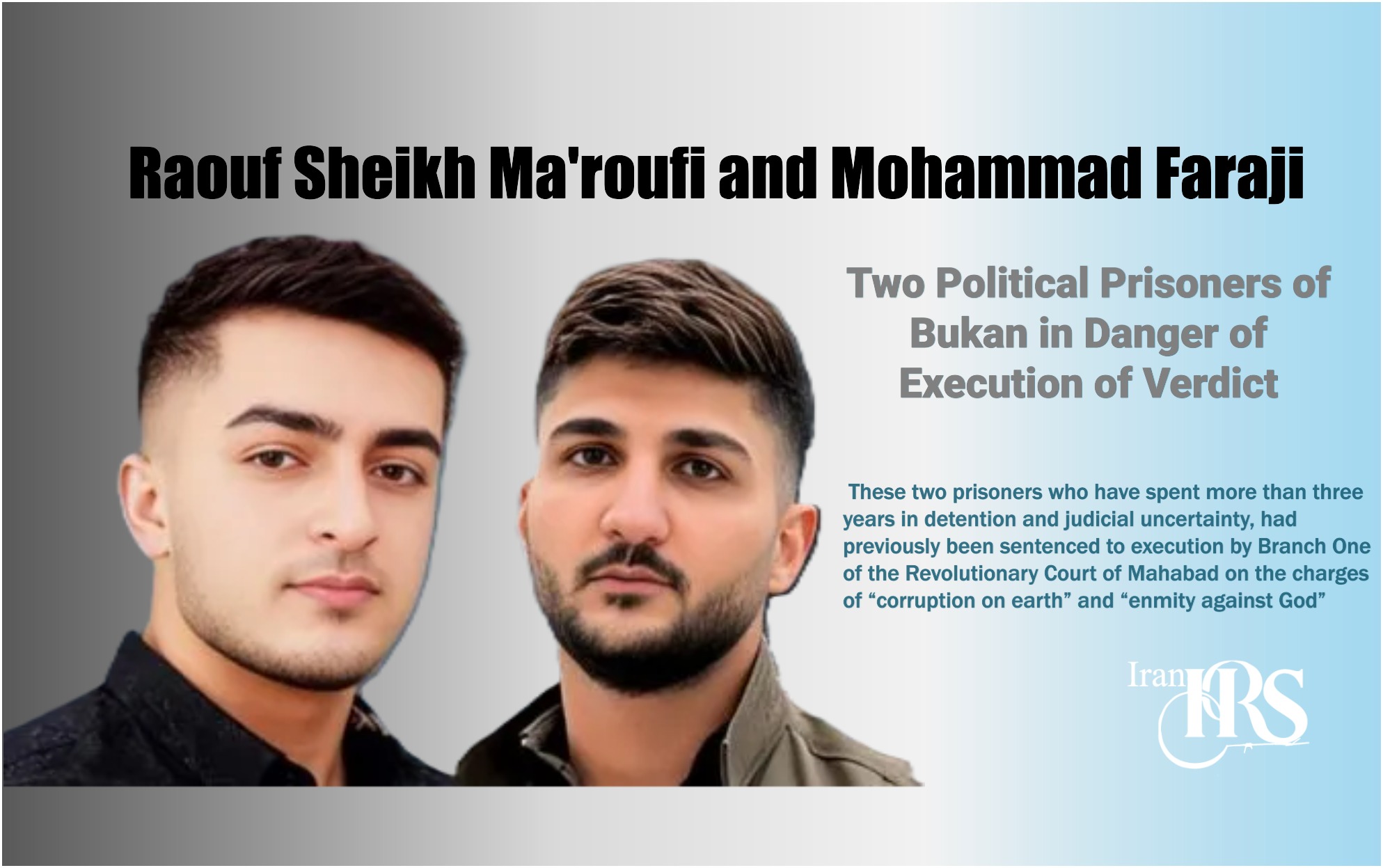
The Supreme Court of the country confirmed the execution verdicts of Raouf Sheikh Ma’roufi and Mohammad Faraji, two political prisoners from Bukan, and sent their cases to the execution of verdicts branch. These two prisoners after years of detention and uncertainty, are facing the danger of execution of the execution verdict in conditions where numerous reports of torture and obtaining forced confessions in their cases have been published.
Iran Human Rights Society, Saturday 30 May 2026 – The execution verdicts of Raouf Sheikh Ma’roufi and Mohammad Faraji, two political prisoners from Bukan, were confirmed by the Supreme Court of the country and sent to the execution of verdicts branch for execution. These two prisoners who have spent more than three years in detention and judicial uncertainty, had previously been sentenced to execution by Branch One of the Revolutionary Court of Mahabad on the charges of “corruption on earth” and “enmity against God”. The confirmation of these verdicts takes place while human rights sources have reported the application of severe physical and psychological tortures for obtaining forced confessions and deprivation of their basic defense rights.

Why Have the Execution Verdicts of Raouf Sheikh Ma’roufi and Mohammad Faraji Become News Again?
Based on the published reports, the Supreme Court of the country as the highest judicial authority of Iran, has confirmed the execution verdicts of Raouf Sheikh Ma’roufi and Mohammad Faraji and sent their cases to the execution of verdicts. This decision has aroused widespread concerns among families, civil activists and human rights institutions.
Raouf Sheikh Ma’roufi and Mohammad Faraji are political prisoners from Bukan who have been in detention since past years. They were sentenced to execution in February 2026 by Branch One of the Revolutionary Court of Mahabad on the charges of “corruption on earth” and “enmity against God” and the issued verdicts were notified to them in Bukan prison on 23 February 2026.
How Were Raouf Sheikh Ma’roufi and Mohammad Faraji Arrested?
Raouf Sheikh Ma’roufi was arrested on 26 December 2022 by the forces of the Intelligence Administration in Bukan. Reports indicate that his arrest was accompanied by the application of violence. On the other hand, Mohammad Faraji was also arrested by security forces without presenting a judicial warrant.
Based on the published information, security agents used a deceptive method for the arrest of Mohammad Faraji. It is said that the forces of the Urmia Intelligence Administration introduced themselves as customers, and since he was active in the field of car mechanics, they asked him to go to a certain location for car repair. After attending the specified location, he was arrested by security forces.
Human rights activists consider this method of arrest as an example of extralegal arrests and contrary to the principles of fair trial.
How Long Have These Two Prisoners Been in Detention and Uncertainty?
Raouf Sheikh Ma’roufi and Mohammad Faraji after arrest were under interrogation for months in the detention center of the Urmia Intelligence Administration. They were finally transferred to Bukan prison on 10 June 2023 with the end of the interrogation stages and since then they have been kept in this prison.
The families of these two prisoners during the past years have repeatedly protested the prolongation of the judicial process and the uncertainty of the case. Civil activists also believe that keeping political prisoners in an unspecified situation for long years is considered a kind of additional psychological pressure on the prisoner and his family.
Have the Confessions of These Two Prisoners Been Obtained Under Torture?
One of the most important concerns in the case of Raouf Sheikh Ma’roufi and Mohammad Faraji is the reports related to torture and forced confessions.
Based on the published report, interrogators have tried to force these two prisoners to accept the charge of “participation in the murder of one of the security forces in Bukan”. Informed sources have announced that they have been under severe physical and psychological pressures during the interrogation period to accept the desired confessions of the security institutions.
It has also been reported that these two prisoners have been deprived of effective access to a lawyer in the interrogation stages. According to human rights activists, confessions that are obtained under pressure, torture or threat lack legal validity and should not be the basis for issuing a verdict.
What Consequences Will the Confirmation of the Execution Verdict Have?
Sending the case to the execution of verdicts means that the danger of execution of the execution verdict threatens these two prisoners more than ever. Human rights institutions have repeatedly warned about the increase in issuing and executing execution verdicts in political cases.
Human rights activists emphasize that in cases that are accompanied by claims of torture, forced confession and violation of the defense rights of the accused, the execution of the execution verdict can have irreparable consequences.
In their belief, independent handling of the raised claims regarding torture and re-examination of the case is necessary before any judicial action.
Human Rights Violation in the Case of Raouf Sheikh Ma’roufi and Mohammad Faraji; Torture, Forced Confession and Threat to the Right to Life
- Violation of the Prohibition of Torture – Article 5 of the Universal Declaration of Human Rights and Article 7 of the International Covenant on Civil and Political Rights:Reports related to the application of physical and psychological tortures for obtaining forced confessions are an example of violation of the absolute prohibition of torture and inhuman behaviors.
- Violation of the Right to a Fair Trial – Article 10 of the Universal Declaration of Human Rights:Handling the case without independent examination of torture claims and using disputed confessions violates the right to enjoy a fair trial.
- Violation of the Right to Access to a Lawyer – Article 14 of the International Covenant on Civil and Political Rights:Deprivation of effective access to a lawyer in the interrogation and investigation stages is one of the most important cases of violation of the rights of the accused in this case.
- Violation of the Right to Liberty and Personal Security – Article 9 of the Universal Declaration of Human Rights:Arrest without presenting a judicial warrant, long-term keeping in security detention centers and years of judicial uncertainty violate the right to liberty and personal security.
- Violation of the Right to Life – Article 3 of the Universal Declaration of Human Rights:Confirmation and the possibility of execution of the execution verdict in a case that is accompanied by claims of torture, forced confession and violation of fair trial, seriously threatens the fundamental right to life.
See also the below articles:
- Benjamin Naghdi Was Sentenced to Execution; Issuance of Verdict for Detainee of Nationwide Protests of 2025
- Tara and Kimia Davoudi; Heavy Sentencing of Two Protesting Sisters in Salavati Court
Follow Iran Human Rights Society on social networks:
Telegram /Twitter /Instagram / YouTube / Facebook
Join Iran Human Rights Society on Twitter