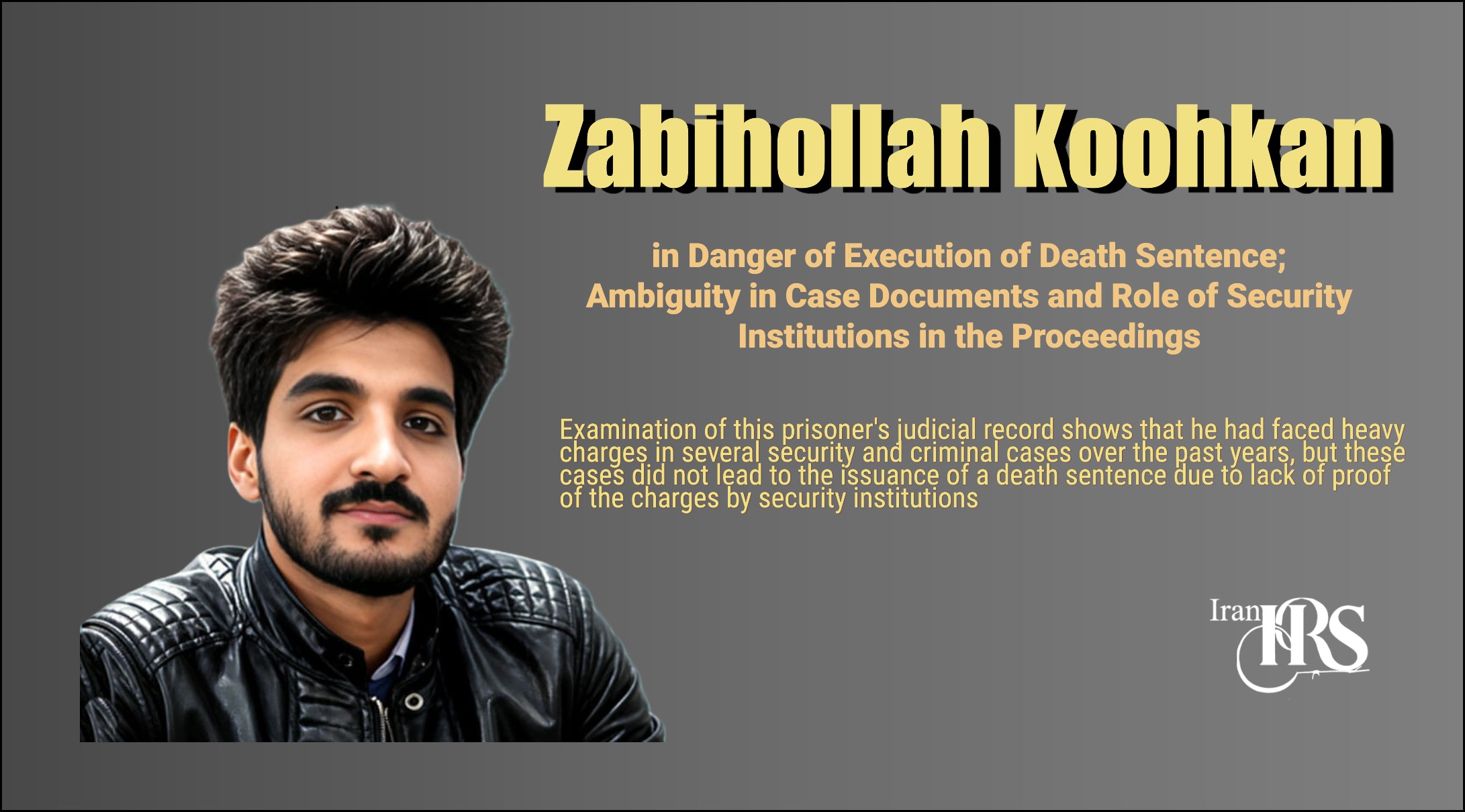
Zabihollah Koohkan, a Baloch prisoner held in Zahedan Central Prison, is facing the danger of imminent execution of the death sentence while his family and informed sources speak of serious ambiguities in the case and the role of security institutions in the proceedings process.
Iran Human Rights Society, Wednesday June 3, 2026 – Zabihollah Koohkan, a Baloch prisoner sentenced to death, is on the verge of execution of the sentence; a sentence that according to reports was issued in a case that his family and close associates consider to lack sufficient documentation. Examination of this prisoner’s judicial record shows that he had faced heavy charges in several security and criminal cases over the past years, but these cases did not lead to the issuance of a death sentence due to lack of proof of the charges by security institutions. Now, concerns have also increased about the role of security organs, reliance on disputed confessions, and the existence of ambiguity in the proceedings process.
Why is Zabihollah Koohkan in danger of execution of the death sentence?

Zabihollah Koohkan, 34 years old, married and father of two children, is currently being held in Ward 8 of Zahedan Central Prison. According to published information, prison officials have made contacts with the private plaintiff of the case in recent days regarding the preparations for the execution of the sentence; a matter that has increased concerns about the imminent execution of the death sentence.
The case that has become the basis for issuing the death sentence for him goes back to the killing of Mansour Shahnavazi in November 2022. However, Zabihollah Koohkan’s family and informed sources believe that the proceedings process for this case has been accompanied by ambiguities and serious questions.
Why are the documents of Zabihollah Koohkan’s case subject to doubt?
One of the most important issues raised about Zabihollah Koohkan’s case is the lack of documentation of the charges and the weakness of the evidence presented against him.
According to existing documents, the victim’s family in the initial stages of the investigations had announced that they had no information about the identity of the shooters and the victim also did not have a known dispute with any particular person. Despite this, the investigation process later was directed towards attributing the charge to several members of the Koohkan family.
Also, according to the issued verdict, one of the most important documents of the court for attributing the murder to Zabihollah Koohkan has been the confessions attributed to him and some other defendants in the interrogation stages. This is while the defendants later in the proceedings process rejected these confessions and announced that they were obtained under pressure and in inappropriate conditions.
Sources close to the case emphasize that independent evidence that definitively proves Zabihollah Koohkan’s presence at the scene of the incident has not been published publicly.
What has been the role of security institutions in Zabihollah Koohkan’s case?
According to published information, Zabihollah Koohkan had previously faced charges such as “enmity against God”, “disrupting national security” and “possession of military weapons” in several security cases.
However, these cases did not reach a result due to lack of proof of the charges by security organs and did not lead to the issuance of a death sentence. Informed sources say that after the closure of these cases, the focus of security and judicial institutions was directed towards the case of Mansour Shahnavazi’s murder.
It has also been reported that the investigation process and directing the case towards the members of the Koohkan family was accompanied by the entry of security forces and some officials responsible for the case. This issue is raised by human rights activists as one of the reasons for concern about the impartiality of the proceedings process.
Why do the family and local sources emphasize Zabihollah Koohkan’s innocence?
According to reports, Mansour Brahoi who was with the victim at the time of the incident and was himself injured, in meetings held in the presence of elders and local trusted figures in Makki Mosque in Zahedan, emphasized Zabihollah Koohkan’s innocence.
In addition, the victim’s family also in the initial stages of the case had announced that they had no knowledge of the perpetrators of the incident. This same issue has caused some observers to raise questions about the way the accusation process was formed and the change in the direction of the case.
Baloch activists and human rights defenders believe that the case still has serious ambiguities and the execution of the death sentence in such conditions can create more concerns.
How has the proceedings process and issuance of the sentence been?
According to the issued verdict from Branch One of the First Criminal Court Special for Juveniles of Sistan and Baluchestan Province, the case ruling was issued by Seyed Moein Javadi, Jalal Beg-Nazar and Mohsen Gol-Mohammadi Tolai.
In the initial confessions, it had been claimed that several of the defendants were present at the scene of the incident with a silver Peugeot 405 vehicle and Zabihollah Koohkan carried out the shooting. However, he and the other defendants in the subsequent stages of the proceedings rejected these statements and announced that they were not present at the location at the time of the incident.
These contradictions and the rejection of the initial confessions by the defendants are among the cases that have caused human rights activists to demand an independent review of the case.
Human rights violation; concern about execution in a case with serious ambiguities
Zabihollah Koohkan’s case is accompanied by numerous concerns in the field of human rights. Reliance of a significant part of the case on disputed confessions, claims of applying pressure in the interrogation stages, existence of ambiguity in the documents and the role of security institutions in the investigation process are among the cases that have drawn the attention of human rights institutions to this case. Human rights activists emphasize that issuing and executing a death sentence in cases that are accompanied by such ambiguities can bring the danger of irreparable violation of the right to life.
Violated articles:
- Article 3 of the Universal Declaration of Human Rights (right to life): Execution of the death sentence in a case with serious ambiguities places the fundamental right to life in danger.
- Article 5 of the Universal Declaration of Human Rights (prohibition of torture): Claims related to obtaining confessions under pressure and torture increase concerns about the violation of this principle.
- Article 10 of the Universal Declaration of Human Rights (right to fair trial): Ambiguity in documents and intervention of security institutions questions the independence and impartiality of the proceedings process.
- Article 11 of the Universal Declaration of Human Rights (presumption of innocence): Criminal conviction must be based on definitive and independent evidence, not disputed confessions.
- Principles guaranteeing the protection of individuals facing the death penalty: In cases leading to execution, any serious doubt about the evidence should be interpreted in favor of the defendant.
- Principle of prohibition of intervention by security institutions in proceedings: The influence of security institutions on the investigation and trial process can violate the right to a fair trial.
See also the below articles:
- Zahra Tabari Sentenced to Death Again Amid Global Outcry
- Sajjad and Shayan Veysi; Charge of Enmity Against God Against Two Yarsani Activists After Months of Detention in Kermanshah
Follow Iran Human Rights Society on social networks:
Telegram /Twitter /Instagram / YouTube / Facebook
Join Iran Human Rights Society on Twitter