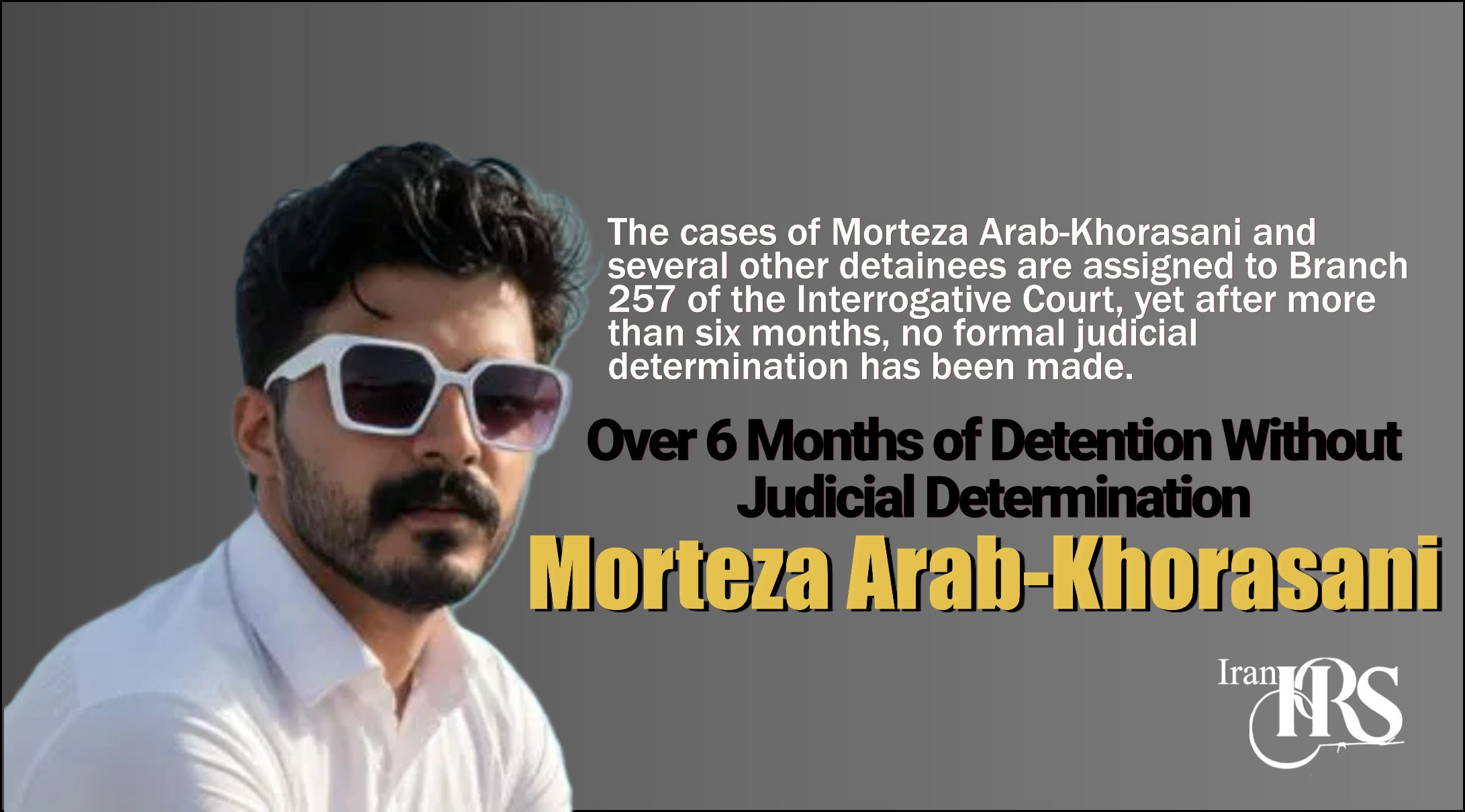
Morteza Arab-Khorasani, a young man born in 2000 who was arrested while working at a welding workshop in Shandiz, has spent over six months in judicial uncertainty at Vakilabad Prison in Mashhad—a situation shared by several other detainees of the January 2026 protests.

Iran Human Rights Society, Friday, August 14, 2026 – More than six months have passed since the arrest of Morteza Arab-Khorasani, a young native of the Shandiz region of Mashhad. According to reports received, his case remains stalled in Branch 257 of the Interrogative Court without a clear judicial procedure being followed. Arrested while working at a welding workshop,he has spent the majority of his detention period in the quarantine ward of Vakilabad Prison. Reports also indicate pressure exerted on several detainees to confirm statements and confessions extracted during interrogations.
Arrest of Morteza Arab-Khorasani While Working in Shandiz
Morteza Arab-Khorasani, born in 2000, was arrested in connection with the wave of detentions following the January 2026 protests in Shandiz and areas surrounding Mashhad.
According to received information, he was arrested by security forces while working at a welding workshop in Shandiz. Morteza Arab-Khorasani spent the first 14 days of his arrest in an incommunicado state, during which his family had no access to clear information regarding his location or condition.
On January 8 and 9, 2026, Shandiz, like several other cities, witnessed popular protests. Following these demonstrations, security forces arrested a number of youth and citizens, opening security-related cases against many of them.
Case Stalled in Branch 257 of the Interrogative Court
According to published reports, the cases of Morteza Arab-Khorasani and several other detainees are assigned to Branch 257 of the Interrogative Court, yet after more than six months, no formal judicial determination has been made.
Informed sources state that the legal process for these cases has effectively ground to a halt; proceedings are not moving forward in a structured manner, nor has the final status of the files been clarified. It has also been reported that judicial authorities have refused to set bail for the temporary release of some detainees.
Among those reported to be in a similar situation are Nemat Alipour and Pejman Ghoochan. A number of these individuals are young residents from the Ab-o-Barq and Shaghayeq areas of Mashhad, who are currently being held in the quarantine ward of Vakilabad Prison.
In other reports regarding Shandiz detainees, mention has been made of at least eight young individuals facing severe judicial cases. However, existing information is insufficient to determine the exact legal status of all these individuals or to verify if their files are at the exact same procedural stage.
Months of Detention in Vakilabad Prison’s Quarantine Ward
One of the most alarming aspects of Morteza Arab-Khorasani’s condition is his prolonged detention in the quarantine ward of Vakilabad Prison.

Quarantine is fundamentally designed as a temporary holding area for prisoners upon arrival or under specific circumstances. However, according to received reports, Morteza Arab-Khorasani has spent the bulk of his detention period in this section rather than being transferred to the general ward.
Prolonged judicial uncertainty, the absence of a clear timeline for court proceedings, and the constant wait for prisoners’ names to be announced over the facility’s loudspeakers have, according to sources, inflicted severe psychological distress on the detainees.
Interrogator Visits and Pressure to Confirm Confessions
Received reports also describe repeated visits by interrogators to Vakilabad Prison to obtain what has been termed “final confirmation of confessions.”
According to this information, certain defendants face threats of being returned to harsh interrogation conditions if they recant or deny their previous statements. While these claims require independent verification, if verified, the evidentiary validity of any confession or statement obtained under such conditions would be severely undermined.
Concurrently, reports have emerged regarding the possibility of extremely heavy penalties for some Shandiz protest detainees, including potential capital charges in certain files. However, based on the provided information, it cannot be concluded that Morteza Arab-Khorasani personally faces a death sentence or charges that carry the death penalty. Differentiating this point in his case report is essential.
Legal Review of Morteza Arab-Khorasani’s Case Based on Domestic Laws
The dictatorial laws governing Iran in recent years have repeatedly been criticized for failing to align with fair trial standards, opacity in security-related prosecutions, and prolonged temporary detentions. Reviewing Morteza Arab-Khorasani’s case under domestic legal statutes does not constitute an endorsement of these laws; the objective is to highlight instances where even these existing statutes have been violated by the judiciary.
Legal Ambiguities of the Case
The primary legal issue is Morteza Arab-Khorasani’s continued detention for over six months without a clear judicial determination. Reports indicate that his file is stalled in Branch 257 of the Interrogative Court, bail requests have been denied, and his confinement in the quarantine ward continues.
Furthermore, the 14-day period of incommunicado detention following his arrest and reports of coercion to confirm prior confessions raise serious questions regarding compliance with defense rights during preliminary investigations.
If statements or confessions were obtained under threats, coercion, or pressure, relying on them judicially violates domestic regulations governing the legal validity of confessions.
Relevant Legal Articles
- Article 32 of the Constitution: Mandates that arrests must strictly follow legal procedures, and charges along with supporting reasons must be formally communicated to the detainee.
- Article 35 of the Constitution: Explicitly recognizes the right of the accused to retain legal representation.
- Article 37 of the Constitution: Emphasizes the presumption of innocence.
- Article 38 of the Constitution: Prohibits all forms of torture or coercion to extract confessions or obtain information.
- Article 39 of the Constitution: Forbids any affront to the dignity and honor of arrested persons and prisoners.
- Article 169 of the Islamic Penal Code: Nullifies the legal validity of confessions obtained under duress, coercion, torture, or physical and psychological abuse.
- Code of Criminal Procedure: Emphasizes respect for the defendant’s defense rights and legal standards regarding bail and temporary detention orders.
Violations and Legal Concerns
- Continued detention for over six months without final judicial determination;
- Reports of stalled proceedings at the preliminary investigation stage;
- 14 days of incommunicado detention post-arrest;
- Prolonged detention in the quarantine section;
- Refusal to issue bail orders and continuation of arbitrary detention;
- Reported pressure on the accused to confirm prior confessions;
- Reported threats against defendants should they recant previous statements;
- Lack of transparency regarding when the case will be forwarded to court for trial.
Reviewing the Case from the Perspective of Human Rights and Potential Violations of International Standards
From a human rights standpoint, the prohibition of arbitrary detention, the right to a fair trial, immunity from torture, and effective access to legal counsel constitute fundamental principles of international law. The ongoing judicial uncertainty of Morteza Arab-Khorasani for over six months, combined with reports of forced confession confirmations, raises serious concerns regarding adherence to these standards.
Human Rights Ambiguities of the Case
Holding a defendant in prolonged detention without resolving their judicial status inflicts severe psychological and social distress on the individual and their family. This concern is amplified in Morteza Arab-Khorasani’s case by his prolonged holding in quarantine and initial 14 days of incommunicado detention.
Furthermore, any threat or pressure aimed at forcing a defendant to validate prior confessions—especially if those statements were extracted under duress—directly violates the right to remain silent, the privilege against self-incrimination, and the prohibition against torture and inhumane treatment.
Relevant International Documents
- Article 5 of the Universal Declaration of Human Rights: Absolute prohibition of torture or cruel, inhuman, or degrading treatment or punishment.
- Article 9 of the Universal Declaration of Human Rights: Prohibition of arbitrary arrest, detention, or exile.
- Article 10 of the Universal Declaration of Human Rights: Right to a fair and public hearing.
- Article 11 of the Universal Declaration of Human Rights: Presumption of innocence and necessary guarantees for defense.
- Article 7 of the International Covenant on Civil and Political Rights (ICCPR): Absolute prohibition of torture or inhuman or degrading treatment.
- Article 9 of the ICCPR: Right to liberty and security of person, and prohibition of arbitrary arrest.
- Article 14 of the ICCPR: Right to a fair trial and protection against forced self-incrimination.
- Nelson Mandela Rules: Obligation to uphold human dignity and appropriate treatment standards for all persons deprived of liberty.
See also the below articles:
- Hamid Haj Jafar Kashani Denied Medical Care in Greater Tehran Prison
- Sepehr Amirzadeh: Medical Student Sentenced to Death in Isfahan
Follow Iran Human Rights Society on social networks:
Telegram /Twitter /Instagram / YouTube / Facebook
Join Iran Human Rights Society on Twitter