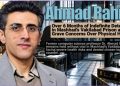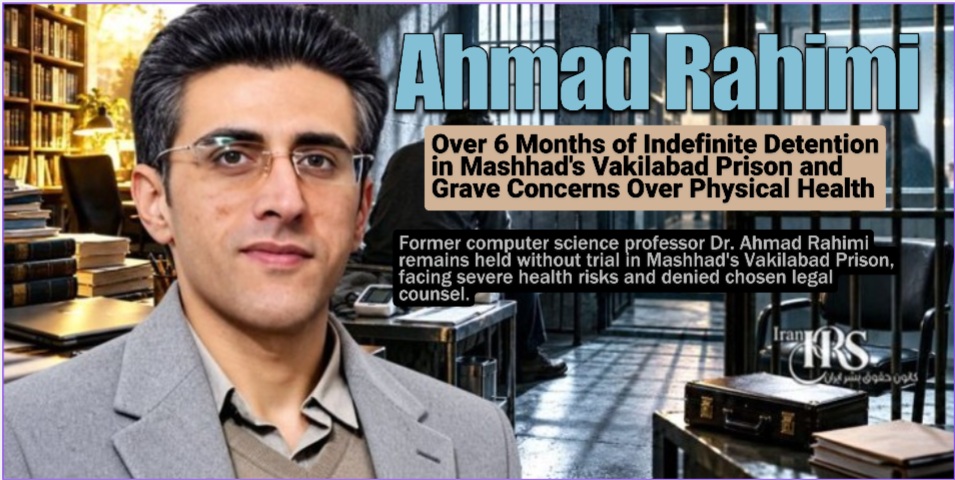
Ahmad Rahimi, a former professor and faculty member at Ferdowsi University of Mashhad, remains in indefinite detention in Vakilabad Prison over six months after his arrest; reports indicate he is denied access to chosen legal counsel and hospital transfer
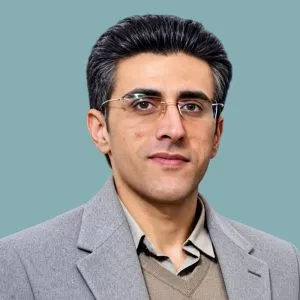
Iran Human Rights Society, Saturday, September 26, 2026– Ahmad Rahmani, a former professor and faculty member at Ferdowsi University of Mashhad, holder of a doctorate in Information Technology, programmer, inventor, and author of several specialized books, remains in Mashhad’s Vakilabad Prison over six months after his arrest. According to received information, following his arrest by the Ministry of Intelligence, he was held for a period in solitary confinement and subsequently kept under the supervision of the IRGC Intelligence Organization. Rahimi’s family has expressed deep concern regarding his physical health, stating that despite multiple pre-existing medical conditions and a physician’s explicit warning regarding the risk of a stroke, authorities are blocking his transfer to an external hospital.
Arrest of Ahmad Rahimi and One Month of Incommunicado Detention
Ahmad Rahimi was arrested on March 17, 2026, by Ministry of Intelligence agents in Mashhad. Based on available information, his wife, Soheila Hosseini, was also arrested on the same day at their joint residence by security forces.
Following his arrest, Ahmad Rahimi’s family had no news of his fate or whereabouts for approximately one month. Subsequently, the university professor’s case was transferred to the IRGC Intelligence Organization, and Rahimi was held in solitary confinement for approximately 30 days.
According to received reports, during this period he was deprived of access to showers and basic hygienic facilities.
Deprivation of Chosen Legal Counsel
One of the primary points of concern in Ahmad Rahimi’s case is the status of his access to legal representation.
Based on available information, the defense attorney chosen by the family was denied permission to enter the case, after which a court-appointed public defender was imposed. No further details have been published regarding the grounds for blocking his chosen attorney or the specific formal charges brought against Rahimi.
Furthermore, despite more than six months having elapsed since his arrest, the judicial standing of his case has not been transparently announced to his family or the public.
Concerns Over Ahmad Rahimi’s Physical Health
Ahmad Rahimi’s deteriorating physical condition has become a primary focus of his family’s concerns.
According to received information, Rahimi suffers from high blood viscosity (polycythemia), hyperlipidemia, osteoporosis, osteomalacia, and asthma. It has also been reported that the prison physician issued a warning regarding the heightened risk of a stroke.
Despite these critical conditions, reports indicate that his transfer to an external hospital has been blocked by order of the prison warden and through intervention by the IRGC Intelligence Organization.
Ahmad Rahimi was eventually returned to Mashhad’s Vakilabad Prison on June 14, 2026, where he continues to be held.
Academic and Professional Background
Prior to his arrest, Rahimi served as a professor and faculty member at Ferdowsi University of Mashhad, specializing in Information Technology.
He holds a PhD in IT, works as a software engineer and web designer, and according to published records, was a member of the National Elites Foundation of Iran.
His professional achievements include registering several patents in robotics, notably designing and building a robot cited as “the country’s first painter robot.”
Rahimi has also authored multiple specialized computer science and programming books, including the textbook “Android Programming.”
Urgent Need for Medical Care and Judicial Clarification
With over six months passed since Ahmad Rahimi’s arrest, clear information regarding formal charges, judicial proceedings, and a timeline for processing his case remains entirely unannounced.
In addition to legal ambiguities, the university professor’s health condition has raised severe alarm. Given his reported illnesses and the doctor’s explicit stroke warning, his family is demanding immediate access to adequate medical care and an independent assessment of his health status.
Information Box | Case Information at a Glance
| Subject | Details |
| Name | Dr. Ahmad Rahimi |
| Background / Profession | PhD in IT, former Ferdowsi University faculty member, software engineer, author, inventor |
| Date of Arrest | March 17, 2026 (Wife Soheila Hosseini arrested same day) |
| Arresting Agency / Custody | Ministry of Intelligence, later transferred to IRGC Intelligence; currently in Vakilabad Prison, Mashhad |
| Duration of Detention | Over 6 months (Indefinite status as of late September 2026) |
| Medical Status | High blood viscosity, hyperlipidemia, osteoporosis, asthma; medical stroke warning ignored |
| Rights Restrictions | Denied chosen legal counsel; denied hospital transfer; 30 days solitary confinement without hygiene facilities |
Legal Review of Ahmad Rahimi’s Case Based on Domestic Laws
The laws enforced in Iran are subject to criticism due to sections that conflict with fair trial standards and restrict defendants’ fundamental rights. Reviewing this case under domestic statutes does not signify endorsement of these regulations, but serves to evaluate whether authorities adhere even to their own statutory requirements.
Legal Ambiguities of the Case
- Article 35 of the Constitution: Explicitly guarantees the right of all parties to select defense counsel in all judicial courts and proceedings.
- Article 37 of the Constitution: Mandates the presumption of innocence until guilt is proven in a competent tribunal.
- Executive Regulations of the Prisons Organization: Obligate authorities to safeguard prisoners’ health, provide necessary medical care, and immediately transfer critically ill detainees to external medical centers upon medical recommendation.
- Procedural Violations: Denying chosen defense counsel, prolonged incommunicado detention, and withholding medical transfer despite physician stroke warnings represent direct violations of statutory mandates under internal law.
Reviewing the Case from the Perspective of Human Rights and International Standards
International human rights standards mandate that state authorities ensure procedural protections, fair trial guarantees, and humane treatment for all detainees.
Human Rights Ambiguities of the Case
The ongoing failure to clarify Rahimi’s legal status, the restriction on his choice of legal representation, and the deliberate denial of life-saving medical care constitute severe breaches of international legal codes governing the treatment of prisoners.
Related International Documents
- Article 9 of the Universal Declaration of Human Rights (UDHR): Prohibits arbitrary arrest, detention, or exile.
- Article 9 of the International Covenant on Civil and Political Rights (ICCPR): Guarantees the right to liberty and security of person, banning arbitrary detention.
- Article 10 of the International Covenant on Civil and Political Rights (ICCPR): Requires that all persons deprived of liberty be treated with humanity and respect for inherent human dignity.
- UN Nelson Mandela Rules (Rules 24, 25, 27): Mandate that healthcare for prisoners is a state responsibility and that detainees requiring specialized medical treatment or surgery must be transferred to specialized institutions or civil hospitals without delay.
Up to the time of drafting this report, no further official information regarding formal charges, judicial scheduling, or approval of medical transfer for this former Ferdowsi University professor has been released.
See also the below articles:
- Forced Confessions and Detention of Dr. Sobhan Esmailpour
- Ward 7 of Evin Prison: Severe Overcrowding, Unsanitary Conditions, and Medical Neglect
Follow Iran Human Rights Society on social networks:
Telegram /Twitter /Instagram / YouTube / Facebook
Join Iran Human Rights Society on Twitter