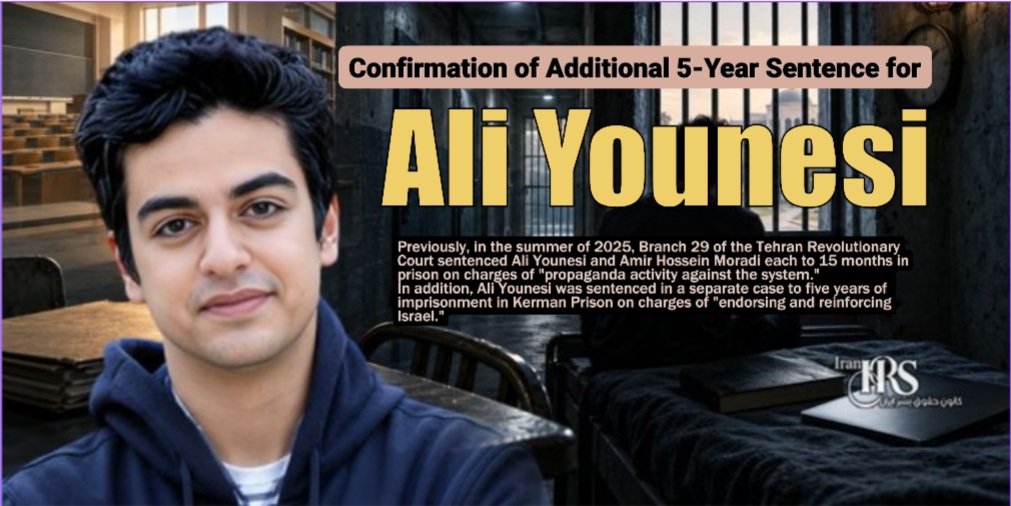
The new five-year prison sentence for Ali Younesi, previously issued by Branch 29 of the Revolutionary Court, has been upheld on appeal; this ruling comes at a time when he and Amir Hossein Moradi were scheduled for release in December 2026 after completing their enforceable sentences
Iran Human Rights Society, Saturday, September 26, 2026– Ali Younesi, an imprisoned student at Sharif University of Technology, will remain in prison following the appellate court’s confirmation of an additional five-year prison sentence. According to published information, the initial ruling by Branch 29 of the Revolutionary Court sentencing Ali Younesi to five additional years of imprisonment was upheld at the appeal stage coinciding with the start of the new academic year. This comes despite the fact that his and Amir Hossein Moradi’s enforceable sentence, following over six years of imprisonment without leave (furlough), was scheduled to end in December 2026. The issuance of these new sentences had previously sparked widespread reactions and human rights reports.
Confirmation of the New Sentence Against Ali Younesi
According to received information, the court of appeal has confirmed the new five-year prison sentence for Ali Younesi, which was originally handed down by Branch 29 of the Revolutionary Court.
Previously, in the summer of 2025, Branch 29 of the Tehran Revolutionary Court sentenced Ali Younesi and Amir Hossein Moradi each to 15 months in prison on charges of “propaganda activity against the system.” In addition, Ali Younesi was sentenced in a separate case to five years of imprisonment in Kerman Prison on charges of “endorsing and reinforcing Israel.” This sentence also included restrictions on his access to cyberspace and telecommunication calls outside the prison environment.
Continued Imprisonment Coinciding with the Start of the Academic Year
The confirmation of this new sentence occurred at a time when Ali Younesi and Amir Hossein Moradi continue to serve their sentences in prison, preventing their return to university as the new academic year begins.
Based on submitted report details, the enforceable sentence for these two students—totaling six years and eight months of imprisonment—was set to conclude in December 2026. However, the new verdicts ensure their continued confinement.
The Iran Human Rights Society previously noted in a report regarding the new sentences against these two students that they have been incarcerated since 2020, and that the new five-year sentence against Ali Younesi pertains to a completely separate legal case.
Background of Arrest and Conviction
Ali Younesi, a computer engineering student at Sharif University of Technology and recipient of Astronomy Olympiad medals, and Amir Hossein Moradi, a physics student at the same university, were arrested in April 2020.
Following their arrest, the two were held for prolonged periods in solitary confinement and closed wards. The Iran Human Rights Society noted in a report marking the fifth year of their detention that Ali Younesi and Amir Hossein Moradi had spent a total of 808 days in solitary confinement and closed security wards.
In 2022, they were each sentenced to 16 years of imprisonment in their initial case—a ruling in which the enforceable portion of imprisonment was subsequently reduced following appeal and subsequent legal procedures.
New Legal Cases During Years of Incarceration
In August 2025, a new legal case was opened against Ali Younesi and Amir Hossein Moradi, resulting in a 15-month prison sentence for each on charges of “propaganda activity against the system.” In addition, Ali Younesi was sentenced to an additional five years of imprisonment.
The Iran Human Rights Society also previously reported that the court session for the new case was conducted without Ali Younesi present in the courtroom.
Continued Deprivation of Higher Education
Now, with the confirmation of the new five-year prison sentence, Ali Younesi will remain in prison, ruling out any possibility of his returning to university for in-person studies. This situation persists despite the approaching end of his previous enforceable sentence, which had raised hopes for his and Amir Hossein Moradi’s release in December 2026.
Full details of the appeal verdict and the court’s judicial reasoning behind upholding the new five-year sentence have not been made available to the public in published reports.
Information Box | Case Information at a Glance
| Subject | Details |
| Name | Ali Younesi |
| Academic Status | Sharif University Computer Engineering student / Astronomy Olympiad medalist |
| Date of Initial Arrest | April 2020 |
| Co-Defendant | Amir Hossein Moradi (Sharif University Physics student) |
| Original Release Date | December 2026 — End of 6-year & 8-month enforceable sentence |
| New Additional Sentence | 5 years imprisonment (Upheld on appeal) + 15 months for “propaganda against the system” |
| Primary Rights Violations | 808 days in solitary/closed wards; trial conducted in absentia; denial of university access |
Legal Review of Ali Younesi’s Case Based on Domestic Laws
The laws applied in such proceedings face widespread criticism due to provisions that infringe upon fair trial standards and prisoners’ basic rights. Reviewing this case under domestic statutes serves to evaluate whether authorities adhere even to internal legal mandates.
Legal Ambiguities of the Case
- Article 35 of the Constitution: Guarantees the right of defendants to retain legal counsel in all courts.
- Article 37 of the Constitution: Establishes the presumption of innocence until proven guilty in a competent court.
- Procedural Violations: Conducting trial sessions in the defendant’s absence and stacking consecutive sentences against political prisoners serving existing terms directly violate fair trial principles codified under domestic procedural law.
Reviewing the Case from the Perspective of Human Rights and International Standards
International human rights frameworks explicitly prohibit arbitrary detention and protect prisoners’ rights to fair trial guarantees and human dignity.
Human Rights Ambiguities of the Case
The continuous issuance of new sentences against student activists nearing the completion of their initial terms, alongside prolonged solitary confinement and trials held in absentia, highlights an ongoing pattern of arbitrary judicial harassment.
Related International Documents
- Article 9 of the Universal Declaration of Human Rights (UDHR): Prohibits arbitrary arrest, detention, or exile.
- Article 9 of the International Covenant on Civil and Political Rights (ICCPR): Guarantees the right to liberty and security of person, banning arbitrary imprisonment.
- Article 10 of the International Covenant on Civil and Political Rights (ICCPR): Mandates that all persons deprived of their liberty be treated with humanity and respect for inherent dignity.
Up to the time of drafting this report, further details regarding the full text of the appellate judgment or judicial justifications behind confirming the additional five-year sentence for this Sharif University student have not been made public.
See also the below articles:
- Death Sentence Issued for Mahbubeh Shabani in Mashhad
- Hamid Ghaeni-Nejad: 1-Billion-Toman Bail Extends Detention of Ill Political Prisoner
Follow Iran Human Rights Society on social networks:
Telegram /Twitter /Instagram / YouTube / Facebook
Join Iran Human Rights Society on Twitter