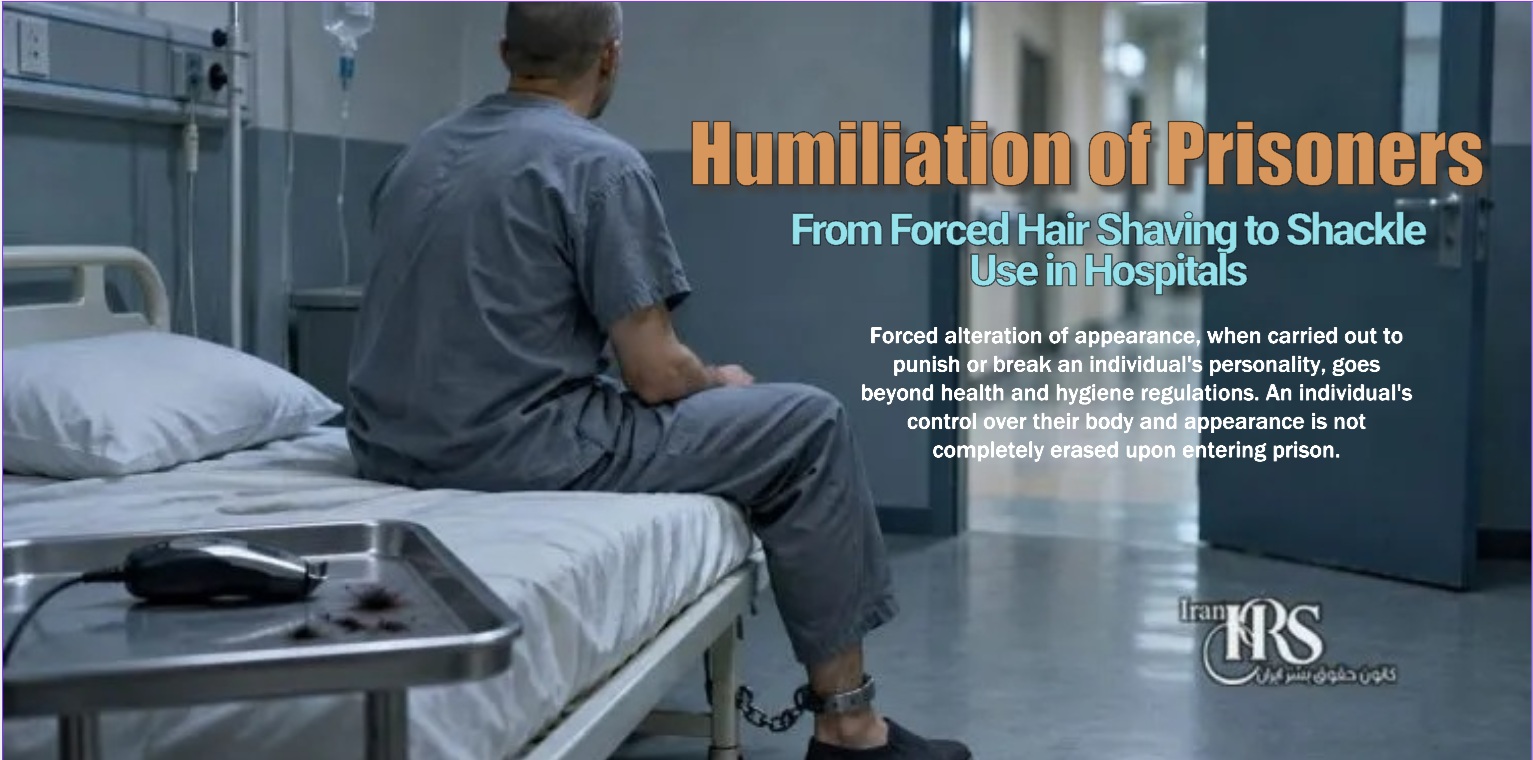
Documented reports from prisons show how forced changes in appearance, mandatory prison uniforms, and restraining patients with handcuffs and shackles target the human dignity and right to medical treatment of prisoners.
Iran Human Rights Society, Monday, November 2, 2026 – Humiliation of prisoners is not limited only to verbal abuse. Forced shaving of head hair and facial hair, public exposure in prison uniforms, chaining patients to hospital beds, and intrusive body searches are among the methods used to subject an individual’s body and identity to the exercise of power. A review of published reports shows that these behaviors are sometimes accompanied by medical deprivation and punishment due to protests; whereas deprivation of liberty is not a authorization to strip away human dignity and honor.
Forced Hair Shaving; Infringement on Personal Identity
Forced alteration of appearance, when carried out to punish or break an individual’s personality, goes beyond health and hygiene regulations. An individual’s control over their body and appearance is not completely erased upon entering prison.

In the report regarding the transfer of Masoud Jamei to solitary confinement in Sheiban Prison in Ahvaz, sources close to the case stated that agents shaved his head hair after transferring him to solitary confinement. These sources cited the objective of this action as humiliating and breaking his morale. Jamei’s transfer was reported after he chanted protest slogans.
This instance highlights the necessity of separating hygiene management from physical and psychological punishment. Citing prison discipline does not negate the requirement for prisoner consent and the prohibition of humiliating treatment.
Documented Precedent in Evin Ward 350
Human rights sources’ reports regarding the April 17, 2014 attack on Evin Ward 350 documented a collection of humiliating behaviors.
According to this report, prisoners transferred to solitary confinement faced forced stripping, shaving of head hair and moustaches, beatings, being dragged on the ground, verbal abuse, blindfolding, and confiscation of blankets and underwear. Furthermore, chaining prisoners to beds in the dispensary was reported.
The significance of these documentations lies in the juxtaposition of physical violence and infringement on individual dignity. Humiliation under such conditions is part of the pressure exerted on the prisoner and must not be reduced to a secondary issue.
Prison Uniforms; From Administrative Requirement to Medical Deprivation
Uniform clothing is not inherently an instance of humiliation under all circumstances; however, using it for stigmatization, public display, or conditioning medical treatment is a different matter. This decision was enforced in circumstances where the prisoner required medical services.
Disputes over attire aimed at humiliating prisoners have turned into an obstacle to treatment. A sick prisoner should not be forced to choose between preserving dignity and accessing a doctor to receive essential services. The responsibility for providing medical treatment rests with the detaining institution.
Handcuffs and Shackles in the Hospital
In the case of Younes Azadbar, an imprisoned labor activist, an audio message published on October 3, 2023, offered a clear account of restraining a patient. He stated that after experiencing a seizure attack and being transferred to Poursina Hospital in Rasht, both of his legs and one hand were tied to the bed, which serves as an example of humiliating prisoners in hospitals.
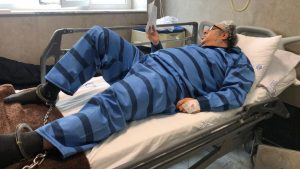
This report highlights the question regarding the actual necessity of restraints: the physical condition of the patient, the nature of the risk, the duration of use, and the possibility of less restrictive methods must be evaluated. Merely being a prisoner is not a sufficient reason to tie a patient to a bed.
The unnecessary use of restraint tools, in addition to harming dignity, can make movement, medical examination, and care difficult.
When Refusal of Humiliation Halts Medical Treatment
Regarding the humiliation of prisoners, a report published on October 1, 2022, concerning the prevention of Kasra Bani-Amerian’s medical dispatch without handcuffs and shackles stated that the continuation of his treatment and physical therapy was halted due to mandatory prison attire and restraint tools.
This prisoner required continuous treatment due to polyneuropathy. According to reports, his opposition to the conditions of transfer led to the suspension of his medical dispatch.
Such a procedure creates double pressure: the prisoner faces illness while simultaneously having to accept imposed transfer conditions to access treatment. Security assessment must be proportionate to the individual’s condition and must not replace medical judgment.
Public Display and Humiliating Searches

The Nelson Mandela Rules set clear criteria to prevent the humiliation of prisoners. Rule 19 rejects humiliating clothing and provides for personal or non-conspicuous clothing during authorized departures from prison. Rule 73 also requires that during transfers, prisoners shall be protected as far as possible from public view, insult, and curiosity.
According to Rules 47 and 48, restraint instruments must not be used as punishment; authorized use must also be necessary, least restrictive, and short-term. Rule 51 prohibits searches intended to harass or intimidate, and Rule 52 restricts strip searches to absolute necessity, private settings, and trained staff. Therefore, punitive stripping or displaying a patient before others conflicts with these standards.
Legal Review Based on Domestic Laws
The laws of the ruling dictatorship in Iran have always been criticized due to restricting human rights; reviewing them does not mean endorsing them, but rather takes place to demonstrate non-compliance with even these very laws. Article 124 of the Prisons Regulations prohibits shaving or excessively trimming head and facial hair beyond standard norms without consent. Article 116 also prohibits the use of handcuffs and shackles inside the institution except in specified dangerous situations, conditioning exceptions on necessity, proportionality, and time limits. This article should not be mistakenly presented as an absolute prohibition of all uses during transfers.
Human Dignity, the Right of All Prisoners
Article 7 of the Covenant on Civil and Political Rights prohibits humiliating treatment and the humiliation of prisoners, and Article 10 emphasizes humane treatment of all persons deprived of their liberty. This protection is not limited to political prisoners, and the nature of the charge does not remove it.
For accountability, the issuer of the order, the executor, the reason for action, the duration of restraint, and its consequences must be recorded. Prisoner complaints must also be reviewed without threat or retaliation. Preserving dignity is not a privilege dependent on a prisoner’s obedience; it is a responsibility that the detaining institution bears at all stages of detention, transfer, and treatment.
See also the below articles:
- Execution of Amirhossein Ebrahimi and Amirhossein Maleki in Isfahan
- Arman Ma’refati Death Sentence Confirmed by Iranian Supreme Court
Follow Iran Human Rights Society on social networks:
Telegram /Twitter /Instagram / YouTube / Facebook
Join Iran Human Rights Society on Twitter