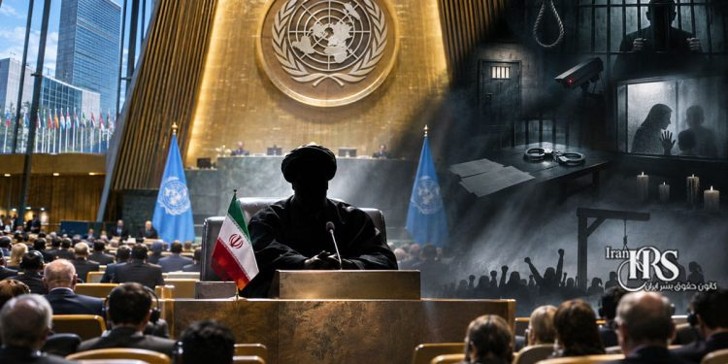
The election of the representative of the ruling dictatorship in Iran with 144 votes for another three-year term to the UN Committee for Program and Coordination, coinciding with growing international criticisms regarding the execution of protesters, torture, unfair trials, and suppression of dissidents, met with strong reactions from Hillel Neuer, Amnesty International, and UN experts.
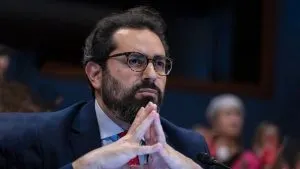
Iran Human Rights Society, Thursday, November 12, 2026 – The election of the representative of the ruling dictatorship in Iran to membership in the United Nations Committee for Program and Coordination has taken place while numerous reports of continued executions, torture, arbitrary arrests, and suppression of protesters and critics are being published. The United Nations General Assembly, on Wednesday, November 11, 2026, in a secret ballot, elected the Iranian regime with 144 votes for another three-year term to membership in this committee. This decision was made under circumstances where Mai Sato, UN Special Rapporteur on the situation of human rights in Iran, and other UN experts had previously called for an immediate halt to executions, and Amnesty International has also criticized the continued implementation of death sentences against protesters.
Election of the Representative of the Ruling Dictatorship in Iran with 144 Votes
The Committee for Programme and Coordination is one of the main organs of the United Nations in the field of planning, long-term programming, and coordination of the organization’s activities. This committee reviews UN programs and program performance and provides recommendations regarding the prioritization of programs and the manner of their implementation.
According to the official United Nations document, the Iranian regime was placed among the candidates for membership for the new term of this committee in 2026.
The final election was conducted in the General Assembly by secret ballot, and the representative of the Iranian regime obtained 144 votes. Due to the secrecy of the vote, it cannot be determined from the election result which states voted for this government. This very issue demonstrates the importance of distinguishing between the nomination stage and the final vote.
Strong Criticism by Hillel Neuer of the Election of the Iranian Regime
Hillel Neuer, Executive Director of UN Watch, condemned the election of the representative of the ruling dictatorship in Iran and deemed it contradictory to this government’s human rights record.
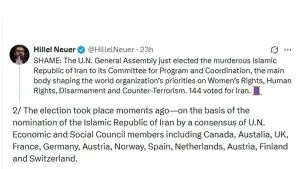
In a sharp reaction, Neuer emphasized that this committee plays a role in determining UN priorities, and issues such as women’s rights, human rights, disarmament, and counter-terrorism are included in the programs reviewed by this organization.
He described the election of the Iranian government to such a position as shameful and warned against the presence of a regime accused of widespread suppression of protesters and violation of citizens’ fundamental rights.
Neuer also criticized the performance of Western countries during the pre-election stage. According to him, on April 8, 2026, the candidacy of the Iranian regime in the UN Economic and Social Council proceeded by consensus, and the United States was the only council member that registered its objection.
Canada: We Voted Against the Representative of the Iranian Regime
Anita Anand, Minister of Foreign Affairs of Canada, announced that her country opposed the membership of the representative of the Iranian regime in the Committee for Programme and Coordination and voted against it in the November 11 ballot.
She emphasized that this committee must consist of countries that uphold the principles of the UN Charter, and criticized the Iranian government for suppressing dissidents domestically and creating instability in the region.
This stance, at the same time, was accompanied by Neuer’s criticism of Canada’s performance during the Iranian regime’s nomination stage in April. UN Watch had asked the Canadian government to officially and publicly announce its opposition at the very nomination stage in the future.
Mai Sato: Immediate Halt to Executions by the Iranian Regime
Criticisms of the human rights situation under the Iranian regime are not limited solely to the issue of membership in the UN committee. Mai Sato, UN Special Rapporteur on the situation of human rights in Iran, prior to the World Day Against the Death Penalty, along with a number of other UN experts, had called for an immediate halt to all executions by the Iranian regime.
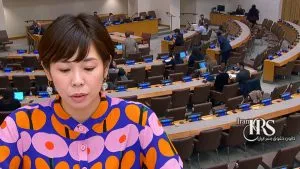
The UN experts stated in an October 9 statement that Iran is among the few countries that still carry out the death penalty and, per capita, is one of the highest-ranking countries in executing this punishment. They warned that cases related to protesters have been accompanied by instances such as torture, enforced disappearance, sexual violence, forced confessions, and deprivation of access to chosen legal counsel.
The statement specifies that none of the individuals arrested in connection with the protests should be executed, and the cases about which UN experts have received information fundamentally cannot serve as a basis for carrying out a death sentence due to serious due process violations.
Mai Sato had also announced that in 2026, at least 600 people and possibly up to a thousand people have been executed in Iran; a statistic that demonstrates more than ever the necessity of establishing a legal moratorium to halt executions and move toward the complete abolition of the death penalty.
UN Experts: Execution Is Used to Silence Protests
In the joint statement of UN experts, the Iranian regime’s use of the death penalty in security cases as a tool to suppress dissent was criticized.
The experts stated that broad charges related to national security can turn peaceful activities into behaviors subject to heavy penalties, and warned that executions do not eliminate protest and discontent, but rather can lay the groundwork for subsequent waves of protest to emerge.
They also called on the Iranian regime to review all death sentences, commute death sentences to other punishments, and establish an official moratorium to halt the execution of death sentences.
Amnesty International: Continued Execution of Protesters Following Unfair Trials
Amnesty International has also repeatedly warned in recent weeks against the continued use of the death penalty against protesters by the Iranian regime.
This organization announced in October that at least 34 people have been executed in connection with the January 2026 protests, and at least 20 others face imminent risk of execution following the confirmation of their death sentences in the Supreme Court.
Amnesty International linked these cases to torture, grossly unfair trials, deprivation of access to a lawyer during the investigation stage, and the use of forced confessions.
Condemnation of Human Rights Violations by Regime Leaders
The entirety of these reports indicates that international criticisms regarding the human rights situation under the Iranian regime are not merely limited to the number of executions. Torture during detention, forced confessions, enforced disappearance, deprivation of chosen legal counsel, unfair trials, and the use of security charges against protesters and critics are among the matters raised in reports by the UN and human rights institutions.
Amnesty International has also spoken in its reports regarding the suppression of protests about the existence of a structure for impunity and called for the establishment of international mechanisms to address serious human rights violations and international crimes under the Iranian regime.
Election of the Regime’s Representative and Questions Regarding the Credibility of UN Mechanisms
The election of the representative of the ruling dictatorship in Iran to the Committee for Programme and Coordination, from the perspective of critics, has raised questions regarding the credibility of international mechanisms and the manner of selecting states for UN bodies.
On one hand, UN experts, Amnesty International, and other human rights institutions speak of increasing executions and violations of trial guarantees under the Iranian regime, and on the other hand, the representative of this same regime has entered one of the important planning and coordination organs of the United Nations with 144 votes for another three-year term.
Nevertheless, the result of this secret ballot cannot be directly attributed to specific states. What can be stated in a documented manner is that the candidacy of the Iranian regime proceeded in the Economic and Social Council stage without collective opposition from members, its representative obtained 144 votes in the final election, and at least Canada has officially announced that it voted against this candidacy.
Under such conditions, continued international condemnations against executions, torture, arbitrary arrests, and violations of fair trial by the ruling dictatorship in Iran have once again highlighted the necessity of accountability regarding the human rights situation and creating effective mechanisms to prevent the continuation of these instances.
See also the below articles:
- Mohammad Javad Vafaei-Sani Receives 2026 Magnitsky Award
- Khavaran; From the Mass Graves of the 1988 Massacre to Wall-Building and the Siege of Seeking Justice
Follow Iran Human Rights Society on social networks:
Telegram /Twitter /Instagram / YouTube / Facebook
Join Iran Human Rights Society on Twitter