
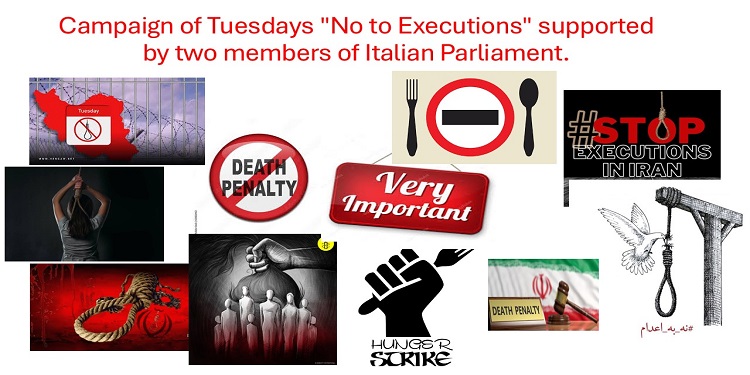
The 31st campaign of “No to Executions Tuesdays” was joined by a group of prisoners from the Greater Tehran Prison and two members of the Italian Parliament.
According to the Iranian Human Rights Society, on Tuesday, August 27, 2024, prisoners in 19 prisons announced a hunger strike for this week’s Tuesday, and the Greater Tehran Prison has also joined the group of prisons participating in the “No to Executions Tuesdays” campaign.
The 31st campaign of “Tuesdays Against Executions” has gained momentum as prisoners from Tehran’s Great Prison and prominent Italian parliamentarians unite to oppose capital punishment in Iran, highlighting human rights violations and systemic failures of the government.
A significant rise in executions, with at least 126 individuals executed in one month, demonstrates the urgent need for international awareness and support. Despite severe repression from authorities, the campaign continues to thrive as more prisoners join in solidarity against state brutality and the death penalty.
Summary of the “Tuesdays Against Executions” Campaign
The “Tuesdays Against Executions” campaign continues to gain traction, with prisoners from 19 different Iranian prisons, including Tehran’s Great Prison, declaring a hunger strike. This movement has received support from prominent Italian parliamentarians, highlighting the international awareness of the human rights violations occurring in Iran.
Key points:
Hunger Strike Announcement: On September 6, 2023, prisoners in 19 prisons announced a hunger strike as part of the ongoing campaign against executions.
Recent Executions: In August 2024 alone, at least 126 individuals were executed, raising alarms about the systematic failures of the Iranian government.
Repression of Dissent: The Iranian authorities have intensified their crackdown on dissent, punishing prisoners who participate in the campaign by denying them basic rights, such as phone calls and visits.
Solidarity Among Prisoners: Despite the oppressive environment, prisoners continue to resist and stand in solidarity against the death penalty and torture.
International Support: The campaign has garnered attention and support from global figures, including Italian lawmakers, who have publicly backed the movement.
Call to Action:
The campaign urges both domestic and international communities to support their efforts to abolish executions and torture in Iran, emphasizing the need for collective action against state brutality.
This ongoing struggle reflects the resilience of those fighting for human rights in the face of severe repression.Prisoners in 19 different Iranian prisons, including Tehran’s Great Prison, have declared a hunger strike as part of the “Tuesdays Against Executions” campaign.
The campaign has garnered international support, particularly from some Italian parliamentarians advocating against capital punishment.
At least 126 executions have been reported in Iran within just one month, underscoring the urgent human rights crisis in the country.
The Iranian government continues to systematically oppress dissenters, particularly targeting those who express opposition to executions.
Women prisoners have faced punitive measures, including the denial of phone calls and visitation rights, as well as harsh treatment like solitary confinement.
The new Iranian cabinet, viewed as a continuation of repression, has particularly concerning backgrounds that may lead to increased state violence against citizens.
Activists are calling on both domestic and international communities to support the campaign aimed at abolishing executions and torture in Iran.
How do hunger strikes impact political activism within authoritarian governments?
Hunger strikes can have significant impacts on political activism within authoritarian governments, serving as a powerful form of protest. Here are some key effects:
Raising Awareness: Hunger strikes draw public attention to specific issues, often highlighting human rights abuses, political repression, or social injustices. This can mobilize both domestic and international support.

Moral High Ground: Strikers often gain moral authority, as their willingness to suffer for their cause can resonate with the public and garner sympathy. This can lead to increased pressure on the governments.
Solidarity and Unity: Hunger strikes can unite various groups within the opposition, fostering solidarity among activists, political prisoners, and the general populace. This collective action can strengthen movements against authoritarianism.
Government Response: Authoritarian governments may respond to hunger strikes with repression, including increased surveillance, arrests, or violence against protesters. However, they may also be compelled to negotiate or make concessions to avoid negative publicity.
International Pressure: Global awareness of hunger strikes can lead to international condemnation of the regime, potentially resulting in sanctions, diplomatic pressure, or calls for intervention from foreign governments and organizations.
Psychological Impact:
The act of fasting can have a profound psychological effect on both the strikers and their supporters, reinforcing commitment to the cause and inspiring others to take action.
Media Coverage: Hunger strikes often attract media attention, which can amplify the message of the activists and bring their struggles to a wider audience, influencing public opinion and policy.
In summary, hunger strikes can be a potent tool for political activism in authoritarian contexts, capable of mobilizing support, raising awareness, and challenging oppressive governments, though they also carry significant risks for those involved.
Follow Iran Human Rights society on social networks:
Telegram / Twitter / Instagram / YouTube / Facebook
Follow the Iranian Human Rights Society on social networks:
Join Iran Human Rights Society on Twitter





Discussion about this post