
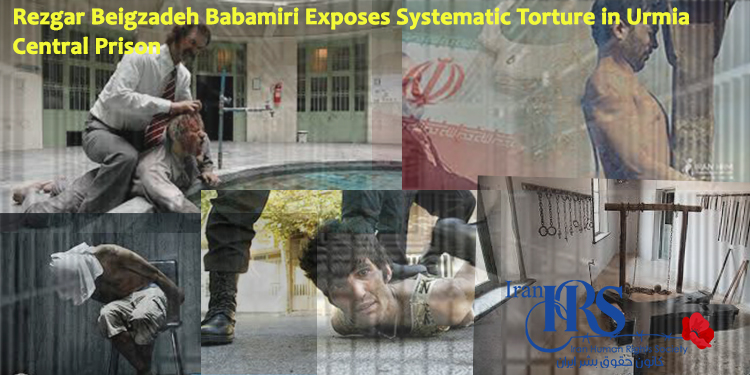
Iran Human Rights Society – Thursday, April 24, 2025. Rezgar Beigzadeh Babamiri, a political prisoner currently held in Urmia Central Prison.
Rezgar Beigzadeh Babamir has published a detailed letter exposing the severe physical and psychological torture he endured during his 130-day detention by Iran’s Intelligence Ministry in Bukan and Urmia.
Impunity for Torturers and Silence of Iran’s Judiciary
Judicial authorities, particularly at the Revolutionary Court of Urmia, have not only ignored the evidence and testimony presented by Rezgar Beigzadeh Babamiri regarding his torture, but have effectively legitimized these inhumane acts. In a telling example, the presiding judge, Reza Najafzadeh, dismissed his complaint by scoffing, “What did you expect, a kebab?” a statement that symbolizes a judiciary stripped of independence and justice, serving instead as a tool to justify state repression.
Torture as a Tool of State Terror
Beigzadeh’s account is not just a personal ordeal—it reflects a deliberate state policy to instill fear, suppress dissent, and exert control through psychological terror and physical abuse. Torture systematically employed to crush popular resistance, with no mechanisms in place for accountability or oversight.
A Call to the International Community
In the final section of his letter, Rezgar Beigzadeh appeals to global public opinion and human rights organizations, condemning the world’s silence in the face of institutionalized torture in Iran. He urges immediate international action to end the cycle of brutality, lift judicial immunity for torturers, and pursue independent legal proceedings against those responsible.
Despite clear evidence and his formal complaints, judicial authorities—especially the Revolutionary Court of Urmia—have failed to respond. Instead, they have normalized and endorsed such inhumane practices. One judge reportedly dismissed his claims with the degrading remark: “What did you expect, a kebab?”
Beigzadeh’s letter documents his abduction on April 17, 2023, and his torture through beatings, death threats, mock executions, electric shocks, and sleep deprivation. His testimony sheds light on the ongoing, systematic use of torture in Iran’s detention centers.
Rezgar Beigzadeh Babamiri’s Letter from Urmia Prison
Below the full text of the letter written by Rezgar Beigzadeh Babamiri, who imprisoned in Urmia.
I am trying, through this letter that recounts my 130 days in detention, to bring my voice to the civilized world. Under constant surveillance by informants and prison monitoring systems, I live with ongoing tension and pressure, making it difficult to focus on writing.

On April 17, 2023, I received a phone call from someone identifying himself as “Saeedi,” an agent of the Intelligence Department of Bukan. At 5 p.m., he summoned me to a location near Roj Hall on the outskirts of Bukan. When I arrived, I abducted by Saeedi and another man—later revealed to be my interrogator, known as “Ghorbani”—and taken to the Intelligence Office of Bukan.
I held in a room until about 10 p.m., when a team of six interrogators began subjecting me to brutal torture and beatings. The team included Saeedi, Ghorbani, the local Intelligence chief “Hojjati,” and three unknown agents working in shifts.
They constantly threaten to kill prisoner
Throughout the beatings, they constantly threatened to kill me and hurled insults and humiliation. They repeatedly told me I was in a place where, according to them, dozens of “rioters” tortured to death. They warned I’d meet the same fate, and that my corpse would end up in Bukan Dam, a sewage canal, or a mass grave.
Their goal was clear: to make me believe I had reached the end, that my torturers were completely immune from prosecution. And that my death would carry no consequences. Their brutality made it obvious they feared no accountability. Over three nights, I lost consciousness dozens of times under beatings and electric shocks.
After roughly 72 hours of continuous torture, I transferred—alongside several other detainees—by a convoy of armed plainclothes officers in a special prisoner transport van to the Intelligence Department detention center in Urmia.
Different type of tortures
There, I was subjected to what they described as “professional, specialized, and well-planned” torture. Some of the techniques used during interrogations included:
Simulated Drowning (Waterboarding): I was bound, blindfolded, and laid on my back in what seemed to be a bathroom, with a bag over my head. And also and water poured over my face to induce the terror of drowning.
Mock Hanging: Blindfolded and gagged. I was taken to an unknown room late at night and forced to stand for hours on a stool with a rope around my neck. They threatened to secretly execute me.
Mock Execution by Firing Squad: With bound limbs and eyes, they taunted me while pretending to fire guns, saying I wasn’t officially registered and that my corpse would be discarded in a sewer or mass grave.
Electric Shocks: Tied to a chair, I was insulted and degraded while electric shocks applied to sensitive areas. Ears, genitals, nipples, spine, ribs, underarms, thighs, and temples—to force confessions.
Sleep Deprivation: For several consecutive nights, they ensured I could not sleep through constant noise, yelling, cell intrusions. And beatings, trying to mentally break me and make me comply with their scripted statements.
All this while my only “crime” was helping others.
From April 17 to August 23, 2023, this inhumane treatment continued. Despite ongoing threats, once transferred to Urmia Central Prison, I tried to legally pursue complaints about the torture and misconduct by interrogators and the prosecutor in case no. 140235920000915742.
After months of stalling, I managed to file a complaint. Case no. 140335920002257834 opened in Urmia’s judiciary and later transferred to the military court of West Azerbaijan Province. But the military court’s prosecutor closed the case, citing the one-year statute of limitations. And refused to refer me to a forensic doctor—effectively shielding the torturers from justice.
It’s clear: torture is a crime against humanity committed in secrecy. The only evidence victims often have is the damage to their bodies. Denying access to independent medical exams is a way to protect the torturers and obstruct justice.
If torture is not systematic, why do courts ignore victims’ complaints? How can an intelligence agency summon a torture victim from prison and threaten execution for filing a complaint, with no accountability?
Why should helping others carry such punishment?
At the Revolutionary Court of Urmia, Judge Reza Najafzadeh responded to torture claims—detailed in submissions from 14 defendants—by casually remarking, “Did you expect kebabs instead?” There is no independence in these courts. Torturers enjoy full immunity, while victims punished further.
The goal of the security forces is not public safety, but serving upper-level officials, enforcing sectarian and ethnic prejudices, and expanding their own power. Torture and fabricated cases are common tools of repression.
I ask the public, NGOs, international institutions, human rights organizations, free media, and all free people: do not stay silent.
During my 130 days of continuous detention and torture, I suffered widespread bruising. My left ear deafened by repeated head blows, and though hearing slowly returned, I suffered frequent severe infections. Scars from the beatings are still visible on my legs. A medical specialist can confirm long-term hearing damage—but my complaints ignored. Judge Najafzadeh’s only response was, “Did you expect kebabs?”
Apparently, in this system, torture is a “normal” punishment for helping fellow human beings.
Unchecked power, sectarian prejudice, personal grudges, material greed, career ambitions—all turn a law enforcer into a brutal violator of rights. The regime uses this violence to maintain fear and control.
The civilized world and freedom-loving people must not remain silent in the face of such organized brutality. Human rights bodies and institutions like the International Criminal Court must not sit idle while human dignity continues to be trampled.
End
Date: April 9, 2025
Urmia Central Prison – Admission Ward 2
Rezgar Beigzadeh Babamiri
Follow Iran Human Rights society on social networks:
Telegram /Twitter /Instagram / YouTube / Facebook
Join Iran Human Rights Society on Twitter







Discussion about this post