

Independence of the Bar Association; Body Searches of Lawyers in Judicial Courts. A Compromise of Legal Defense or Lawyers in Submission?
In recent years, numerous reports from lawyers’ professional associations have revealed that. In certain judicial complexes across Iran, defense attorneys subjected to physical searches upon entering court premises and prohibited from carrying mobile phones. This practice has sparked widespread criticism within the legal community and bar associations. Also prompting campaigns demanding an end to such treatment.
This raises important questions: Are such actions legally and ethically justified? Do they respect the dignity of lawyers and uphold the independence of the Bar Association?
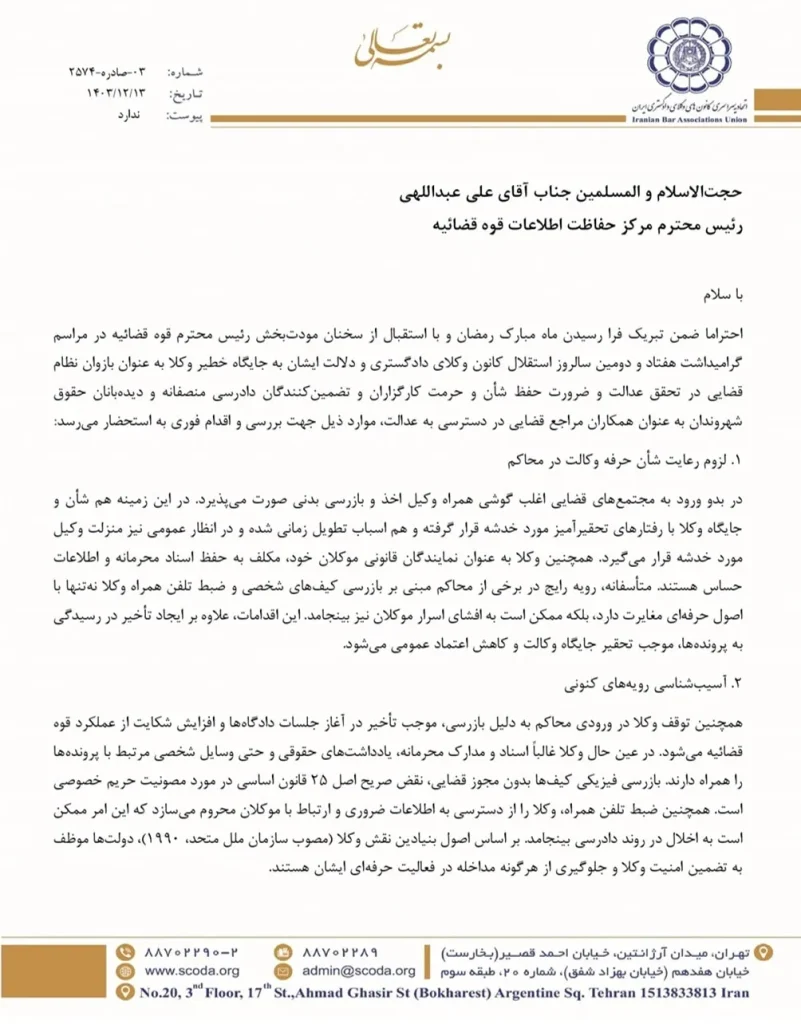
In response to this degrading and legally questionable practice, lawyers, presidents of bar associations, and current and former officials of the Iranian Bar Associations Union (SCODA) have issued multiple open letters of protest.
The Dignity of the Legal Profession
According to the 1991 resolution passed by Iran’s Expediency Discernment Council—an institution that rarely upholds rights for individuals or professions—it stated: “In the course of their defense, they shall enjoy the same protections as those afforded to judges.”
This phrase not only underscores the professional immunity of lawyers but also affirms their institutional role in the legal system. A defense attorney is not merely a court visitor; they are a pillar of fair trial proceedings.
Therefore, practices such as physical searches and the confiscation of personal belongings effectively undermine the independence of the legal profession and degrade the stature of lawyers.
A Contradiction to Fair Trial Principles
The right to a fair trial is a cornerstone of human rights. Subjecting lawyers to physical searches or confiscating their personal items, especially mobile phones, which may contain confidential client information, poses serious conflicts with these principles:
– It endangers client data security,
– It erodes public trust in the judicial process,
– It compromises the independence and neutrality of lawyers.
Discrimination in Judicial Practices: Court-Appointed Experts vs. Independent Lawyers
A key criticism concerns the stark contrast in how official judicial experts (affiliated with the judiciary) treated compared to independent defense lawyers. According to official notices, experts allowed to enter courtrooms without body searches or mobile phone restrictions, whereas lawyers are deprived of such rights.
This clear discrimination not only violates Clause 9 of Article 3 of Iran’s Constitution—regarding the elimination of unjust discrimination—but also highlights an inconsistent approach to legal professionals, which may demotivate practicing attorneys and undermine their role in upholding justice.
A History of Disrespect and Protest
In response to these humiliating and legally questionable practices, numerous lawyers, presidents of bar associations, and both current and former officials of the Iranian Bar Associations Union (SCODA) have issued multiple open letters and public statements of protest. These actions reflect a deep and ongoing concern within the legal community regarding the erosion of professional dignity and the violation of basic legal norms.
A Longstanding Pattern of Disrespect and Protest
Disrespectful treatment of lawyers is not a new phenomenon. In 2011, Seyed Mohammad Jandaghi Kermanipour, then head of the Central Bar Association, wrote a letter to the head of Tehran’s judiciary, demanding an end to the “harassment and insults toward lawyers.”
In another letter addressed to the Chief Justice of Tehran Province, it stated:
“Recently, judicial staff stationed at court complexes have imposed restrictions, including the confiscation of mobile phones and the inspection of lawyers’ personal bags. These measures have caused dissatisfaction and humiliation among the legal community, violating the dignity and status of the legal profession. No justification for such actions has been reported to date.”
Khalil Bahramian also criticized the judiciary’s treatment of lawyers, saying:
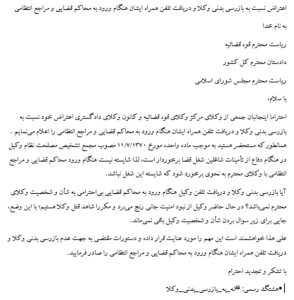
“Frankly, lawyers not seen as important by the judiciary. They make lofty statements and say ‘respected lawyers,’ but behind the scenes, the behavior is ugly and degrading. Most judges see lawyers as an annoyance. From the very beginning, the legal community sensed that the Bar Association never fully accepted. Authorities tolerated it only to a certain extent, but that tolerance is now gone. The current level of harsh treatment is unprecedented. The law may say a lawyer’s dignity equals that of a judge. But that’s more of a joke than a reality.”
A Look at the Execution Statistics in Iran – April 2025 – Iran HRS
Female prisoners are controlled by injecting ampoules in Zahedan – Iran HRS
Questioning the Underlying Intentions
This raises an important question: What are the hidden motivations behind such directives? Are those who issue these orders truly familiar with the principles of criminal procedure, human rights, and legal hierarchy? Do they realize that lawyers and judges are two essential pillars of justice? And if so, isn’t the issuance of such restrictive policies against lawyers itself a criminal act?
Clearly, such regulations are designed to undermine the professional independence of lawyers, violate civil rights, and silence attorneys who dare to defend their clients. This enables the authorities—particularly the judiciary—to proceed more freely with the suppression of detainees and the issuing of death sentences.
The current practice of bodily searches and personal inspections of lawyers in court is a deliberate attack on the institution of lawyering. And its independence—an institution that has taken over 70 years to establish and protect.
Follow Iran Human Rights society on social networks:
Telegram /Twitter /Instagram / YouTube / Facebook
Join Iran Human Rights Society on Twitter








Discussion about this post