
Alongside street protests, voices of dissent also rose from within prisons. Female prisoners in the women’s ward of Evin Prison chanted slogans such as “No repression, no execution, no threats; they no longer work” and “This is the final message: execute, and there will be an uprising,” expressing solidarity with the campaign.
Iran Human Rights Society, Tuesday, June 3, 2025 – In the seventy-first week of the nationwide “Tuesdays Against Execution” campaign, protesters in 22 Iranian cities once again demanded an end to the use of execution as a tool of repression. This campaign, which has become a symbol of resistance against dictatorship and the culture of death in the ruling regime, was held this week with broader participation and a stronger presence across various cities.
Protests in 22 Cities: From Tehran to Beyond
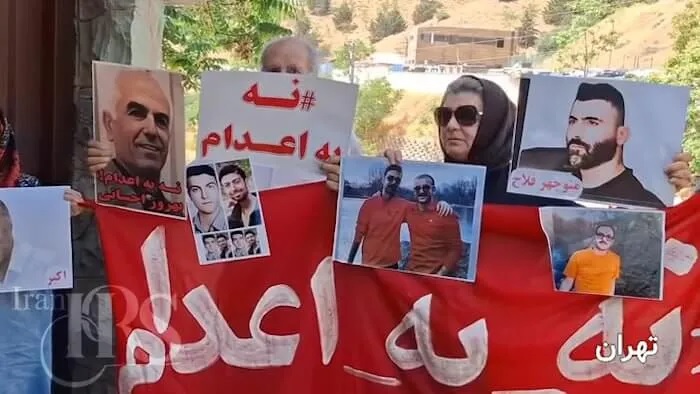
On Tuesday, June 3, 2025, protesters took to the streets in Tehran, Ahvaz, Bandar Abbas, Rasht, Shiraz, Izeh, Anzali, Isfahan, Ramsar, Dezful, Tabriz, Bushehr, Zanjan, Shabestar, Shahroud, Sari, Kermanshah, Kerman, Mahabad, Lahijan, Gorgan, and Kangavar. Holding placards with images of prisoners sentenced to death and chanting slogans like “Do not execute,” “Free political prisoners,” “Immediately abolish the death penalty,” and “This is the final message: execute, and there will be an uprising,” they expressed outrage at the rising number of death sentences.
In many cities, protests took place in public spaces, main streets, and squares. Participants, with faces uncovered or masked, boldly stood against the relentless cycle that sends dozens to execution squads each week.
Growing Resistance Against the Execution Machine
Launched over 16 months ago, the “Tuesdays Against Execution” campaign has gradually become one of the most significant movements against executions in Iran. It is not merely symbolic but a genuine effort to deter the ruling dictatorship from using death and fear as tools to maintain power.
Reports from some cities indicate that security forces have attempted to prevent participation by threatening families. Pressure has also been applied to protesters and students to deter their involvement, yet the movement grows broader each week. In Tehran, Ahvaz, Tabriz, and Rasht, protesters distributed leaflets and, in some cases, chanted slogans collectively despite the presence of security forces.
The Execution Machine Continues Unabated
As the campaign expands, the wave of executions in Iran persists with alarming intensity. According to human rights reports, over 20 prisoners were executed in the past week alone in prisons such as Ghezel Hesar, Dastgerd in Isfahan, and Dieselabad in Kermanshah. Many were sentenced to death without fair trials, deprived of independent legal counsel, and subjected to severe torture to extract confessions.
This surge in executions occurs amid growing domestic and international outcry over widespread human rights violations in Iran’s prisons and courts. The instrumental use of executions to suppress protests, intimidate society, and eliminate political opponents is a hallmark of the ruling dictatorship’s repression.
The Need to Amplify the “Tuesdays Against Execution” Campaign
The “Tuesdays Against Execution” campaign has reached a stage where it requires greater support from the global community, human rights organizations, Iranians abroad, and all domestic activists. The increasing number of participating cities, solidarity from prisoners, and the consistent presence of families of political prisoners demonstrate the campaign’s potential to evolve into a national movement against the death penalty.
As the regime attempts to silence protesters through threats and repression, widespread support for this movement could serve as a deterrent to mass and unlawful executions. The persistent use of the death penalty, without regard for basic human rights standards, starkly violates the principles of the International Covenant on Civil and Political Rights (ICCPR), a key global human rights document.
Violations of ICCPR Principles
Article 6 – Right to Life: This article recognizes the right to life as a fundamental right. Executions in Iran, conducted without fair trial standards and often based on confessions obtained through torture, clearly violate this article.
Article 7 – Prohibition of Torture and Inhumane Treatment: No individual should be subjected to torture or cruel, inhuman, or degrading treatment. Threats against families to prevent their participation in protests and coerced confessions from prisoners are clear violations of this article.
Article 9 – Right to Liberty and Security: Arbitrary arrests without clear judicial warrants, lack of notification to families, and prolonged solitary confinement are ongoing violations of this article.
Article 14 – Right to a Fair Trial: Security trials in revolutionary courts, denial of independent legal counsel, closed-door hearings, and lack of effective defense opportunities blatantly violate the right to a fair trial.
The Future of the Campaign
The Future of the Campaign
The future of the “Tuesdays Against Execution” campaign depends on sustained street presence, increased awareness, and broader solidarity. It is no longer a simple movement; it is a resounding voice against the machinery of death, growing louder each week.
Follow Iran Human Rights Society on social networks:
Telegram /Twitter /Instagram / YouTube / Facebook
Join Iran Human Rights Society on Twitter






Discussion about this post