

Table of Contents
Women’s Discourse During the Pahlavi Era
Women Writers and Cultural Activists in the Pahlavi Era
Iranian Literature During the Pahlavi Era
Evolution of Women Writers’ Works
Women Writers: New Experiences, New Issues
Pen in Chains; Women Writers: Standing Against Oppression and Decay – 100 Years of Writing in Iran Under the Shadow of Tyranny
Women’s Discourse During the Pahlavi Era
Before the 1979 Revolution, the policies of the monarchical regime, particularly based on Mohammad Reza Shah Pahlavi’s rhetoric about women, emphasized the “modernity” and “sociability” of middle- and upper-class women. This discourse, promoted through publications like Zan-e Rooz (aligned with the official Pahlavi narrative), focused on beauty and adherence to Western fashion trends. This pseudo-modernist project, despite emphasizing male superiority (father, husband, son), was in stark contrast to egalitarian legal-political discourses, Marxist ideologies, and progressive religious identities (distinct from traditional or reactionary tendencies).
During this period, organizations such as the Women’s Association, established in 1942 to improve women’s legal status, published Zan-e Emrooz from 1944 to 1945. Safieh Pirouz founded the Iranian Women’s Council in 1943 to promote gender equality and enhance women’s intellectual development. Additionally, the Women’s Organization, a branch of the Tudeh Party, was formed in 1943 and published Bidari.
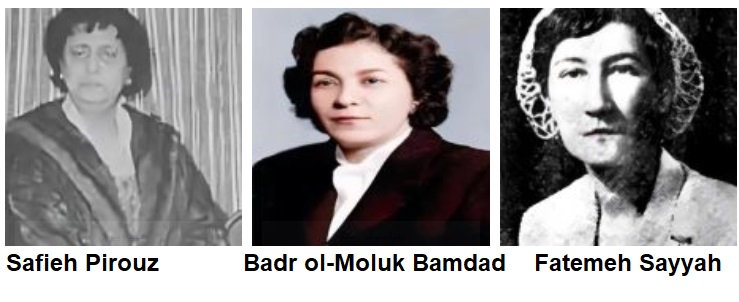
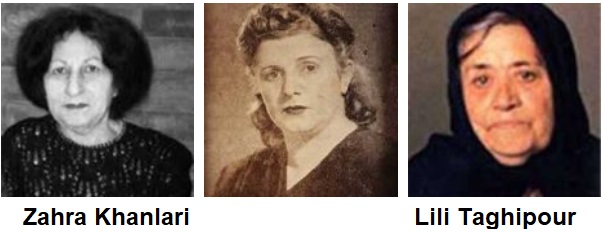
Other notable publications from this era include Zanan-e Pishro (by Sedigheh Ganjei), Azadi-ye Zanan, and Zanan-e Mobarez (1950). In 1952, Badr ol-Moluk Bamdad established the Iranian Women’s Society, which published Zanan-e Iran, edited by Fatemeh Sayyah and with contributions from figures like Zahra Khanlari, Forough Hekmat, and Simin Daneshvar.
However, women’s political activities were largely prohibited during this period, often resulting in severe consequences such as imprisonment and torture. Until the years approaching the 1979 Revolution, organized women’s groups were not highly visible, except in clandestine organizations like the People’s Fedayeen Guerrillas and the Mojahedin-e Khalq, which included active female cadres. Groups such as the Women’s Awakening Society, the Society of Militant Women, and the Democratic Women’s Society emerged on the eve of the revolution.
Women Writers and Cultural Activists in the Pahlavi Era
Despite restrictions, women active in culture, literature, and writing played significant roles during this period. Below are some key figures:
Badr ol-Moluk Bamdad (1898–1987): Journalist, teacher, writer, and social activist. She was a member of the Women’s Society, a founder of the Women’s Human Rights Organization, and the publisher of Zan-e Rooz.
Fatemeh Sayyah (1902–1948): Literature professor and a founder of the Women’s Society at the Ministry of Culture. She was the first female professor at the University of Tehran, establishing the chair of literary criticism and advocating for women’s rights.
Sorour Mahkameh Mohasses Lahijani (1912–1977): Poet, calligrapher, and women’s rights activist. She won first place in the Ferdowsi Millennium literary competition in 1934 and was among the first women to join the presidium of the Writers’ Congress in 1946. Over 5,000 of her poems survive.
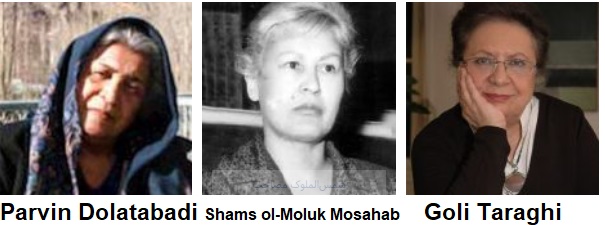
Shams ol-Moluk Mosahab (1913–1997): Poet, writer, and one of the first female senators in the Iranian Senate. She was an advocate for women’s voting rights and among the first Iranian women to attend university.
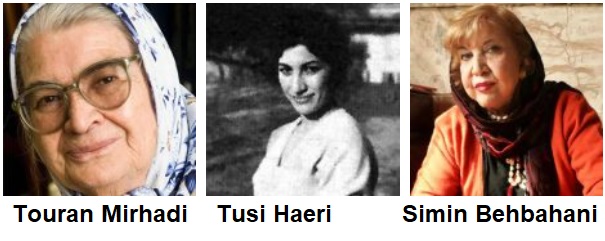
Tusi Haeri (1917–1993): Writer, translator, and the first female broadcaster on Iran’s National Radio. With a doctorate in French from the Sorbonne, her translations appeared in Ettelaat-e Haftegi and Ketab-e Hafteh from 1941. She co-published Ashna magazine with Ahmad Shamlou in 1958.
Lili Taghipour (1920–2001): Painter and illustrator, the first female graduate of the Faculty of Fine Arts (1941) and the first children’s book illustrator in Iran.
Simin Daneshvar (1921–2012): Writer and translator, the first Iranian woman to write fiction professionally. Her novel Savushun (1969) has been translated into 17 languages and is one of Iran’s best-selling works of fiction. She was a member and president of the first Writers’ Association of Iran alongside Jalal Al-e Ahmad.
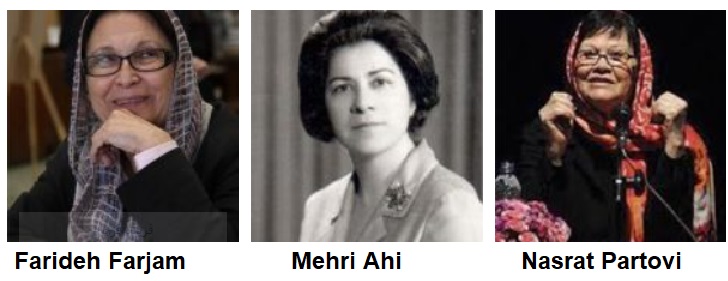
Mehri Ahi (1922–1987): Translator of Russian literature with a doctorate in Russian language and literature. Her notable translations include Dostoevsky’s Crime and Punishment.
Parvin Dolatabadi (1924–2008): Poet and co-founder of the Children’s Book Council.
Touran Mirhadi (1927–2016): Children’s literature professor, writer, and co-founder of the Children’s Book Council and the Children’s and Young Adults’ Encyclopedia.
Simin Behbahani (1927–2014): Contemporary poet and ghazal writer, member of the Writers’ Association of Iran. Her first poetry collection, Setar-e Shekasteh (1951), earned her the title “Nima of Ghazal” for her innovations in Persian ghazal.
Forough Farrokhzad (1934–1967): Pioneering modernist poet. Her collections Another Birth and Let Us Believe in the Beginning of the Cold Season cemented her place in contemporary poetry. Her documentary The House is Black (1962) is a landmark work.
Farideh Farjam (1934): Theater director, playwright, and children’s literature writer. She was the first Iranian female playwright and a co-founder of the Writers’ Association of Iran.
Nasrat Partovi (1937): Theater actress and playwright, the first female dramatist in Iran.
Goli Taraghi (1939): Writer known for her short story collection I Am Che Guevara Too (1969) and the novel Winter Sleep (1975).
Leili Golestan (1944): Translator and gallerist, known for translating Life, War, and Nothing Else by Oriana Fallaci.
Homa Sarshar (1946): Writer and journalist, contributing to Zan-e Rooz and later Kayhan from 1964.
Iranian Literature During the Pahlavi Era
Scholars note that in the 1950s, despite intellectual and theoretical efforts, most novels lacked literary creativity. Following the 1953 coup, a stifling social atmosphere overshadowed writers. Cultural hubs disintegrated, and earlier optimism gave way to disillusionment. A return to allegorical, mythological, and nihilistic stories, influenced by Western nihilistic culture, characterized this period’s literature. American literature had a dominant influence, and many writers turned to translation due to censorship.
From the late 1950s, with a relative easing of social crises, Iranian fiction entered a period of flourishing. In the 1960s, writers focused on lesser-known regions of Iran, creating new literary material. In the 1970s, a bold and inquisitive generation emerged, with writers committed to addressing social, political, and cultural contradictions. The Writers’ Association of Iran, founded in 1968 with figures like Simin Daneshvar and Jalal Al-e Ahmad, saw left-leaning writers fight against censorship and restrictions.
However, severe censorship in the 1970s, particularly after government raids on libraries in 1972, banned many writers. Nevertheless, this decade can be called the “decade of protest.” Works like Gholamhossein Saedi’s short stories, depicting social poverty and misery, and Simin Daneshvar’s Savushun, with its hopeful ending, symbolized resistance and hope.
Evolution of Women Writers’ Works
Notably, the works of women writers during this period showed a clear evolution. Early stories like The Unfortunate Girl and The Fickle Youth (by Irandokht Teimurtash, 1931), Zhaleh or the Leader of Maidens (by Zahra Khanlari, 1936), Extinguished Fire (by Simin Daneshvar, 1948), and The Pearl Pin (by Mahin Tollai, 1959) often focused on victimized women and culpable men. However, from the 1960s, women’s works addressed themes of gender equality and freedom.
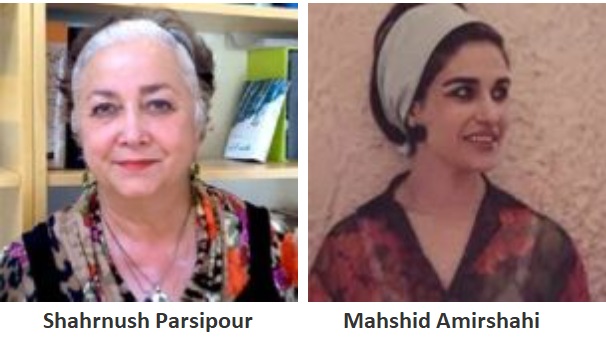
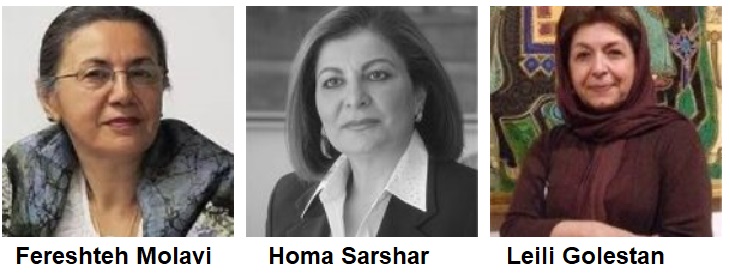
Mahshid Amirshahi, with stories like Sar Bi Bi Khanum and After the Last Day, portrayed proactive and militant women. Shahrnush Parsipour, with The Dog and the Long Winter (1974), Crystal Pendants (1977), and Free Experiences (1978), and Goli Taraghi, with Winter Sleep (1973), tackled new questions facing Iranian women. These questions later evolved into themes of identity and self-belief in the works of writers like Ghazaleh Alizadeh, Fereshteh Molavi, and Moniro Ravanipour.
Women Writers: New Experiences, New Issues
Women writers during the Pahlavi era not only resisted censorship and discrimination but also reflected women’s and societal issues through enduring literary works. These efforts laid the groundwork for subsequent transformations in Iranian women’s literature.
With the victory of the anti-monarchical revolution of 1979, a spring breeze began to blow over the women of the homeland and their literary and artistic works, promising a flourishing garden of their experiences and achievements. However, Khomeini and misogynistic, regressive forces, by usurping the people’s right to self-determination, imposed a dark and cold autumn and winter on our homeland.
In future issues, we will continue to explore the evolution of writing and writers in Iran.
Follow Iran Human Rights Society on social networks:
Telegram /Twitter /Instagram / YouTube / Facebook
Join Iran Human Rights Society on Twitter




Discussion about this post