
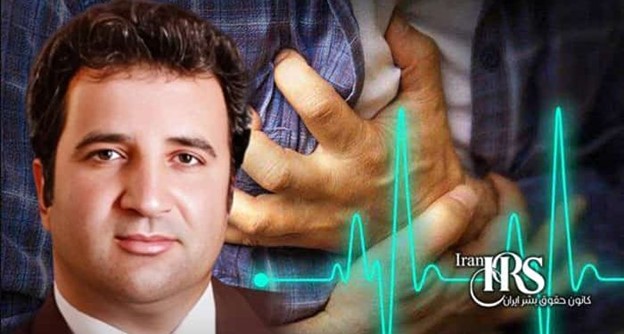
Mohammad Najafi, a lawyer and political prisoner, is grappling with multiple serious health issues, including severe diabetes, heart disease, and a herniated disc, while Evin Prison authorities, by preventing his transfer to a hospital, have effectively put his life at risk.
Iran Human Rights Society, June 6, 2025 – Mohammad Najafi, a lawyer and human rights activist imprisoned since 2018, is facing a severe deterioration in his health, and according to reliable reports, Evin Prison authorities are denying him essential medical treatment. Born in 1975, married, and father to a son, Najafi is currently held in Ward 4 of Evin Prison in conditions that render him unfit to endure incarceration.
In November 2024, while heading to the visitation hall, Najafi experienced dizziness and lost consciousness, requiring an emergency transfer to a hospital. This incident followed a history of a heart attack in 2021. Despite undergoing various tests, the exact cause of his recurring nausea and dizziness remains unidentified, and he continues to suffer from these symptoms.
In addition to his heart condition, Mohammad Najafi suffers from severe diabetes, which has caused retinal hemorrhaging. On May 28, 2025, he was taken to an ophthalmologist, who warned that if his blood sugar levels are not controlled, he will require monthly eye injections.
Despite this critical condition, prison authorities and the head of Evin Prison’s medical facility continue to delay his transfer to specialized medical centers. According to regulations, prisoners requiring urgent medical care must be transferred to external facilities without obstruction.
Persistent Physical Strain and Spinal Injury
Najafi also suffers from a herniated disc in his lower spine. According to reports from his close associates, frequent transfers between prison wards and the requirement to carry his personal belongings have severely exacerbated this condition. Medical specialists have emphasized the need for surgery, yet authorities continue to deny his transfer to a medical facility.
This treatment reflects the use of illness and dire physical conditions as a tool for the gradual torture of political prisoners—a practice that violates not only domestic laws but also fundamental human rights.
The Onset of Persecution: From Investigating a Murder to Years of Imprisonment

Mohammad Najafi was first arrested in 2018 for investigating the suspicious death of Vahid Heydari, one of the detainees of the January the January 2018 protests in Arak’s Police Station No. 12. The authorities claimed Heydari’s death was a suicide, but Najafi, through documented evidence and testimonies, proved that Heydari died due to torture.
This investigation marked the beginning of a series of judicial and security pressures against Najafi, leading to multiple cases with charges such as “propaganda against the system,” “insulting the leadership,” and “spreading false information.” He has been sentenced to a total of over 21 years in prison, 74 lashes, and a fine, reflecting the judiciary’s harsh and repressive approach toward human rights activists.
Permanent Ban from Practicing Law: Politically Motivated Prosecution
In a recent development, on December 22, 2024, the Supreme Disciplinary Court of Judges permanently banned Najafi from practicing law. This decision stemmed from a 2019 security complaint and a letter from the Arak Prosecutor’s Office to the Central Province Bar Association.
Initially, the Bar Association’s Disciplinary Court issued a dismissal due to the statute of limitations, but the then-Disciplinary Prosecutor appealed, and the First Branch of the Supreme Disciplinary Court ultimately imposed a permanent ban on Najafi’s legal practice.
This action is a clear example of undermining the independence of the legal profession in Iran. In a letter from prison, Najafi explicitly accused the Central Province Bar Association of “betrayal” and collaboration with repressive institutions.
A Voice from Prison: “The Bar Association, a Ruined Fortress”
In a letter published from Evin Prison, Najafi stated that the disciplinary hearing for his case was held in a Revolutionary Court rather than a legal authority, describing it as a sign of the collapse of the Bar Association’s independence. He wrote:
“The Iranian Bar Association, like Iran itself, bears a grand name but is a ruined fortress.”
In parts of the letter, he spoke of the humiliation, insults, and relentless judicial pressures he has endured, stating:“No longer do sword and shield avail me, for the dagger of my colleague is in my back.”
Human Rights Violations in Denying Mohammad Najafi Essential Medical Treatment
Article 7 – Prohibition of Torture and Inhuman Treatment:
Denying Mohammad Najafi essential medical treatment in prison, with the intent of physical and psychological pressure, constitutes gradual torture and a clear violation of Article 7 of the International Covenant on Civil and Political Rights.
Article 9 – Right to Liberty and Security of Person:
Prolonged detention and heavy sentences motivated by political reasons violate the principles of personal liberty and judicial security outlined in this article.
Article 10 – Humane Treatment of Prisoners:
Denial of medical facilities, disregard for critical health conditions, and using illness to pressure a prisoner blatantly violate the principle of humane and respectful treatment of prisoners.
Article 14 – Right to a Fair Trial:
Depriving Mohammad Najafi of his legal profession through a politically motivated process lacking independent judicial review is a clear denial of justice and the right to a fair trial.
As Mohammad Najafi’s health deteriorates daily, the deliberate delays by Evin Prison authorities and the judiciary in providing medical treatment and care seriously threaten his life. His name is not only on the list of banned and imprisoned lawyers but also among the victims of Iran’s system of repression and injustice.
Follow Iran Human Rights Society on social networks:
Telegram /Twitter /Instagram / YouTube / Facebook
Join Iran Human Rights Society on Twitter







Discussion about this post