
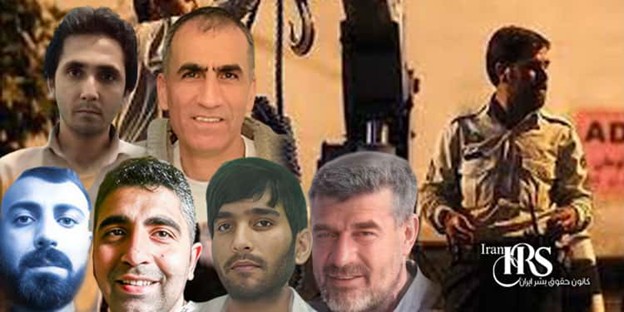
Iran executed 8 prisoners in Minab, Malayer, Aligudarz, Isfahan, and Yazd prisons in July 2025, raising human rights concerns. Learn about these violations.
Iran Human Rights Society, Monday, July 28, 2025- Iran’s execution rate in July 2025 alarms human rights advocates. Authorities executed eight prisoners in Minab, Malayer, Aligudarz, Isfahan, and Yazd prisons. This brings Tir’s Persian calendar month execution total to 86, with at least 21 in early Mordad Persian calendar month. These actions spark global concern over Iran’s death penalty practices, which often violate international human rights standards. This article explores these executions, their charges, and their conflict with global human rights obligations.
Executions in Minab Prison: Eisa Narouei and Amir Ghanbari

On July 27, 2025, Minab Prison authorities executed Eisa Narouei and Amir Ghanbari. Eisa, 35, from Karhemat village, faced drug-related charges since 2020. Amir, 26, a married father of two from Delgan, was arrested six years ago on similar charges. Both received death sentences, highlighting Iran’s harsh drug policies. These cases fuel criticism, as drug offenses often do not meet international standards for capital punishment.
Esmaeil Hajivand’s Execution in Malayer Prison
On July 27, 2025, Esmaeil Hajivand faced execution in Malayer Prison. Arrested nine years ago for murder, he received a death sentence. This case underscores Iran’s frequent use of capital punishment for murder charges, often without transparent judicial processes. Lack of fair trial guarantees raises questions about justice in such cases.
Saleh Hatami Executed in Isfahan Prison
On July 26, 2025, Saleh Hatami, a 37-year-old father from Masjed Soleyman, was executed in Isfahan Prison. Arrested four years ago for murder, his case reflects Iran’s reliance on the death penalty for serious crimes. However, the judiciary’s lack of independence often undermines fair trial standards, drawing global condemnation.
Mohammad Parsa’s Execution in Aligudarz Prison
On July 22, 2025, Mohammad Parsa faced execution in Aligudarz Prison. Arrested three years ago for murder, his death sentence adds to the growing tally of executions in Lorestan Province. Such cases highlight systemic issues, including restricted legal rights for defendants, which violate international human rights norms.
Yazd Prison: Surge in Executions, Including a Woman
On July 21, 2025, Yazd Prison executed ten prisoners, including one woman, Atefeh Amini. Five faced murder charges, and five others had drug-related convictions. Confirmed identities include Reza Akhiri, 31, from Minab; Ali Momeni, 40, from Borujerd; Behram Seyed Nasiri, 46, from Bandar Abbas; Amirhossein Hasankhani, 35, from Rasht; Fakhruddin Ra’ei, 44, from Tabriz; and Atefeh Amini, 35, from Yazd. These executions signal an alarming trend, as drug-related death sentences often lack proportionality under global human rights frameworks.
Death Penalty Violates Universal Declaration of Human Rights
Article 3 of the Universal Declaration of Human Rights states, “Everyone has the right to life.” Only a competent court can deprive this right for legally recognized crimes. The death penalty conflicts with this principle for several reasons. First, it violates the fundamental right to life. Second, its irreversibility prevents correcting judicial errors. Finally, some execution methods constitute torture or inhuman treatment, breaching human rights standards.
Iran’s Breach of International Human Rights Obligations
Article 6 of the International Covenant on Civil and Political Rights, which Iran signed, allows the death penalty only for the most serious crimes with fair trial guarantees. However, Iran’s judicial system often lacks transparency and independence. Defendants frequently face restricted legal rights, violating global human rights principles. These systemic flaws in Iran’s death penalty practices demand urgent international attention.
Conclusion: A Call for Accountability
The execution of eight prisoners in Minab, Malayer, Aligudarz, Isfahan, and Yazd prisons reflects Iran’s escalating use of the death penalty. These actions, often for drug-related or murder charges, violate the Universal Declaration of Human Rights and the International Covenant on Civil and Political Rights. Advocates urge global leaders to address Iran’s judicial practices and push for fair trials and humane treatment.
Follow Iran Human Rights Society on social networks:
Telegram /Twitter /Instagram / YouTube / Facebook
Join Iran Human Rights Society on Twitter





Discussion about this post