
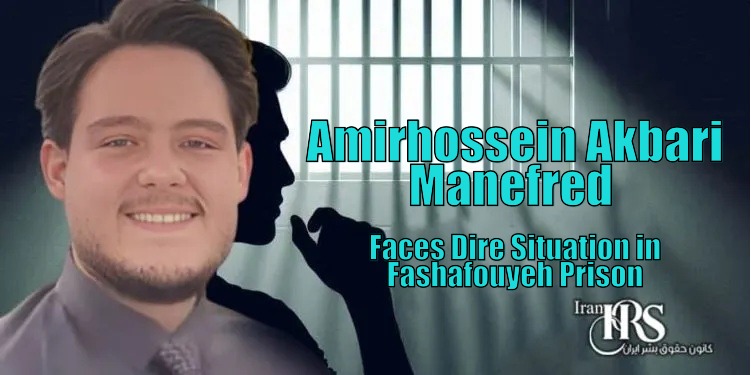
Amirhossein Akbari Manefred endures torture and indefinite detention in Fashafouyeh Prison. He protests unsafe conditions and his father’s critical health crisis.
Iran Human Rights Society,, Monday, October 20, 2025 –Amirhossein Akbari Manefred endures severe risks in Fashafouyeh Prison. Security forces arrested him on January 30, 2025, during a raid on his Tehran home. Now, over nine months later, he remains detained without a trial or lawyer access. He shares cells with violent criminals, despite laws mandating crime separation. This setup endangers his safety and inflicts targeted psychological torture. Furthermore, he stages a hunger strike for his gravely ill father. His case highlights Iran’s systemic abuses against political prisoners.
Arrest, Torture, and Violation of Crime Separation Principles

Security agents stormed Amirhossein Akbari Manefred’s family home on January 30, 2025. They dragged the 37-year-old political prisoner to Ward 209 of Evin Prison. There, interrogators subjected him to months of physical and psychological torment. Eventually, officials transferred him to Fashafouyeh Prison in Tehran. However, they ignored crime separation rules. As a result, he now lives among dangerous inmates and ordinary offenders.
Informed sources describe this placement as deliberate. It aims to break his spirit through constant fear. Amirhossein Akbari Manefred repeatedly alerts officials to threats and violence from fellow prisoners. Yet, guards dismiss his pleas. Consequently, his physical safety hangs in peril. Moreover, this violates Iran’s explicit legal mandates for separating detainees by charge type.
Four Grave Charges Amid Judicial Indefiniteness
Prosecutors level four serious accusations against Amirhossein Akbari Manefred. Each carries a potential ten-year sentence. Nevertheless, no court hearings occur. Authorities present zero evidence to substantiate these claims. This judicial silence traps him in limbo for over nine months.
In response, Amirhossein Akbari Manefred launches a hunger strike. He protests the endless uncertainty and his father’s worsening health. Security agents react with fury. They issue violent threats. One prison official snarls, “We’ll beat you so much that you’ll forget your own name.” This chilling remark exposes the regime’s routine brutality. Even basic legal rights evaporate inside these walls.
Hunger Strike Ignites Over Father’s Critical Illness

Amirhossein Akbari Manefred starts his hunger strike on September 15, 2025. He demands action for his father, Mohammad Ali Akbari Manefred. This elderly man, a 1980s political prisoner, now languishes under security watch in Tajrish Hospital. Multiple ailments plague him: diabetes, heart issues, and paralysis in both legs.
Doctors warn of dire consequences. His left leg festers with a severe infection. Without urgent treatment, amputation looms large. The Legal Medicine Organization declares him unfit for imprisonment. However, Ministry of Intelligence orders block his release. Shackles bind him to the hospital bed—handcuffs and leg irons restrain his frail body. Even family visits remain forbidden in this crisis.
Decades of Repression Target the Akbari Manefred Family
The Akbari Manefred family battles relentless pressure from security and judicial forces. Mohammad Ali Akbari Manefred faced arrest in the 1980s for alleged Mujahedin-e Khalq support. He endured years behind bars. Post-release, threats and re-arrests dogged him repeatedly.
Just two days after Amirhossein’s capture, agents raid the home again. They seize the aging father on January 21, 2025. Now, father and son suffer parallel ordeals. One chains to a hospital bed; the other rots in Fashafouyeh Prison. Daily updates on his father’s agony torment Amirhossein Akbari Manefred. Sources near the family note his profound distress. He agonizes over his powerlessness to aid his parent.
Blatant Disregard for Crime Separation Endangers Lives
Iran’s prison regulations stress crime separation as a core principle. International treaties reinforce this standard. Yet, officials flout it blatantly with Amirhossein Akbari Manefred. He shares space with violent offenders. This not only imperils his body but also wages psychological warfare.

Prison insiders report multiple assaults on him by inmates. Threats escalate daily. Instead of relocation, guards turn a blind eye. This pattern reveals a calculated strategy. Authorities pile extra torment on political detainees like Amirhossein Akbari Manefred. Such tactics erode dignity and amplify isolation.
Fundamental Rights Violations in Father and Son’s Cases
Amirhossein Akbari Manefred and his father’s plights scream human rights abuses. The regime shreds key protections. Article 7 of the International Covenant on Civil and Political Rights bans torture and cruel treatment. Agents ignore it entirely.
Article 9 forbids arbitrary arrests. It demands swift, fair trials. Officials deny both. Article 10 requires humane prisoner handling. Shackles and neglect mock this mandate. Even domestic rules on crime separation crumble under pressure. These breaches paint a grim portrait of Iran’s detention system.
Urgent Warnings Amid Judicial Inaction
Father and son’s conditions deteriorate rapidly. Yet, courts and officials maintain a deafening silence. Human rights advocates sound alarms. They predict a looming tragedy if pressures persist.
Political prisoners like Amirhossein Akbari Manefred face rigged trials from the start. Post-arrest, even minimal rights vanish. This saga underscores the regime’s iron grip on prisons. Justice fades further into shadow. Activists urge global scrutiny. Only sustained outcry can pierce this veil of repression.
See also the below articles:
- Qezel Hesar Prison Strike: A Historic Stand Against Executions
- Zahra Shahbaz Tabri: Seven Months of Uncertainty in Lakan Prison
Follow Iran Human Rights Society on social networks:
Telegram /Twitter /Instagram / YouTube / Facebook
Join Iran Human Rights Society on Twitter




Discussion about this post