
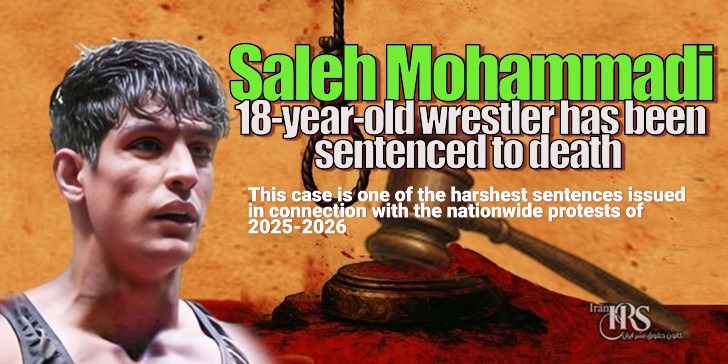
Saleh Mohammadi, an 18-year-old wrestler, has been sentenced to death on charges of murdering a special unit officer during the nationwide protests of 2025-2026 in Qom; the court rejected claims of confessions obtained under torture.
Iran Human Rights Society, Friday, February 13, 2026 – According to reports from human rights organizations, Saleh Mohammadi, an 18-year-old protester, has been sentenced to death in connection with the nationwide protests of 2025-2026 in Qom. The issued sentence stipulates that his punishment be carried out publicly at the location of the alleged crime.
Issuance of Sentence in Qom Criminal Court
According to received information, the Qom Criminal Court issued the qisas (retribution) sentence for Saleh Mohammadi on February 3, 2026. Saleh Mohammadi is accused of causing the death of a special unit officer by stabbing him during the nationwide protests on January 8, 2026 in Qom.
This case is one of the harshest sentences issued in connection with the nationwide protests of 2025-2026. According to the ruling, the execution of qisas will take place at the site of the alleged crime.
This sentence has been issued amid widespread arrests and the formation of numerous judicial cases following the nationwide protests of 2025-2026.
Arrest of Saleh Mohammadi Following the Nationwide Protests

Saleh Mohammadi was arrested on January 15, 2026, a few days after the nationwide protests on January 8, 2026. His arrest was part of the security crackdown following the nationwide protests.
Saleh Mohammadi is a wrestler and, according to his Instagram page, won a medal in international freestyle wrestling competitions in Russia in 2024. He is set to turn 19 next month.
Saleh Mohammadi’s case is one of the files related to the nationwide protests that has been processed rapidly.
Claims of Torture and Forced Confessions
According to the published report, Saleh Mohammadi was forced to confess against himself during the interrogation and preliminary investigation stages. These confessions were later used as one of the evidences in the judicial proceedings.
Saleh Mohammadi stated in court that his confessions were obtained under torture and coercion. However, the court did not accept this claim.
The court relied on the confessions made during the crime scene reconstruction and what was described as “eyewitness reports” to issue the conviction sentence for Saleh Mohammadi.
The issue of forced confessions has been raised in many cases related to the nationwide protests of 2025-2026. Numerous reports have been published about pressure on detainees from the nationwide protests to extract confessions.
Public Execution of the Sentence
According to the issued ruling, Saleh Mohammadi’s punishment is to be carried out at the site of the alleged crime in Qom. The public execution of the sentence is one of the notable aspects of this case.
The issuance and execution of harsh sentences in connection with the nationwide protests of 2025-2026 continue while the social atmosphere remains influenced by these nationwide protests.
Saleh Mohammadi’s case has now become one of the prominent examples among the sentences issued after the nationwide protests.
Judicial Cases Following the Nationwide Protests of 2025-2026
The nationwide protests of 2025-2026 in various cities were accompanied by widespread arrests of protesters. Following these nationwide protests, numerous cases were formed in the courts.
Saleh Mohammadi’s case has been examined within the framework of this process of handling cases related to the nationwide protests. Many of these cases have involved serious charges.
Human rights reports emphasize that in the handling of cases related to the nationwide protests, issues such as access to a lawyer, claims of torture, and the speed of judicial proceedings have been among the discussed matters.
Violations of Fair Trial Principles in Saleh Mohammadi’s Case
Saleh Mohammadi’s case has been reported to conflict with several fundamental human rights principles:
- Violation of the prohibition of torture: Article 5 of the Universal Declaration of Human Rights – Obtaining confessions under torture is prohibited.
- Violation of the right to a fair trial: Article 10 of the Universal Declaration of Human Rights – Every individual has the right to a fair hearing.
- Violation of the right to life: Article 3 of the Universal Declaration of Human Rights – Every individual has the right to life.
See also the below articles:
- Overcrowding and torture in Vakilabad Prison, Mashhad; A detainee’s account of the nationwide protests of 2025-2026
- 35 more prisoners were executed in various prisons during the past three weeks in Iran
Follow Iran Human Rights Society on social networks:
Telegram /Twitter /Instagram / YouTube / Facebook
Join Iran Human Rights Society on Twitter





Discussion about this post