
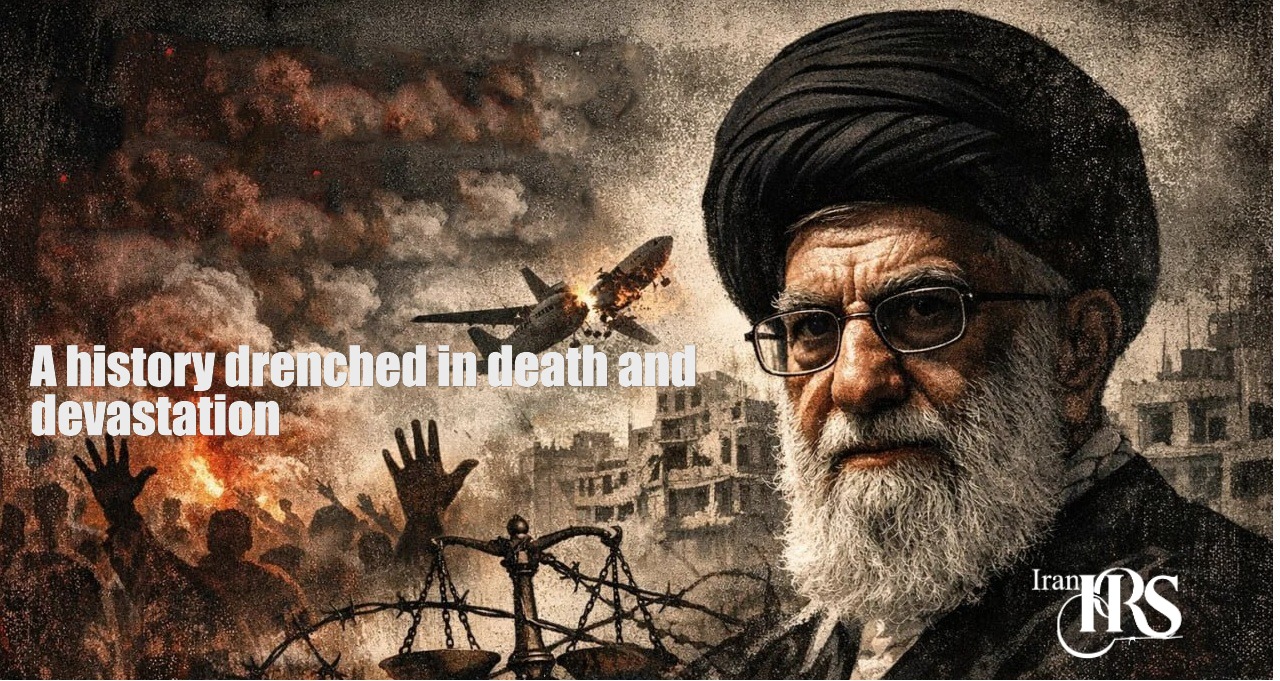
A documented review of three decades of Ali Khamenei’s rule; from issuing orders for bloody suppressions, the killing of protesters, and the deadly downing of flight PS752 to military support for Bashar al-Assad, participation in the Syrian war, and the expansion of interventionist policies in the region that have been accompanied by widespread human consequences.
Iran Human Rights Society, Sunday, 1 March 2026 – Khamenei has passed away. From the beginning of the establishment of the ruling structure after the revolution, he was present in key positions and was considered part of the main core of power. After Khomeini’s death, he was appointed as the leader of the regime and for 36 years stood at the head of the political and security structure. During this period, all major political, security, and judicial decisions were made under his direct supervision.
During Khamenei’s era, widespread suppression of political opponents, security confrontations with protesters, restriction of freedom of expression, and extensive arrests have been reported. Popular protests at various times faced direct intervention by security and military forces, and numerous cases of killing of protesters were recorded. Also, the issuance and execution of death sentences continued on a large scale.
According to reports from human rights organizations, the performance of the structure under his command in some cases has been evaluated as constituting serious and systematic violations of citizens’ fundamental rights. These reports point to arbitrary detentions, torture, enforced disappearances, and the killing of protesters, which from the perspective of international law can be examined within the framework of crimes against humanity. The ultimate responsibility for these policies during his period lies with the highest authority of the ruling structure.
Crimes That Khamenei Cannot Escape From
The record of more than three decades of Ali Khamenei is intertwined with events that have had extensive human consequences. After the death of Ruhollah Khomeini, he was appointed as the leader of the ruling structure and for 36 years stood at the top of the political, military, and judicial power pyramid. According to the constitution, the command of all armed forces and supreme oversight over the three branches are in his hands. For this reason, many of the security events and political suppressions in this period, from the perspective of political and legal responsibility, are attributed to the highest authority of the regime.
Mass Executions of the 1980s
The mass executions of political prisoners between the years 1981 and 1988 are considered one of the most important cases of widespread human rights violations in recent decades. According to reports published by human rights organizations, thousands of political prisoners were executed in these years without fair trial or in short processes lasting a few minutes. These executions were carried out by the direct order of Ruhollah Khomeini and through a committee known as the “Death Committee.”
Although Ali Khamenei was not the leader at that time, he was acting as president and was considered part of the highest level of political decision-making. Therefore, critics believe that he cannot claim ignorance regarding events of such magnitude. The issue of the 1980s executions continues to be raised in international reports as an example of systematic violation of the right to life and fair trial, and from the perspective of international law, it can be placed within the framework of examination of crimes against humanity.
Suppression of University Dormitory in 1999
In July 1999, protests began following the closure of the newspaper “Salam,” which led to the events at Tehran University dormitory. Military forces and plainclothes agents attacked the student dormitory. Reports spoke of beatings, widespread arrests, and the killing of a number of students. Some commanders of the Revolutionary Guards at the time later referred to the role of forces under their command in these events.
A few days after these events, a letter from a group of Revolutionary Guards commanders addressed to the then-president was published, in which they threatened direct military intervention if the protests continued. Given the leader’s position as commander-in-chief of the armed forces, the ultimate responsibility for the performance of the armed forces in this period is attributed to him.
2009 Protests and Their Consequences
The 2009 presidential election was accompanied by widespread popular protests. After a Friday prayer in which Ali Khamenei announced his official position, security confrontations with protesters intensified. Security and military forces were deployed in the streets, and reports of direct shooting at protesters were published. Various statistics indicate the killing of dozens of people and the arrest of thousands.
Some Revolutionary Guards commanders later referred to the organization of Basij forces and so-called plainclothes groups to confront the protests. These statements show that the suppression operations were carried out with planning and coordination at high levels. In such circumstances, the leader’s lack of knowledge of the details of these actions, given his legal authorities, is seriously questionable.
Bloody Suppression of November 2019
In November 2019, following a sudden increase in gasoline prices, nationwide protests took shape in dozens of cities. These protests lasted about two weeks and their scope was described as unprecedented. Reports showed that the protesters’ slogans directly targeted the ruling structure. At this juncture, security and military forces entered the scene with direct orders from Khamenei. A nationwide internet shutdown was also implemented simultaneously with the start of the suppression to limit the flow of information.
According to Reuters news agency reports, about 1,500 people were killed during this suppression, 18 of whom were children. Official authorities never provided an exact figure, and families of the victims faced security restrictions. Reports published by human rights organizations indicated direct shooting at protesters and widespread use of firearms. Given the leader’s position as commander-in-chief of the armed forces, the ultimate responsibility for the performance of the armed forces in this event is attributed to him. This event, from the perspective of international law, is examinable as an example of widespread and systematic suppression.
Downing of Flight PS752
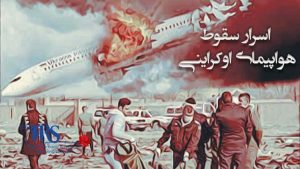
On 8 January 2020, Ukraine International Airlines flight PS752 was hit by two air defense missiles minutes after taking off from Tehran airport and crashed. All 176 passengers and crew on board perished. This incident occurred amid heightened military tensions between the regime and the United States following the killing of Qasem Soleimani.
In the first three days, official authorities denied any missile fire. After the publication of images and technical information by foreign sources, the missile strike was confirmed. The commander of the Revolutionary Guards Aerospace Force stated that the air defense had mistakenly targeted the aircraft. However, contradictory statements and delay in accepting responsibility raised widespread questions about the decision-making process.
Since the ultimate control of the armed forces and air defense systems is in the hands of the commander-in-chief, the possibility of such an event occurring without the knowledge of high decision-making levels is seriously questionable. The victims’ families continue to demand full transparency and accountability from senior officials. This case has also been raised internationally as a matter with human rights dimensions and potential serious violation of the right to life.
Prohibition of Corona Vaccine
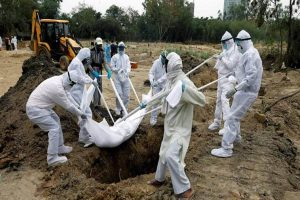
In January 2021, simultaneously with the start of global distribution of valid corona vaccines, the regime’s leader announced a ban on the entry of vaccines produced in America and Britain. This decision was made while several countries had announced readiness to supply vaccines. He claimed that he did not trust these vaccines and that there was a possibility of misuse.
This position was taken at a time when the corona pandemic had taken thousands of lives. According to official statistics, about 150,000 people died from this disease in the country. Critics believe that a significant part of the casualties occurred in a period when access to valid global vaccines was restricted. Although imports of vaccines from other sources were later carried out, the time gap created had a direct impact on the mortality trend.
Given that macro health policies are determined at the highest level of the regime, the decision to ban vaccine imports is also attributed to the leader himself. In the event of legal examination, this action can be evaluated within the framework of responsibility arising from governing decisions that have led to widespread violation of the right to life.
Bloody Suppression of the 2022 Uprising
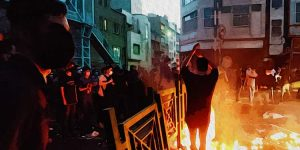
The nationwide protests of 2022 turned into one of the most extensive waves of public discontent in recent years. This uprising, which flowed in numerous cities, faced a harsh reaction from security and military forces. According to published reports, at least 300 people lost their lives during these suppressions. Simultaneously, the issuance of heavy judicial sentences, including execution for a number of detainees, was placed on the agenda. Critics emphasize that these sentences were issued within the framework of an intimidation policy and with direct guidance from the highest authority of the regime. The continuation of arrests, rapid trials, and restriction of access to lawyers are among the cases recorded in human rights reports.
Suppression of 2025 Protests
In the nationwide protests of 2025 as well, the official policy shifted from economic promises to armed suppression. Reports indicate that in less than two days, about
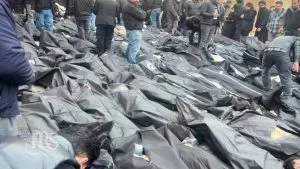
a thousand people were killed during confrontations with security forces. In cities such as Fasa and Marvdasht, direct shooting at protesters was recorded. Military helicopter flights to create fear and the widespread presence of armed forces in the streets were part of this operation. In some areas, government centers were temporarily taken over by protesters. Thousands were injured and tens of thousands were arrested, and economic protests turned into a bloody scene.
Digital Blackout and Expansion of the Scope of Suppression
Simultaneously with the intensification of confrontations, the country’s nationwide internet was cut off from 8 January. This “digital blackout” was implemented with the aim of limiting the publication of images of suppression and disrupting the coordination of protesters. The cutting of communications increased concerns about the real dimensions of violence and severely restricted citizens’ access to information.
In some cities, hospitals also became part of the security confrontation field. Local reports speak of the arrest of the injured in medical centers or shooting at them. Such actions are considered a clear violation of domestic rules and international standards for the protection of medical centers. The collection of these events has once again placed the political and legal responsibility of the command structure at the highest level of the regime at the center of attention.
Legal Responsibility and the Concept of Crimes Against Humanity
In international law, when widespread and systematic violations of citizens’ fundamental rights, including the right to life, prohibition of torture, freedom of expression, and freedom of assembly occur, there is the possibility of examining them within the framework of “crimes against humanity.” Numerous reports from international organizations over the past years have pointed to cases such as arbitrary detentions, torture, enforced disappearances, and the killing of protesters during
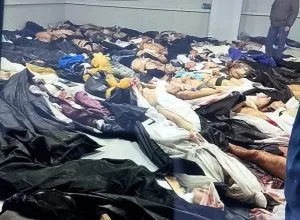
Khamenei’s period.
Given his position at the head of the power structure and his decisive role in appointing military and security commanders, the political and possibly legal responsibility for these events is attributed to him personally. In the event of the formation of any international or independent national court, these cases can be examined.
Khamenei’s record, from the executions of the 1980s to the suppressions of 1999 and 2009, includes events that remain disputed and pursued by the victims’ families and human rights organizations. These records have turned the issue of accountability before justice into a lasting matter in the political and legal arena.
A Record Beyond Borders; From Domestic Suppression to Regional Intervention and Support for Bashar al-Assad
The examination of three decades of Ali Khamenei’s rule is not limited to domestic suppressions. Alongside the bloody protests of the years 1999, 2009, November 2019, and the uprisings of 2022 and 2025, the regional policies of the ruling structure have also left extensive human consequences in Syria and other regional countries. The concentration of power in the position of commander-in-chief has caused the ultimate responsibility for these decisions to be defined at the highest level of the regime.
In the domestic arena, confrontation with popular protests has often been accompanied by the use of coercive force. Published reports speak of the killing of hundreds to thousands of people at various times. Nationwide internet shutdowns, widespread arrests, issuance of heavy judicial sentences, and restriction of freedom of expression have been part of the fixed pattern of dealing with public discontent. The downing of flight PS752 and the prohibition of importing valid corona vaccines are also evaluated within this framework of macro decisions and human consequences.
At the regional level, comprehensive support for Bashar al-Assad’s government in Syria has been one of the most prominent policies of Khamenei’s period. With the beginning of popular protests in Syria and their transformation into civil war, the structure under his command stood alongside the Damascus government through military forces, advisors, and financial support. This support continued while international reports spoke of the killing of hundreds of thousands of people and the displacement of millions of Syrian citizens. The role of forces affiliated with the regime in some military operations has been recorded in reports of human rights organizations and has been referred to as part of the organized violence process in the Syrian war.
In addition to Syria, the so-called “expansion of regional influence” policy has led to the strengthening and support of armed groups in various countries. This approach has been described by critics as “exporting instability” and intervention in regional conflicts. The presence and financial and military support of armed groups in some Middle Eastern countries, alongside ongoing tensions with regional and international actors, has fueled a cycle of violence and conflict.
In total, the record of the past three decades includes two main axes: organized suppression domestically and support for military interventions beyond borders. This collection of actions has been recorded in human rights reports and political analyses as examples of widespread violation of fundamental rights and the intensification of regional instability. The issue of accountability, both towards domestic victims and towards the human consequences of regional policies, continues to be raised as a serious demand at the domestic and international levels.
See also the below articles:
- Emergency Situation in Evin Prison: Concerns Grow Over Prisoners’ Safety and Basic Rights
- Medical Neglect of Political Prisoner Sajjad Imannejad in Evin Prison Worsens Health Crisis
Follow Iran Human Rights Society on social networks:
Telegram /Twitter /Instagram / YouTube / Facebook
Join Iran Human Rights Society on Twitter



Discussion about this post