

The Judiciary announced the execution of three detainees from the nationwide protests of Dey month 1404; meanwhile, the execution of Saleh Mohammadi, the teenage wrestler, with claims of torture and forced confessions, has provoked widespread reactions.
Iran Human Rights Society, Thursday, March 19, 2026 – In continuation of the wave of executions simultaneous with wartime conditions, the Judiciary announced that three detainees from the Dey 18 protests, Saleh Mohammadi, Saeed Davoudi, Mehdi Ghasemi, were executed at dawn on Thursday, March 19, 2026. These 3 executions have been carried out while reports of obtaining confessions under torture and rapid processing of his case have been published and concerns about the violation of the rights of the accused have increased.
Official Announcement of Execution of Saleh Mohammadi
Mizan News Agency, affiliated with the Judiciary, announced that three detainees from the Dey 18 protests were executed on charges of murdering two Faraja officers in Qom. According to this report, the names of the executed are Mehdi Ghasemi, Saleh Mohammadi and Saeed Davoudi.
According to this source, these individuals were convicted on charges including “enmity against God (moharebeh)” and “retribution for life (qisas-e nafs)”, and the process of arrest, interrogation and judicial proceedings in their cases was carried out with speed. Judicial authorities emphasized that the accused confessed to their crimes at various stages of interrogation and trial.
Saleh Mohammadi; From Athlete to Sentenced to Death
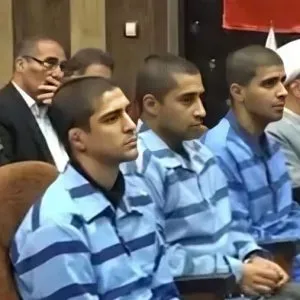
The execution of Saleh Mohammadi has drawn special attention. He who was a young wrestler, in the year 1403 succeeded in winning a medal in the international freestyle wrestling competitions in Russia and had recently turned 19 years old.
Saleh Mohammadi was arrested on Dey 25, only a few days after the nationwide protests. His case is one of the examples that in connection with the nationwide protests has been processed with high speed.
According to reports, the process of handling his case from arrest to issuance of the death sentence was carried out in a short period of time which this matter itself has created questions about compliance with the principles of fair trial.
Claims of Torture and Forced Confessions
One of the most important points raised in the execution case of Saleh Mohammadi is the claim of obtaining confessions under torture. According to reports, he was forced to confess against himself in the interrogation stage and preliminary investigations.
Saleh Mohammadi announced in court that his confessions were obtained under pressure and torture, but the court did not accept this claim and cited his confessions as one of the main documents of the case.

The court also relied on “crime scene reconstruction” and “eyewitness reports”. However, the issue of forced confessions has also been raised in many cases related to nationwide protests and numerous reports of pressure on detainees to confess have been published.
Execution in the Shadow of War; Message of Intensified Repression
Saleh Mohammadi’s execution was carried out in conditions where the country is simultaneously involved in war and bombardment. Observers believe that carrying out death sentences in such conditions can carry a message of intensified internal control and repression.
While public attention is focused on war developments, the execution of heavy sentences including execution is interpreted as a tool for controlling protests and creating a deterrent atmosphere in society.

Some analysts believe that the simultaneity of war and the increase in executions can be a sign of efforts to prevent the formation of internal dissatisfactions in crisis conditions.
Rapid Processing and Increased Concerns
One of the notable points in the execution case of Saleh Mohammadi is the high speed of judicial proceedings. From the time of arrest to the execution of the sentence, a short process has been followed which according to observers can have prevented precise examination of the case and full access of the accused to his legal rights.
Also, reports have been published about restriction of access of the accused to independent lawyers and lack of transparency in the trial process which has added to the concerns.
Violation of Human Rights in the Review and Sentencing of Three of the Dey Month Protesters
This case is an example of serious concerns about the trial process, the method of obtaining confessions and the execution of sentences in crisis conditions which can affect the fundamental rights of the accused.
Violation of the prohibition of torture – Article 5 of the Universal Declaration of Human Rights: Obtaining confession under torture or pressure can be considered an example of inhuman behavior and violator of human dignity.
Violation of the right to fair trial – Article 14 of the International Covenant on Civil and Political Rights: Rapid proceedings, failure to examine torture claims and reliance on confessions can call into question the independence and justice in trial.
Violation of the right to life – Article 6 of the International Covenant on Civil and Political Rights: Execution of the death sentence in conditions where there are ambiguities about the trial process and the validity of confessions can be contrary to the fundamental right to life.
In total, the execution of Saleh Mohammadi along with other recent developments has once again drawn attention to the human rights situation and the method of handling cases related to protests; an issue that in wartime conditions has also found more complex dimensions.
See also the below articles:
- Execution of Kourosh Keivani; Beginning of the Wave of Hasty Executions Under the Shadow of Security Charges
- Humanitarian Crisis in Evin Prison; Hot Water Cut Off and Severe Shortage of Medicine for Prisoners
Follow Iran Human Rights Society on social networks:
Telegram /Twitter /Instagram / YouTube / Facebook
Join Iran Human Rights Society on Twitter







Discussion about this post