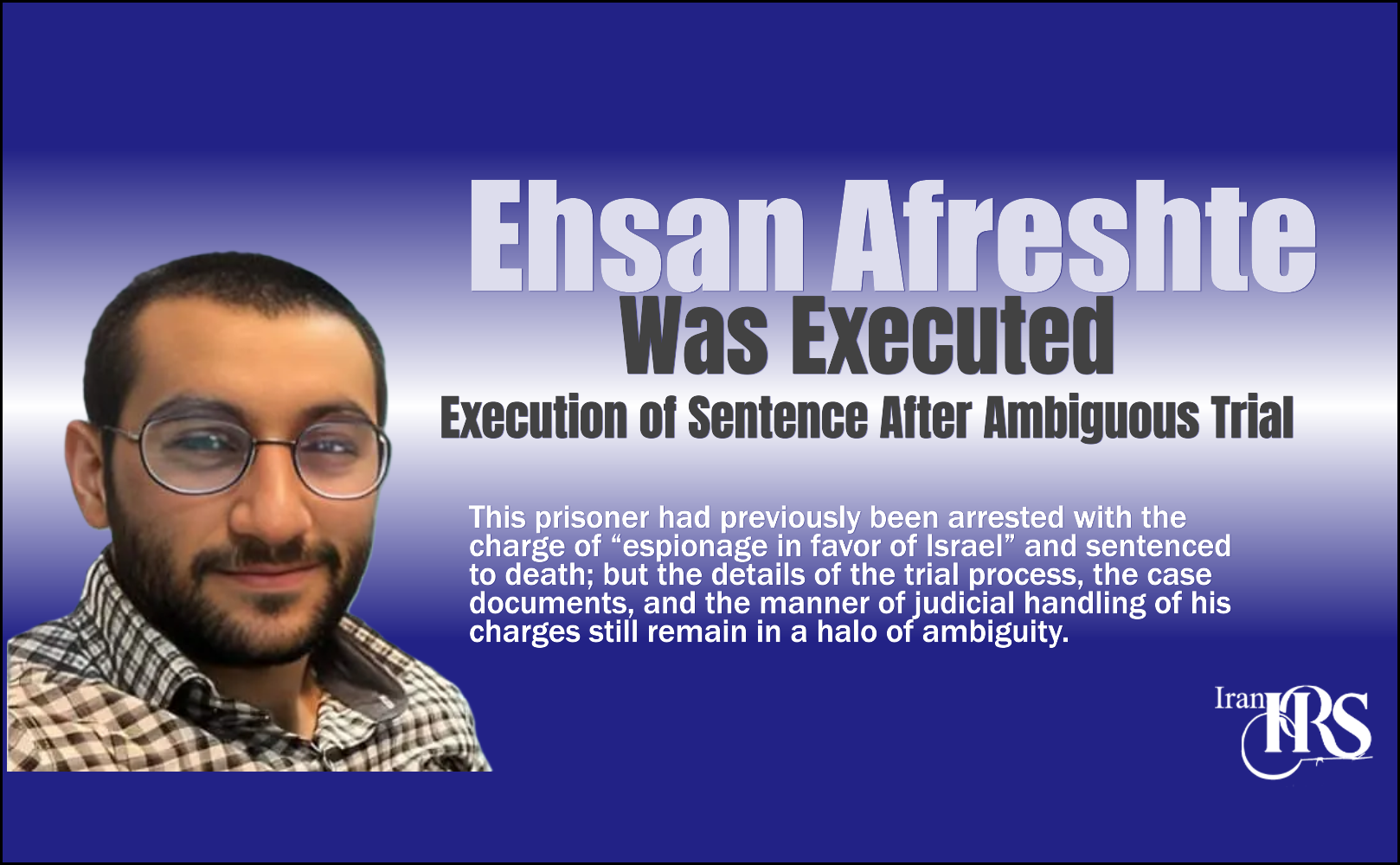
Ehsan Afreshte, a prisoner sentenced to execution with the charge of “espionage,” was executed at dawn today; while previously the effort to transfer him to Qezelhesar faced protest and collective resistance by political prisoners in Ward 7 of Evin.
Iran Human Rights Society, Wednesday May 13 2026 – At dawn today Ehsan Afreshte was executed. This prisoner had previously been arrested with the charge of “espionage in favor of Israel” and sentenced to death; but the details of the trial process, the case documents, and the manner of judicial handling of his charges still remain in a halo of ambiguity. Human rights activists say the judiciary under the influence of security institutions has not even observed the minimum standards of trial and the execution machine continues to take victims.
How Was Ehsan Afreshte Executed?
Based on published reports, the execution sentence of Ehsan Afreshte was carried out at dawn today. He had previously been arrested with the charge of “espionage in favor of Israel” and sentenced to death. Despite the execution of the sentence, so far no transparent information about the arrest process, court sessions, the manner of judicial handling, and the documents presented against him has been published.

Human rights activists say in many security cases, the trial process is carried out in a non-public space and under the direct influence of security institutions, and the public opinion remains uninformed about the real details of the case. According to them, the widespread use of security charges in recent years has turned into a tool for intensifying suppression and issuing heavy sentences against political prisoners.
Why Did the Transfer of Ehsan Afreshte to Qezelhesar Face Protest?
Previously in September/October 2025, Evin prison agents intended to transfer Ehsan Afreshte to Qezelhesar Karaj prison for the execution of the death sentence. This action faced a collective protest reaction from political prisoners in Ward 7 of Evin. Informed sources say the prisoners, after being informed of the transfer goal, took a protest action by closing the ward door to prevent the execution of the sentence.
Reports indicate that political prisoners, by chanting slogans such as “No to Execution” and “Execution is Enough,” declared their opposition to the execution of the sentence. According to sources inside the prison, the ward atmosphere had become extremely tense for hours, and prison agents tried to stop the prisoners’ protest with threats and warnings about disciplinary action.
Why Do Human Rights Institutions Warn About the Trial Process?
Human rights activists say one of the most important concerns in Ehsan Afreshte’s case is the lack of transparency about the judicial handling process and the ambiguity of the trial rails. According to them, in many security cases, courts are held non-publicly and defendants are deprived of free access to an independent lawyer and a transparent trial process.
Human rights observers believe the judiciary under the domination of institutions such as the IRGC and the Ministry of Intelligence does not even fully implement its own legal rails and trial procedures. In their belief, the pressure of security institutions on the judicial apparatus has caused political and security cases to be examined more within the framework of security decisions rather than having a legal process.
Why Has the Increase in Executions Increased Concerns?
In recent months, human rights institutions have repeatedly warned about the increase in the implementation of execution sentences. Human rights activists say the continued implementation of execution sentences, especially in political and security cases, is a sign of intensifying the atmosphere of suppression and using the death penalty to create fear in society.
According to them, in conditions where political, social, and economic crises have increased, the ruling power is trying to control the protest atmosphere of society by intensifying executions. Human rights observers believe the execution machine in Iran continues to take victims without stopping; this is in conditions where many cases are accompanied by ambiguity, non-transparent judicial process, and extensive restrictions on defense rights.
What Message Did Evin Have?
The protest of political prisoners in Ward 7 of Evin against the transfer of Ehsan Afreshte once again highlighted the opposition of a part of political prisoners to the death penalty. Civil activists say the prisoners’ action in closing the ward door and chanting slogans against execution shows the expansion of oppositions to the use of the death penalty in political cases.
According to them, the protest of political prisoners took place in conditions where any opposition in prisons is accompanied by the risk of disciplinary action, security pressure, and more restrictions.
Violation of Human Rights; Non-Transparent Trial and Security Use of the Death Penalt
Ehsan Afreshte’s case from a human rights perspective is accompanied by serious concerns. The lack of transparency in the trial process, holding non-public courts, and the influence of security institutions on the judicial process have increased concerns about the violation of the principles of fair trial. Human rights activists say the judiciary under the domination of the IRGC and the Ministry of Intelligence has even ignored its own legal rails and the execution machine continues to take victims without interruption.
Violated Articles:
Violation of the Right to Life – Article 3 of the Universal Declaration of Human Rights: The implementation of the execution sentence in cases with a non-transparent judicial process threatens the fundamental right to life.
Violation of the Right to a Fair Trial – Article 10 of the Universal Declaration of Human Rights: Non-public courts and lack of judicial transparency violate the principles of fair trial.
Violation of the Right to Effective Defense – International Covenant on Civil and Political Rights: Restrictions on access to an independent lawyer and a free judicial process destroy the defendant’s right to defense.
Violation of the Principle of Independence of the Judiciary – Fundamental Principles of Human Rights: The influence of security institutions on the judicial handling process calls into question the independence of courts.
Violation of Freedom of Expression and Peaceful Protest – International Covenant on Civil and Political Rights: Security handling of prisoners’ protest against the death penalty violates the right to peaceful opposition to execution.
See also the below articles:
- Worsening Situation of Prisoners in Unit 2 of Qazal Hesar Prison
- Iran Forces Prisoners Into Street Propaganda in Babol
Follow Iran Human Rights Society on social networks:
Telegram /Twitter /Instagram / YouTube / Facebook
Join Iran Human Rights Society on Twitter