Mezopotamya News Agency, in a detailed and multilingual report citing a collection of reports and data published by the Iran Human Rights Society, has addressed the increasing trend of executions, widespread arrests, torture, and human rights violations in Iran, while warning of the intensification of the repressive atmosphere.
Iran Human Rights Society, Friday, May 15, 2026)– Mezopotamya News Agency has published an analytical report citing several reports and documents released by the Iran Human Rights Society, examining the situation of executions, widespread arrests, and the suppression of protests in Iran. This media outlet has repeatedly referred to the data and assessments of the Iran Human Rights Society throughout various sections of its report and has reported on the rise in executions of political prisoners, the arrest of protesters, and the use of torture and forced confessions.
Mezopotamya News Agency’s Citation of Reports by the Iran Human Rights Society
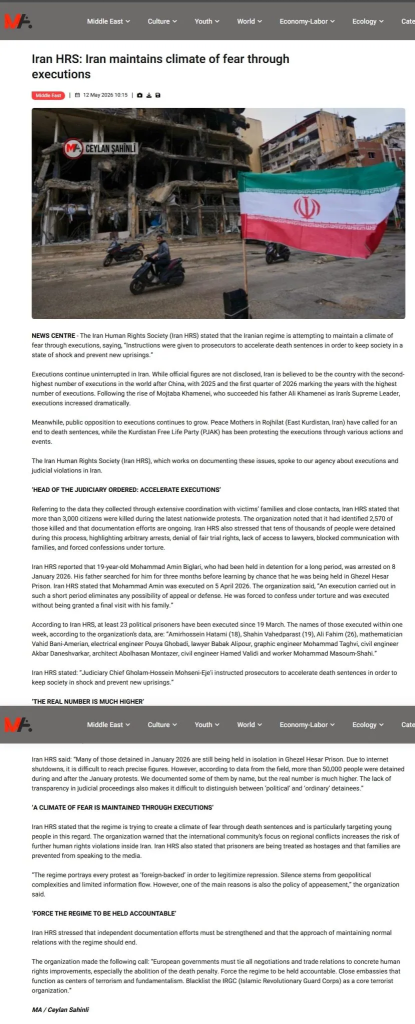
Mezopotamya News Agency has published this report in three languages and has covered the data and assessments of the Iran Human Rights Society regarding the situation of executions, arrests, and human rights violations in Iran. In this report, the name IHRS is repeatedly cited as the source of data, documentation, and analyses related to protests, the suppression of protesters, and the execution of political prisoners. Mezopotamya has used information published by the Iran Human Rights Society in various sections of its report on the number of those killed in the protests, the status of detainees, the trend of executions, and prison conditions, using it as the basis for its analysis of the human rights situation in Iran.
Reflection of the Warning on the Use of Executions to Create Fear
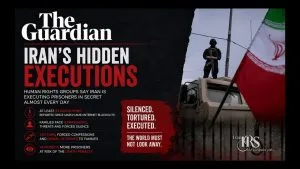
In one part of the report, Mezopotamya, quoting the Iran Human Rights Society, wrote that the regime is trying to use executions as a tool to create fear and prevent protests. Citing reports published by the Iran Human Rights Society, this media outlet stated: > “The head of the judiciary, Gholamhossein Mohseni Eje’i, has ordered prosecutors to accelerate the process of issuing and carrying out execution sentences so that society remains in a state of shock and the formation of new uprisings is prevented.” According to the report, the new wave of executions has intensified alongside the worsening economic crisis, the spread of public discontent, and the regime’s fear of the return of nationwide protests. Human rights activists say the regime is trying to prevent the formation of new protests by carrying out rapid executions and creating an atmosphere of terror.
Reflection of Statistics on Those Killed in Nationwide Protests
Mezopotamya News Agency, continuing its report, referred to statistics published by the Iran Human Rights Society on those killed in the nationwide protests. According to data from the Iran Human Rights Society reflected in this report, more than 3,000 citizens were killed during the protests, and the identities of 2,570 of them have so far been identified and documented. Mezopotamya also referred to reports by the Iran Human Rights Society on the arrest of tens of thousands of people during the protests and wrote that many of the detainees were deprived of their basic due process rights. In this section, it referred to cases such as: – Arbitrary arrests – Cutting off contact with families – Deprivation of lawyers – Prolonged solitary confinement – And forced confessions under torture
Reflection of the Case of Mohammad Amin Biglari
One of the important sections of the Mezopotamya report reflects the case of Mohammad Amin Biglari, a 19-year-old teenager about whom the Iran Human Rights Society had previously published a report. According to the report, Mohammad Amin Biglari was held in detention for a long time, and his family had no information about his place of detention for months. The Iran Human Rights Society had announced that his father, after extensive searching, accidentally discovered that his son was being held in Qezelhesar Prison. Citing this report, Mezopotamya News Agency wrote that Mohammad Amin Biglari was executed on April 5, 2026; according to the Iran Human Rights Society, he was forced to confess under torture and was executed without the possibility of a final visit with his family.
Reflection of the Execution of Political Prisoners

Continuing the report, Mezopotamya referred to a list of executed political prisoners whose details had previously been published by the Iran Human Rights Society. Citing IHRS, this media outlet wrote that at least 23 political prisoners have been executed since March 19, 2026. In this section, the names of some of the executed political prisoners are listed, including: – Amirhossein Hatami – Shahin Vahedparast – Ali Fahim – Vahid Bani Amrian – Pouya Ghobadi – Babak Alipour – Mohammad Taghavi – Akbar Daneshvar Kar – Abolhassan Montazer – Hamed Validi – Mohammad Masoum Shahi Mezopotamya News Agency emphasized that these prisoners faced trials with non-transparent judicial processes and severe restrictions on their defense rights.
Widespread Arrests and Internet Shutdowns
Mezopotamya also addressed the widespread arrests during and after the protests, citing reports by the Iran Human Rights Society. The report states that many of the detainees are still being held in solitary cells in Qezelhesar Prison and other detention centers. This media outlet also referred to reports by the Iran Human Rights Society on severe internet restrictions and wrote that the internet shutdown lasted for nearly two months to disrupt documentation and information dissemination. According to data published by the Iran Human Rights Society, more than 50,000 people were arrested during and after the protests; however, the lack of transparency and communication restrictions have made it difficult to record exact statistics.
Reflection of the Warning on Attributing Protests to “Foreign Enemies”
In another section of the report, Mezopotamya, quoting the Iran Human Rights Society, wrote that the regime tries to attribute every social protest to a “foreign enemy” and “foreign support” in order to justify the repression. The report states: > “The regime portrays every protest as foreign-backed in order to legitimize the suppression.” Human rights activists say this policy has led many of those arrested in the protests to face charges such as “espionage,” “cooperation with hostile governments,” and “acts against national security.”
Call for Holding the Regime Accountable
At the end of its report, Mezopotamya News Agency also reflected the demands raised by the Iran Human Rights Society. This section states that the Iran Human Rights Society has called for an end to the policy of appeasement and for increased international pressure on the regime. This human rights organization has emphasized that European governments should condition the continuation of their economic and political relations on improvements in the human rights situation and an end to executions. Additionally, the report reflects the demand to place the Islamic Revolutionary Guard Corps on the list of terrorist organizations and to hold officials responsible for the suppressions accountable.
Increased Attention by Regional Media to Iranian Human Rights Reports
The extensive reflection of reports by the Iran Human Rights Society in Mezopotamya News Agency indicates growing attention by regional media to the human rights situation in Iran. Human rights activists say that the publication of these reports and their international reflection plays an important role in documenting human rights violations and preventing the victims from being forgotten. According to them, at a time when repression, executions, and pressure on victims’ families are intensifying, independent documentation and reporting on the situation of political prisoners and detainees have become even more critical.
See also the below articles:
- Concerns Mount for Political Prisoner Mohammad Ali Omouri Nejad After Secret Transfer
- Golrokh Iraei Letter to PEN America: We Write Even If Chained
Follow Iran Human Rights Society on social networks:
Telegram /Twitter /Instagram / YouTube / Facebook
Join Iran Human Rights Society on Twitter