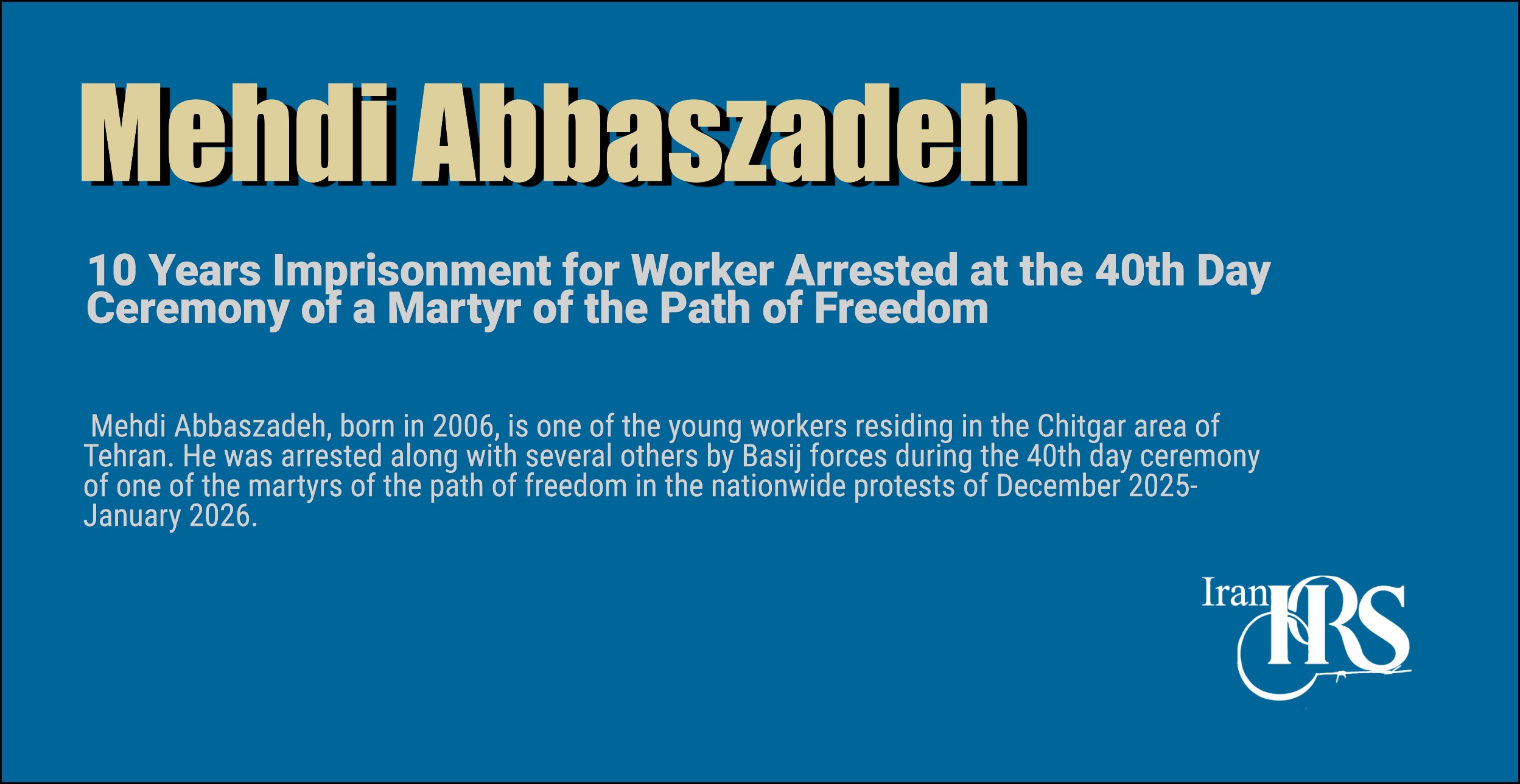
Mehdi Abbaszadeh, a 20-year-old worker from Tehran, was sentenced to 10 years in prison after being arrested at the 40th day ceremony of one of the martyrs of the nationwide protests of December 2025-January 2026. Reports indicate torture, threats of execution, and extraction of forced confessions from him during the detention period.
Iran Human Rights Society, Sunday June 7, 2026 – Issuing heavy sentences against detainees of the protests continues. In the latest case, Mehdi Abbaszadeh, a 20-year-old worker residing in Chitgar, Tehran, has been sentenced to 10 years in prison by the judicial apparatus. This young man who was arrested at the 40th day ceremony of one of the martyrs of the path of freedom, according to published reports, has been subjected to torture and threats during the detention period and has been forced to make forced confessions. Human rights activists consider this case another example of the continuation of the suppression of protesters and the use of confessions under pressure in judicial processes.
How Was Mehdi Abbaszadeh Arrested?
Based on published information, Mehdi Abbaszadeh, born in 2006, is one of the young workers residing in the Chitgar area of Tehran. He was arrested along with several others by Basij forces during the 40th day ceremony of one of the martyrs of the path of freedom in the nationwide protests of December 2025-January 2026.
Informed sources say his arrest took place while many families and citizens had participated in the memorial ceremony of the martyrs of the protests. In recent years, security and law enforcement forces have repeatedly put the memorial ceremonies of the martyrs of the protests under control and have arrested or summoned participants in these ceremonies.
What Do Reports Say About Torture and Forced Confessions?
Based on received reports, the first stage of interrogation of Mehdi Abbaszadeh was carried out by Basij forces and after that he was transferred to security police.
Knowledgeable sources have announced that this young prisoner has been subjected to severe psychological and physical pressures during the detention period and has been repeatedly threatened with the issuance of an execution sentence. According to these sources, the purpose of these pressures and threats has been to force him to confess against himself.
Reports related to torture and forced confessions in cases related to protests in recent years have been raised many times by human rights institutions. These institutions have emphasized that confessions obtained under pressure lack legal validity and cannot be the basis for issuing heavy sentences.
How Has the Detention and Trial Process of Mehdi Abbaszadeh Been?
Based on available information, Mehdi Abbaszadeh was held in the suite of Qezelhesar Prison from March 19, 2026 to mid-May 2026; a part of the prison whose name has been mentioned many times in reports related to detainees of protests in recent months.
After that, he was transferred to the general ward of unit 3 of Qezelhesar Prison. In the continuation of the judicial process, the adjudicating branch on April 13, 2026 convicted him on charges of “assembly and collusion” and “sending images and videos of the protests” to 10 years in prison.
While the complete details of the case have not been published, human rights activists believe that the severity of this sentence is not proportional to the nature of the charges raised and is considered an example of harsh treatment with detainees of protests.
Why Have Concerns About Heavy Sentences Increased?
In recent months, numerous reports about the issuance of long-term prison sentences and even execution sentences for detainees of protests have been published. Human rights observers believe that the new wave of heavy sentences indicates that the policy of judicial suppression continues.
In their belief, in many political and security cases, security institutions including the Islamic Revolutionary Guard Corps and the Ministry of Intelligence play a central role in the process of arrest, interrogation, and case formation, and the path of judicial proceedings is influenced by reports and scenarios prepared by these institutions.
Critics say that in such conditions, the independence of the judicial apparatus faces serious questions and the issuance of heavy sentences against protesters, students, civil activists, and political prisoners continues.
Suppression of Protesters Continues After the 2025-2026 Protests
The case of Mehdi Abbaszadeh is only one of dozens of cases that have been formed after the nationwide protests of December 2025-January 2026. Human rights activists say that the widespread arrest of protesters, exerting pressure on families, deprivation of legal rights, and issuance of heavy sentences are part of a policy that is pursued with the aim of preventing the formation of new waves of protests.
However, published reports show that social concerns and the demands of protesters still remain and security crackdowns have not been able to eliminate these demands.
Human Rights Violations; Torture and Forced Confessions in the Trial Process
The case of Mehdi Abbaszadeh has once again highlighted concerns about the use of torture, threats, and forced confessions in cases related to protests. Arrest at memorial ceremonies of martyrs, exerting pressure to obtain confessions, and issuing heavy sentences are among the cases that human rights institutions consider contrary to the fundamental principles of fair trial.
Human Rights Violations; Torture and Forced Confessions in the Trial Process
The case of Mehdi Abbaszadeh has once again highlighted concerns about the use of torture, threats, and forced confessions in cases related to protests. Arrest at memorial ceremonies of martyrs, exerting pressure to obtain confessions, and issuing heavy sentences are among the cases that human rights institutions consider contrary to the fundamental principles of fair trial.
Violated Articles:
- Article 5 of the Universal Declaration of Human Rights: No one shall be subjected to torture or to cruel, inhuman or degrading treatment or punishment.
- Article 9 of the Universal Declaration of Human Rights: No one shall be subjected to arbitrary arrest or detention.
- Article 10 of the Universal Declaration of Human Rights: Everyone is entitled in full equality to a fair and public hearing by an independent and impartial tribunal.
- Article 14 of the International Covenant on Civil and Political Rights: The accused must have access to a lawyer, effective defense, and a fair trial.
- Article 15 of the Convention against Torture: Any confession obtained under torture or pressure lacks legal validity and should not be the basis for issuing a sentence.
See also the below articles:
- Ali Kamali Faces Execution Sentence in Iran
- Hassan Moslavi Faces Execution Amid Serious Judicial Concerns
Follow Iran Human Rights Society on social networks:
Telegram /Twitter /Instagram / YouTube / Facebook
Join Iran Human Rights Society on Twitter