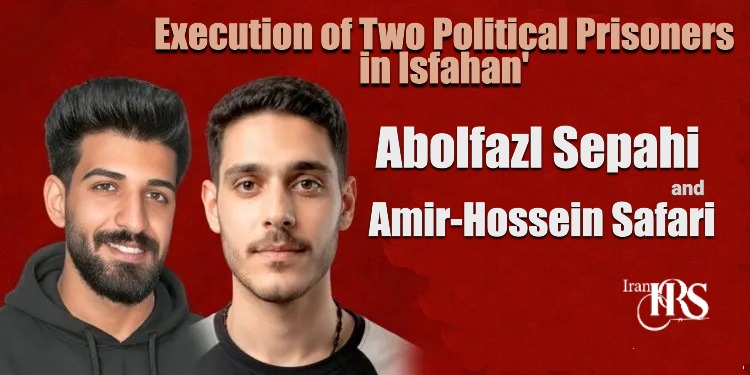
The death sentences of Abolfazl Sepahi and Amir-Hossein Safari, two detainees of the 2025 nationwide protests, were publicly executed on the morning of July 28, 2026, in Isfahan’s Ali-Khani Square. Concurrently, reports emerged of a heavy security environment, citizen protests, and grave concerns regarding the fate of other defendants in this case.

Iran Human Rights Society, July 28, 2026 – On the morning of Tuesday, July 28, 2026, the death sentences of Abolfazl Sepahi Badjani and Amir-Hossein Safari Hossein-Abadi, two detainees of the 2025 nationwide protests linked to the so-called “Ali-Khani Square” case, were publicly executed in the city’s Ali-Khani Square.
Mizan News Agency, affiliated with the Judiciary of the Islamic Republic, published a report confirming the execution of Abolfazl Sepahi and Amir-Hossein Safari, identifying both prisoners as defendants in the Ali-Khani Square case. These executions were carried out despite the case drawing widespread criticism from human rights organizations since its inception regarding the proceedings, interrogation methods, and compliance with fair trial principles.
Execution of Abolfazl Sepahi and Amir-Hossein Safari Under Heavy Security
According to received reports, the public execution of Abolfazl Sepahi and Amir-Hossein Safari in Ali-Khani Square, Isfahan, took place in the presence of a massive security deployment and an intensely militarized atmosphere.
Informed sources reported that during the execution, several citizens present at the scene protested the action; however, security forces intervened and confronted the protesters, preventing the continuation of the gathering. Reports of officers raiding protesting citizens were also published, though official authorities have offered no explanation regarding these reports.
The public execution of these death sentences in one of the city’s major squares has once again made the practice of public executions a focal point of human rights discourse.
Official Narrative of the Ali-Khani Square Case
Mizan News Agency claimed in its report that Abolfazl Sepahi actively participated in the Ali-Khani Square protests and, armed with cold weapons including an axe and a knife, played a role in blocking streets, burning tires, destroying public property, and attacking security forces.
The agency further claimed that Abolfazl Sepahi attacked a police officer during the clashes, ultimately contributing to the officer’s death. However, the report published by Mizan provided no documentary evidence, independent proof, or information that would allow for an impartial assessment of these claims.
Regarding Amir-Hossein Safari, Mizan News Agency claimed that from the onset of the events at Ali-Khani Square, he was present with his face covered and holding a machete, participating directly in the clashes. The report also made assertions regarding Amir-Hossein Safari’s role in attacking an officer, though, as with other portions of the report, no independent supporting evidence was published.
Human Rights Reports of Torture and Forced Confessions
Contrasting the official narrative, reports published by human rights sources indicated that Abolfazl Sepahi and Amir-Hossein Safari were subjected to intense security pressure, physical and psychological abuse, and torture following their arrest to extract forced confessions.
According to these reports, the families of Abolfazl Sepahi and Amir-Hossein Safari repeatedly protested the lack of free access to independent legal representation, restrictions on their right to defense, and the reliance on confessions extracted under coercion. Human rights activists emphasized that the use of such confessions, if proven, severely undermines the legal validity of the judicial process.
Furthermore, human rights bodies deemed the proceedings lacking in sufficient transparency, calling for the full disclosure of case details, evidence of the charges, and the provision of an independent and fair trial.
Concerns Over the Fate of Other Defendants in the Case
Simultaneously with the execution of Abolfazl Sepahi and Amir-Hossein Safari, reports surfaced regarding the status of other defendants in the Ali-Khani Square case.
Based on incoming information up to the time of this report’s preparation, precise details remain unavailable regarding the condition of Alireza Sepahi—another defendant in the case whose family was summoned alongside Abolfazl Sepahi’s family for a final visit. This lack of information has heightened fears concerning the potential execution of remaining convicts in this case.
Legal Review of the Case Based on Domestic Laws
The judicial framework governing Iran in recent years has drawn repeated criticism from legal scholars and human rights organizations over non-compliance with fair trial standards, ambiguities in security-related proceedings, and the extensive application of capital punishment. The case of Abolfazl Sepahi and Amir-Hossein Safari is among those that have raised serious legal questions due to reports concerning the arrest process, judicial handling, access to counsel, and public execution.
Legal Ambiguities in the Case
According to human rights sources, Abolfazl Sepahi and Amir-Hossein Safari faced security pressures, physical and mental abuse, and torture following their detention to elicit forced confessions. Furthermore, the families of both prisoners repeatedly expressed concern over the denial of freely chosen legal counsel, limitations on the right to defense, and a lack of transparency in judicial proceedings.
In contrast, the official account published by Mizan News Agency leveled severe charges against the two prisoners without releasing documented details, independent evidence, or information allowing for an objective evaluation. Under these circumstances, carrying out the death penalty—particularly amid torture allegations—remains a point of critical legal contention.
Relevant Legal Provisions
Reviewing this case under domestic law brings several key constitutional and statutory principles to light:
- Article 32 of the Constitution: Mandates adherence to legal procedures during arrest and requires immediate notification of charges.
- Article 35 of the Constitution: Recognizes the right to legal counsel for all defendants and considers access to chosen representation a fundamental right.
- Article 37 of the Constitution: Guarantees the presumption of innocence, stating that no one is deemed guilty unless proven in a competent court under the law.
- Article 38 of the Constitution: Prohibits all forms of torture to extract confessions or information, rendering forced confessions legally void.
- Article 39 of the Constitution: Forbids insulting or degrading the honor and dignity of any arrested, imprisoned, or convicted person.
- Code of Criminal Procedure: Emphasizes the right to defense, access to legal counsel, impartial proceedings, and procedural compliance at all judicial stages.
Potential Violations of Law
Based on reports surrounding the case of Abolfazl Sepahi and Amir-Hossein Safari, key legal concerns include:
- Reports of torture and coercion used to extract confessions;
- Restrictions on accessing independent legal representation and exercising defense rights;
- A lack of transparency in proceedings and failure to release case evidence;
- Execution of death sentences despite widespread criticism regarding fair trial violations;
- Public implementation of capital punishment, which continuously draws criticism from legal scholars regarding human dignity and proportionality of punishment.
Human Rights Violations Regarding Abolfazl Sepahi and Amir-Hossein Safari
The case of Abolfazl Sepahi and Amir-Hossein Safari also presents serious conflicts with international human rights standards. Reports of torture, coerced confessions, restricted legal access, opaque proceedings, and public execution stand in direct opposition to fundamental human rights principles.
Human rights organizations have repeatedly stressed that in cases involving capital punishment, strict adherence to fair trial guarantees is mandatory, and any allegation of torture or forced confession must be independently and impartially investigated before a sentence is passed or executed. Moreover, public executions are widely criticized by international bodies as degrading to human dignity and a tool for instilling public fear.
Relevant International Standards
- Article 3 of the Universal Declaration of Human Rights: The right to life, liberty, and security of person.
- Article 5 of the Universal Declaration of Human Rights: Absolute prohibition of torture or cruel, inhuman, or degrading treatment or punishment.
- Article 10 of the Universal Declaration of Human Rights: The right to a fair and public hearing by an independent and impartial tribunal.
- Article 14 of the International Covenant on Civil and Political Rights: Guarantees fair trial rights, legal representation, and an effective defense.
- Article 6 of the International Covenant on Civil and Political Rights: Recognizes the inherent right to life and restricts capital punishment to the strictest legal guarantees.
- Convention Against Torture: Explicitly rejects all forms of torture and the admissibility of forced statements.
- UN Nelson Mandela Rules: Reaffirms the necessity of respecting prisoner dignity and prohibiting inhuman or degrading treatment.
The public execution of Abolfazl Sepahi and Amir-Hossein Safari, alongside reports of torture, forced confessions, and judicial opacity, has once again placed the protection of defendants’ rights in protest-related cases and the use of capital punishment at the center of human rights oversight. Meanwhile, the lack of news regarding the status of Alireza Sepahi and other co-defendants continues to heighten fears of further executions.
See also the below articles:
- Ghezel Hesar Hunger Strike 14th Day: Authorities Relocate 240 Prisoners
- Isa Chari Death Sentence Issued for Political Prisoner in Ghezel Hesar
Follow Iran Human Rights Society on social networks:
Telegram /Twitter /Instagram / YouTube / Facebook
Join Iran Human Rights Society on Twitter