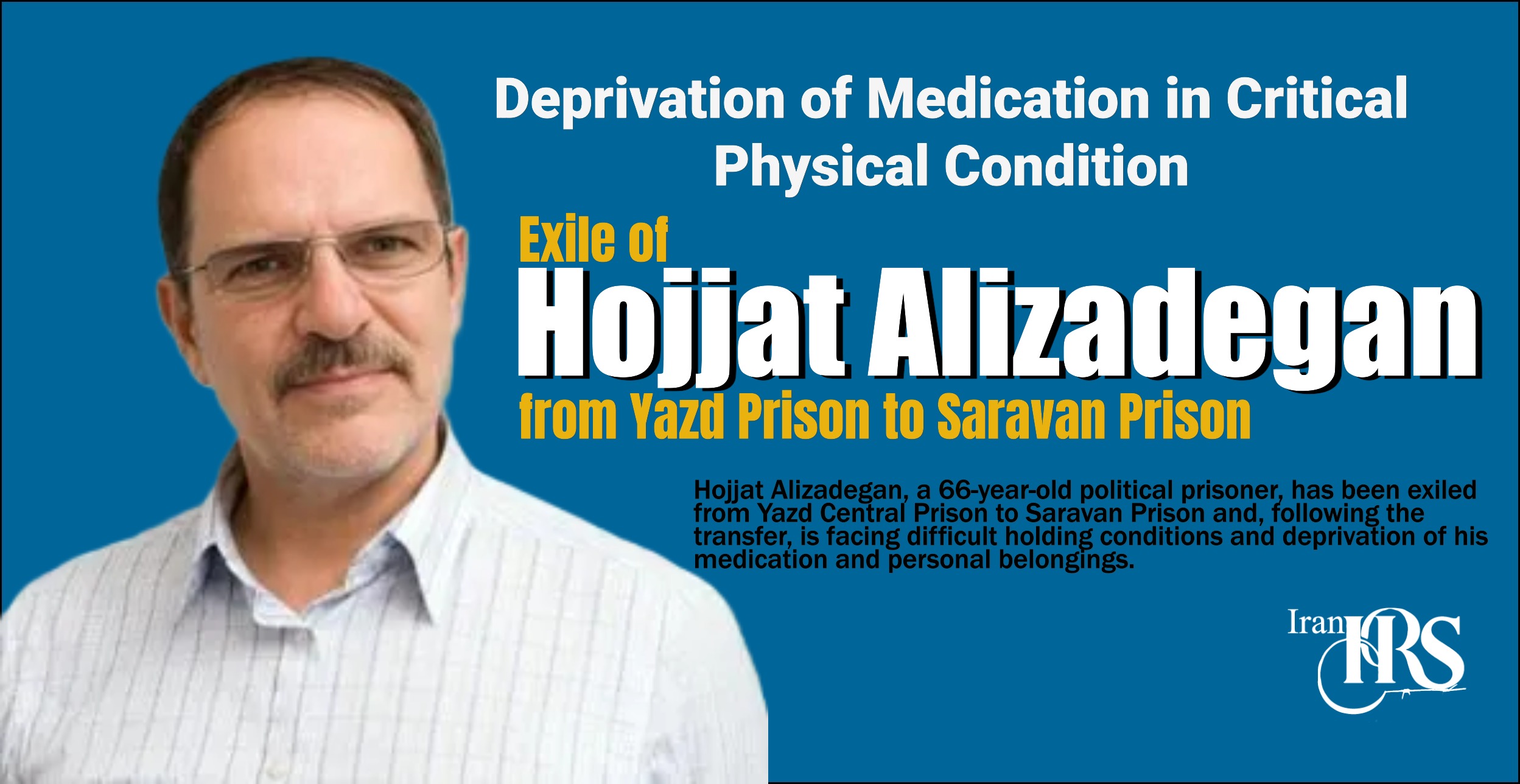
Hojjat Alizadegan, a 66-year-old political prisoner who had been incarcerated in Yazd Central Prison since 2024, has been exiled to Saravan Prison. Reports indicate that following the transfer, his medication and personal belongings were not delivered to him, and this prisoner, who suffers from a severe lung disease, is currently being held under poor sanitary conditions in Saravan Prison.
Iran Human Rights Society, Sunday, August 9, 2026 – According to reports received, Hojjat Alizadegan, a 66-year-old political prisoner, has been exiled from Yazd Central Prison to Saravan Prison and, following the transfer, is facing difficult holding conditions and deprivation of his medication and personal belongings.

Hojjat Alizadegan suffers from a severe lung condition and had previously been denied medical leave to specialized medical facilities while in Yazd Central Prison, despite requiring specialized care.
According to information received, Saravan Prison authorities did not hand over the necessary medication and personal belongings of this political prisoner to him following his transfer.
This measure was taken under circumstances where the continuation of medication and access to medical care are of critical importance for Hojjat Alizadegan given his pulmonary disease.
Reports received also describe the detention conditions in Saravan Prison as extremely poor and unsanitary.
According to these reports, the principle of the separation of crime categories is not observed in this prison, and prisoners with different offenses and circumstances are held alongside one another.
Prisoners also face a serious shortage of sanitary facilities, and the existing conditions have raised further concerns, particularly for sick and elderly prisoners.
Transfer to Saravan and Increased Pressure on Hojjat Alizadegan
The transfer of Hojjat Alizadegan from Yazd to Saravan, in addition to changing his place of detention, has moved him hundreds of kilometers away from his previous place of incarceration and his family.
According to the report received, after the arrival of this political prisoner at Saravan Prison, his medications and belongings were not handed over to him. This measure has been reported as part of the pressures exerted upon him.
Depriving a sick prisoner of medication, particularly an individual grappling with a severe lung condition, can place his physical state at greater risk.
At the same time, the general state of Saravan Prison has added to the concerns. Reports received indicate unsanitary conditions, a lack of adequate facilities for personal hygiene, and non-compliance with the separation of crime categories.
These conditions can create double pressure for a 66-year-old prisoner who already required specialized medical treatment prior to the transfer.
History of Treatment Deprivation in Yazd Prison
The medical issues of Hojjat Alizadegan are not limited to his transfer to Saravan Prison.
He has been incarcerated in Yazd Central Prison since 2024 on charges of supporting the People’s Mojahedin Organization, and prior to his exile, reports regarding the deterioration of his physical condition and his deprivation of treatment had been published.
According to information received from informed sources, this political prisoner suffers from severe lung disease and requires specialized medical care.
However, Yazd Central Prison authorities, in coordination with the Ministry of Intelligence, prevented his transfer to medical centers outside the prison.
The continuation of medical deprivation in Yazd Prison, followed by his transfer to Saravan Prison and the withholding of his medications, has now heightened concerns regarding the health of this political prisoner.
Information Box | Status of Saravan Prison at a Glance
| Title | Information |
| Name of Prison | Saravan Prison |
| Sanitary Condition | Reports indicate very poor and unsanitary conditions across various sections of the prison |
| Sanitary Facilities | Prisoners are reported to be deprived of adequate access to sanitary facilities and supplies |
| Separation of Crime Categories | According to reports received, the principle of separation of crime categories is not properly observed |
| Holding Conditions | Overcrowding, limited facilities, and poor environmental conditions are among the raised issues |
| Status of Sick Prisoners | Current conditions are assessed as more alarming for elderly prisoners and those with underlying illnesses |
| Access to Medication and Treatment | In the case of Hojjat Alizadegan, non-delivery of medications and personal belongings following transfer has been reported |
| Distance from Family | Transferring prisoners from other provinces to Saravan can make family visits and tracking their case status more difficult |
| Core Human Rights Concern | Right to health, access to treatment, human dignity, sanitary conditions, and adherence to proper separation of prisoners |
Poor Sanitary Conditions in Saravan Prison
According to the report received, the sanitary condition of Saravan Prison is unsuitable, and prisoners are deprived of adequate facilities to maintain personal hygiene.
Non-observance of the principle of separation of crime categories is another problem reported in this prison.
The separation of prisoners based on their judicial status and type of offense, in addition to being emphasized in internal prison regulations, is considered one of the important principles for preserving security and proper holding conditions for prisoners.
The transfer of Hojjat Alizadegan to such conditions, while he suffers from severe lung disease, doubles the urgent necessity of his immediate access to medication, medical examination, and specialized care.
Legal Review of Hojjat Alizadegan’s Case Based on Domestic Laws
The dictatorial laws governing Iran in recent years have repeatedly been criticized for failing to align with fair trial standards, ambiguity in handling security cases, and restricting prisoners’ rights. Reviewing Hojjat Alizadegan’s case based on domestic laws does not imply endorsement of these laws; the goal is to highlight instances where even these existing laws were not observed by the judiciary and prison authorities.
Legal Ambiguities of the Case
According to published information, Hojjat Alizadegan, a 66-year-old political prisoner, has been incarcerated in Yazd Central Prison since 2024 on charges of supporting the People’s Mojahedin Organization and has now been exiled from this prison to Saravan Prison.
This transfer took place under circumstances where Hojjat Alizadegan suffers from severe lung disease and requires specialized medical care and medication. Prior to the transfer, it was also reported that Yazd Central Prison officials, in coordination with the Ministry of Intelligence, prevented his medical transfer to specialized centers outside the prison.
Following his transfer to Saravan Prison, according to received reports, the medications and personal belongings of this political prisoner were not handed over to him. Depriving an ill prisoner of required medication, particularly considering the age and severe lung condition of Hojjat Alizadegan, raises direct responsibility for prison authorities to protect the life and health of the prisoner.
On the other hand, the conditions in Saravan Prison are reported to be extremely poor and unsanitary. Prisoners are deprived of adequate health facilities, and the principle of separation of crime categories is not observed in this prison. Holding a 66-year-old prisoner suffering from lung disease under such conditions can increase the risk of worsening illness and physical harm.
The transfer of Hojjat Alizadegan from Yazd to Saravan has also resulted in a significant distance between him and his family and previous place of detention. This issue can make visits, following up on the prisoner’s condition, and maintaining regular contact with his family more difficult, thereby increasing the necessity of examining the legal basis and intent of this transfer.
Relevant Legal Articles
Reviewing this case from the perspective of domestic laws recalls several important principles and regulations:
- Article 22 of the Constitution: Considers the life, rights, and dignity of individuals immune from violation.
- Article 32 of the Constitution: Emphasizes adherence to legal regulations regarding detention and the treatment of detainees.
- Article 39 of the Constitution: Explicitly forbids any affront to dignity or dishonorable treatment of arrested persons and prisoners.
- Executive Regulations of the Prisons Organization: Obligates prison officials to provide required health, medical, and healthcare services to prisoners.
- Regulations related to Prisoner Health and Treatment: Emphasize the necessity of medical examination, treatment, provision of medication, and, if needed, transfer of sick prisoners to medical facilities.
- Regulations related to the Classification and Separation of Prisoners: Emphasize the necessity of holding prisoners according to their judicial status, type of charge, and conditions.
- Regulations related to Prisoner Communication with Family: Emphasize maintaining the possibility of visits and communication between prisoners and their families.
Instances of Law Violation
Considering the published information, the most important legal concerns include:
- Transferring Hojjat Alizadegan from Yazd Prison to Saravan Prison despite his severe lung disease and need for medical care;
- Preventing the transfer of this political prisoner to specialized medical centers during his detention at Yazd Prison;
- Failing to deliver required medications to Hojjat Alizadegan after his transfer to Saravan Prison;
- Failing to deliver personal belongings to this prisoner after the transfer;
- Holding a 66-year-old prisoner suffering from lung disease in unsuitable and unsanitary conditions;
- Non-observance of the principle of separation of crime categories in Saravan Prison;
- Increased risk to the health and life of the prisoner as a result of deprivation of medication and specialized treatment;
- Transfer to a prison far from the previous place of incarceration, making communication and visits with family more difficult;
- Ambiguity regarding the necessity and legal basis for transferring Hojjat Alizadegan to Saravan Prison.
Reviewing the Case from the Perspective of Human Rights and Potential Violations of International Standards
From a human rights perspective, deprivation of liberty does not mean the forfeiture of the right to health and human dignity, and the government holds direct responsibility for providing the medical needs of persons in its custody. The reported situation regarding Hojjat Alizadegan, particularly his deprivation of medication despite severe lung disease and detention in unsanitary conditions, raises serious concerns regarding compliance with fundamental rights.
Human Rights Ambiguities of the Case
Depriving a 66-year-old prisoner suffering from severe lung disease of medication and specialized care, the continuation of this state after his transfer to Saravan Prison, and the unsanitary conditions of his place of detention are among the most primary human rights concerns in this case.
Transferring a prisoner to a remote prison can also make access to his family and support network more difficult, which must be evaluated in terms of necessity, proportionality, and its impact on the prisoner’s rights.
Relevant International Documents
- Article 5 of the Universal Declaration of Human Rights: Prohibition of torture and cruel, inhuman, or degrading treatment or punishment.
- Article 10 of the International Covenant on Civil and Political Rights: Mandates that all persons deprived of their liberty shall be treated with humanity and with respect for inherent dignity.
- Nelson Mandela Rules: Emphasize prisoners’ access to adequate medical services and the government’s responsibility to protect their health.
- Nelson Mandela Rules regarding place of detention for prisoners: Emphasize holding prisoners near their homes or places of social rehabilitation.
See also the below articles:
- Ardabil Prison: 54 Protest Detainees Remain Held in Legal Limbo
- Evin Prison Ward 7 Raid: 50 Guards Assault Political Prisoners
Follow Iran Human Rights Society on social networks:
Telegram /Twitter /Instagram / YouTube / Facebook
Join Iran Human Rights Society on Twitter