Reports received from Evin Prison indicate oppressive heat, malfunctioning cooling systems, a widespread bedbug infestation, and the housing of political prisoners alongside social crime convicts—conditions that have significantly heightened physical and psychological pressure on inmates.
Iran Human Rights Society, Tuesday, August 11, 2026 – Detention conditions in Evin Prison have reached a critical state following a sharp surge in temperatures and the inadequacy of cooling equipment. According to received information, temperatures inside certain halls exceed 40°C, while existing evaporative coolers fail to cool the premises. Simultaneously, housing political prisoners of Ward 7 alongside ordinary convicts, continuous locking of hall doors, unsuitable open-air yard conditions, bedbug infestations, the absence of sports facilities, and unhygienic conditions have placed severe double pressure on inmates.
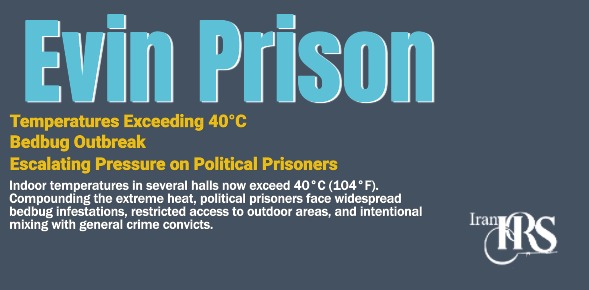
Temperatures Exceeding 40°C in Evin Prison
According to reports received, one of the most critical current issues in Evin Prison is the extreme heat inside the wards and housing halls.
Sources describe the indoor temperature as exceeding 40°C. Direct sunlight hitting the building’s walls and windows further raises indoor hall temperatures, making the environment unbearable for prisoners.
Existing cooling equipment lacks proper efficiency. Reports indicate that instead of cooling the air, these units function merely as fans, circulating warm air without noticeably lowering temperatures.
Consequently, prisoners spend long hours throughout the day and night in an enclosed, extremely hot environment.
Unusable Outdoor Yards and Locked Hall Doors
The extreme heat is not confined to indoor areas. The prison’s outdoor yard is exposed to direct, intense sunlight during usable hours, severely impeding prisoners’ ability to utilize the open space.
Furthermore, hall doors remain locked around the clock, restricting inmate movement and access to broader areas.
Sources have likened this situation to a “crowded solitary confinement”—a phrase reflecting the combination of restricted movement with high inmate density in a closed space.
For political prisoners already facing other layers of restrictions, these conditions inflict heightened physical and psychological strain.
Incarcerating Political Prisoners Alongside Ordinary Inmates
A key highlight of the reports is the condition of political prisoners in Ward 7 of Evin Prison.
The principle of separation of crime categories is ignored in this ward, with political prisoners held next to individuals convicted of ordinary social crimes. Sources state that similar conditions exist across other halls.
Specifically, roughly one-fifth of Hall 2 has been allocated to individuals accused of narcotics-related offenses.
Placing distinct categories of prisoners with differing judicial statuses and case types into a shared environment diminishes available physical space and exerts further strain on inmates.
For political prisoners, this is particularly acute; housing them alongside common-law prisoners jeopardizes their daily safety, peace of mind, and general living conditions.
Bedbug Infestations and Unhygienic Conditions
Another major issue highlighted in the reports is the severely degraded state of hygiene.
Sources report an extensive bedbug infestation within the wards. The combination of intense heat, closed quarters, and inadequate sanitation worsens living conditions.
Prisoners are subjected not only to high temperatures but also to insect bites and a lack of supplies necessary to maintain basic cleanliness.
This is especially alarming given that inmates remain confined inside closed halls for extended periods with minimal outdoor access.
Absence of Sports and Recreational Amenities
Sports facilities are non-existent in the referenced sections.
The lack of sports equipment, combined with restricted yard access, locked hall doors, and extreme temperatures, deprives prisoners of regular physical exercise.
Sources also describe high expenses imposed on prisoners alongside minimal amenities, noting that current conditions have effectively turned Evin Prison into an exhausting and restrictive internal exile camp.
The aggregate impact of temperatures exceeding 40°C, failing cooling equipment, bedbug outbreaks, restricted open-air access, lack of exercise amenities, and failure to segregate crime categories places constant pressure on prisoners, especially political detainees.
Legal Analysis of Political Prisoners’ Conditions in Evin Prison Under Domestic Law
The legal frameworks enforced in Iran have faced ongoing criticism for violating fair trial standards, maintaining substandard prison environments, and curtailing political prisoners’ rights. Analyzing conditions under domestic statutes does not imply validation of these laws; the intent is to highlight areas where existing statutory provisions are breached by prison authorities.
Legal Ambiguities
The severe heat, broken cooling infrastructure, unhygienic conditions, bedbug outbreaks, restricted outdoor access, and lack of recreational amenities establish clear failures regarding the prison administration’s duty to provide minimum standards of care.
Furthermore, housing political prisoners alongside ordinary criminals and dedicating parts of Hall 2 to narcotics suspects violates binding regulations on prisoner classification and segregation.
Relevant Domestic Statutes
- Article 22 of the Constitution: Deems the lives, rights, and dignity of individuals immune from violation.
- Article 39 of the Constitution: Forbids affronts to the dignity and honor of arrested persons and prisoners.
- Executive Regulations of the Prisons Organization: Mandates classification and housing of prisoners based on offense category, judicial status, and statutory criteria.
- Prisons Organization Health and Sanitation Provisions: Obligates administration officials to ensure sanitary conditions, health-preserving equipment, access to physical activities, and adequate facilities.
Instances of Statutory Violations
- Failure to enforce crime segregation by holding political prisoners alongside common-law offenders;
- Housing narcotics defendants within halls assigned to other prisoner categories;
- Inadequate cooling infrastructure amid extreme heat;
- Extensive bedbug infestation and poor sanitary conditions;
- Severe restrictions on open-air yard access;
- Absence of adequate physical fitness amenities;
- Continuous locking of hall doors, exacerbating confinement.
Evaluation Under International Human Rights Standards
Holding conditions for persons deprived of liberty must uphold human dignity. Incarceration does not negate the fundamental rights to health, adequate sanitation, open-air access, and humane treatment.
Human Rights Ambiguities
Subjecting prisoners to prolonged high temperatures without effective cooling, unchecked bedbug infestations, restricted yard access, and mixing distinct prisoner categories violate basic standards of humane treatment.
Relevant International Instruments
- Article 5 of the Universal Declaration of Human Rights: Prohibition of cruel, inhuman, or degrading treatment or punishment.
- Article 10 of the International Covenant on Civil and Political Rights: Mandates humane treatment and respect for the inherent dignity of all persons deprived of their liberty.
- The Nelson Mandela Rules: Mandate adequate space, ventilation, sanitation, lighting, access to physical exercise, and daily open-air yard access.
- The Nelson Mandela Rules on Classification: Obligate authorities to classify and separate prisoners according to their legal status and individual needs.
Potential Human Rights Violations
Extreme heat without effective cooling, pervasive bedbug infestations, unsanitary living quarters, restricted yard time, absence of fitness equipment, arbitrary mobility restrictions, and the forced cohabitation of political prisoners with ordinary offenders constitute key international human rights violations in Evin Prison.
See also the below articles:
- Ziabar Prison: Sattar Babaei Transferred to Overcrowded Ward
- Fardis Prison: Intelligence Official Threatens Atefeh Hassani
Follow Iran Human Rights Society on social networks:
Telegram /Twitter /Instagram / YouTube / Facebook
Join Iran Human Rights Society on Twitter