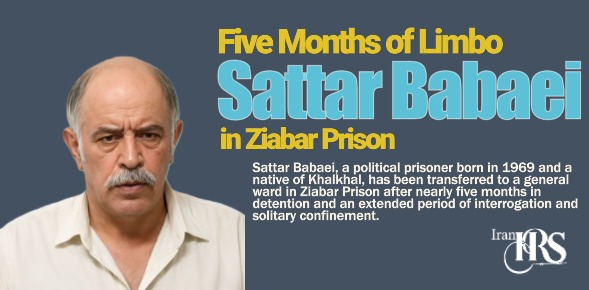
Sattar Babaei, a political prisoner held in Ziabar Prison, has been transferred to a general ward after enduring months of harsh interrogation and solitary confinement. According to received information, approximately 200 prisoners are held in this ward, with only three telephone lines available for communication with their families. Sattar Babaei remains in judicial limbo since his arrest in March 2026.
Iran Human Rights Society, Monday, August 10, 2026 – Sattar Babaei, a political prisoner born in 1969 and a native of Khalkhal, has been transferred to a general ward in Ziabar Prison after nearly five months in detention and an extended period of interrogation and solitary confinement. The poor condition of the ward, the overcrowding of around 200 prisoners, and severe restrictions on telephone access have created difficult conditions for the inmates. Sattar Babaei remains incarcerated in this prison without any final judicial determination.
Transfer of Sattar Babaei from Solitary Confinement to Ziabar Prison General Ward
According to received reports, Sattar Babaei has been transferred to a general ward in Ziabar Prison following months of interrogation and solitary confinement.

This transfer occurred while conditions in the general ward where he is held are also reported to be unsuitable. Approximately 200 prisoners are held in this ward, and existing communication facilities are inadequate for this population.
One of the most significant problems faced by the prisoners is severe restrictions on telephone calls with their families. Only three telephone lines have been designated for the approximately 200 prisoners in this ward.
As a result of this shortage, each prisoner is typically able to use the telephone and speak with their family only once every three or four days. This situation imposes serious limitations on the regular communication of prisoners with their families.
Five Months of Limbo for Sattar Babaei in Ziabar Prison
Sattar Babaei has been held in Ziabar Prison for nearly five months and, according to available information, remains in judicial limbo.
He was arrested in March 2026. At the time of his arrest, officers confiscated a number of his personal belongings and documents.
These items included his mobile phone, laptop, house ownership deeds, and several other personal documents. Based on information received, these belongings have not yet been returned to him or his family.
The ongoing uncertainty of this prisoner’s status after several months of detention, coupled with an extended period of interrogation and solitary confinement, represents one of the primary concerns regarding his situation.
Background of Sattar Babaei’s Arrest
Sattar Babaei, born in 1969 in Khalkhal, has been identified as a supporter of the People’s Mojahedin Organization.
He was previously arrested in 2019/2020 on charges of cooperating with this organization.
His rearrest took place in March 2026, after which he was subjected to prolonged interrogation and held in solitary confinement. Although he has now been transferred to the general ward, his judicial status remains undetermined, and no information is available regarding his trial date or the judiciary’s final decision on his new case.
Legal Review of Sattar Babaei’s Case Based on Domestic Laws
The dictatorial laws governing Iran in recent years have repeatedly been criticized for failing to align with fair trial standards, ambiguity in handling security cases, and restricting freedom of expression and political activities. Reviewing Sattar Babaei’s case based on domestic laws does not imply endorsement of these laws; the objective is to highlight instances where even these existing laws were not observed by security and judicial authorities.
Legal Ambiguities of the Case
Sattar Babaei remains in judicial limbo nearly five months after his arrest. Available information also indicates his prolonged detention in solitary confinement and interrogation prior to his transfer to the general ward.
The confiscation and failure to return his mobile phone, laptop, ownership deeds, and other personal documents upon arrest raise questions regarding compliance with regulations governing the seizure and retention of a defendant’s property.
Relevant Legal Articles
- Article 22 of the Constitution: Holds individual property, rights, and dignity immune from violation, except as authorized by law.
- Article 32 of the Constitution: Mandates that arrests must be conducted according to legal procedures and charges must be communicated to the individual.
- Article 35 of the Constitution: Recognizes the right to have an attorney.
- Article 37 of the Constitution: Emphasizes the presumption of innocence.
- Article 39 of the Constitution: Forbids any affront to the dignity and honor of arrested persons and prisoners.
- Code of Criminal Procedure: Emphasizes determining the status of the accused, respecting defense rights, and regulating the seizure of property and items connected to the case.
Instances of Law Violation
- Continued judicial limbo following nearly five months of detention;
- Prolonged detention in solitary confinement;
- Ambiguity regarding the review process and the timeline for resolving the case;
- Confiscation and non-return of personal property and documents;
- Severe restrictions on communication with family after transfer to the general ward.
Reviewing the Case from the Perspective of Human Rights and Potential Violations of International Standards
From a human rights perspective, prolonged detention without resolution, extended periods in solitary confinement, and severe restrictions on a prisoner’s communication with family can infringe upon the fundamental rights of a person deprived of liberty.
Human Rights Ambiguities of the Case
The primary concerns regarding Sattar Babaei’s situation include prolonged judicial limbo, the length of his solitary confinement, and the conditions of the general ward in Ziabar Prison.
The availability of only three telephone lines for approximately 200 prisoners, restricting their phone access to once every three or four days, constitutes a significant limitation on maintaining prisoners’ connections with their families.
Relevant International Documents
- Article 9 of the Universal Declaration of Human Rights: Prohibition of arbitrary arrest and detention.
- Article 10 of the Universal Declaration of Human Rights: Right to a fair trial.
- Article 9 of the International Covenant on Civil and Political Rights: Protection against arbitrary arrest and the right to judicial review.
- Article 10 of the International Covenant on Civil and Political Rights: Requirement of humane and respectful treatment for all persons deprived of liberty.
- Nelson Mandela Rules: Emphasize maintaining prisoners’ communication with family, humane holding conditions, and strict limits on the use of solitary confinement.
See also the below articles:
- Fardis Prison: Intelligence Official Threatens Atefeh Hassani
- Amol Prison: Spoiled Food Rations and Severe Health Crisis
Follow Iran Human Rights Society on social networks:
Telegram /Twitter /Instagram / YouTube / Facebook
Join Iran Human Rights Society on Twitter