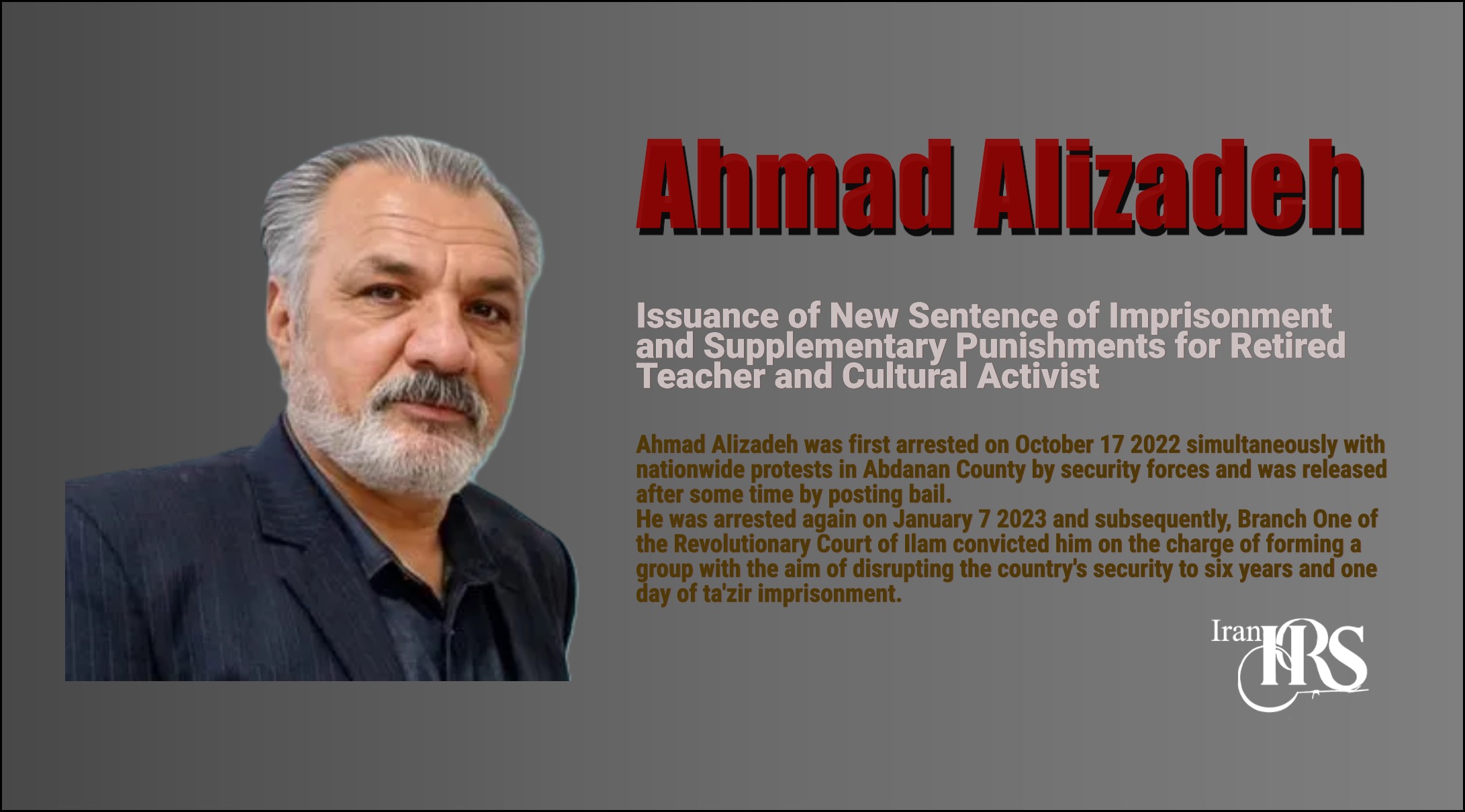
Ahmad Alizadeh, retired teacher and cultural activist from Abdanan, while facing a new sentence of two years imprisonment, ban on leaving the country and supplementary punishments, is currently serving his compulsory exile period in Fanuj County of Sistan and Baluchestan Province.
Iran Human Rights Society, Tuesday June 30 2026 – The issuance of a new sentence for Ahmad Alizadeh, retired teacher and cultural activist from Abdanan, has once again drawn attention to the continuation of judicial actions against political and guild activists. He, who had previously been sentenced to imprisonment, compulsory retirement and exile due to activities related to nationwide protests and security charges, is now facing a new conviction while still serving his compulsory exile period in Sistan and Baluchestan Province.
What Punishments Does the New Sentence of Ahmad Alizadeh Include?
According to published reports, Branch of the Revolutionary Court of Ilam under the presidency of Judge “Rajab Mohammadi” has notified Ahmad Alizadeh of the new sentence in person.
According to this ruling, Ahmad Alizadeh has been sentenced to two years of ta’zir imprisonment of the fifth degree, taking into account the previous days of detention, for the charges of “propaganda against the regime”, “propaganda in favor of groups opposed to the regime” and “insulting the founder and leader of the Islamic Republic”.
In addition to the imprisonment punishment, the court has sentenced him to one year ban on leaving the country, cancellation of passport and 1080 hours of free public services in Abdanan Municipality as supplementary punishment.
What Is the History of Arrest and Conviction of Ahmad Alizadeh?
Ahmad Alizadeh was first arrested on October 17 2022 simultaneously with nationwide protests in Abdanan County by security forces and was released after some time by posting bail.
He was arrested again on January 7 2023 and subsequently, Branch One of the Revolutionary Court of Ilam convicted him on the charge of forming a group with the aim of disrupting the country’s security to six years and one day of ta’zir imprisonment.
Also in the same case, for the charge of “propaganda against the regime”, he was sentenced to seven months and sixteen days of ta’zir imprisonment, compulsory retirement, exile to Fanuj County in Sistan and Baluchestan Province and deprivation of any activity in virtual space.
How Has the Process of Judicial Cases of Ahmad Alizadeh Continued?
According to published information, Ahmad Alizadeh in another one of his judicial cases had also been sentenced to 27 months of ta’zir imprisonment, two years of dismissal from service, one year deprivation of activity in virtual space and two years of exile for charges of “forming a group and assembly with the aim of disrupting security”, “propaganda against the regime” and “disturbing public minds”.
After serving part of the imprisonment period and also five months of house arrest with an electronic anklet, on February 15 2025 he was sent to Fanuj County for the execution of the two-year exile sentence and is currently serving his exile period in this county.
The issuance of the new sentence has taken place while he is still executing the previous punishments.
Why Has the Issuance of Multiple Sentences for Cultural Activists Attracted the Attention of Legal Observers?
Some legal observers believe that the issuance of multiple and consecutive sentences for cultural and guild activists, especially in cases with general security titles, can have extensive consequences for the freedom of political and guild activities.
In their belief, the use of supplementary punishments such as exile, compulsory retirement, deprivation of activity in virtual space, ban on leaving the country and compulsory public services, along with imprisonment punishment, increases the scope of restrictions imposed on political activists and its effects continue beyond the period of criminal conviction.
Legal Examination of the Case Based on Domestic Laws
Legal Ambiguities
The issuance of multiple sentences for a political activist, along with the simultaneous application of punishments such as imprisonment, exile, compulsory retirement, deprivation of activity in virtual space, ban on leaving the country and compulsory public services, raises questions about the principle of proportionality of punishment, the necessity of applying supplementary punishments and respecting the defense rights of the accused. Also, the use of general security titles without publishing the details of the case documents makes the evaluation of the trial process difficult.
Related Legal Articles
Article 22 of the Constitution: The dignity, rights and occupation of individuals are inviolable except by law.
Article 23 of the Constitution: Inquisition of beliefs is prohibited.
Article 32 of the Constitution: No one can be arrested except by law.
Article 34 of the Constitution: The right to seek justice is an absolute right of every individual.
Article 35 of the Constitution: The accused has the right to choose and access a lawyer.
Article 37 of the Constitution: The principle is innocence unless the crime is proven in a competent court.
Criminal Procedure Law: Emphasizes respecting the defense rights of the accused and fair trial.
Cases of Violation of Law
Issuance of multiple sentences and simultaneous application of heavy and supplementary punishments.
Restriction of civil and guild activities through extensive deprivations.
Use of general security titles without publishing clear documents.
Continuation of social and occupational restrictions after serving part of the conviction.
Why Can Ahmad Alizadeh’s Case Be Noteworthy from a Human Rights Perspective?
Ahmad Alizadeh’s case from a human rights perspective raises issues such as freedom of expression, the right to a fair trial and the right to employment. Also, the application of punishments such as exile, deprivation of activity in virtual space and compulsory retirement, along with criminal convictions, is among the cases that have always been the focus of human rights institutions.
Related Human Rights Articles
Article 9 of the Universal Declaration of Human Rights and Article 9 of the International Covenant on Civil and Political Rights: Prohibition of arbitrary arrest.
Article 10 of the Universal Declaration of Human Rights and Article 14 of the International Covenant on Civil and Political Rights: The right to a fair trial.
Article 19 of the Universal Declaration of Human Rights and Article 19 of the International Covenant on Civil and Political Rights: Protection of freedom of expression and opinion.
Article 23 of the Universal Declaration of Human Rights: The right to work and job security.
The issuance of the new sentence against Ahmad Alizadeh has taken place while this retired teacher and cultural activist is still serving his compulsory exile period. The addition of new convictions to the collection of previous sentences has once again placed the issue of how to deal with political and guild activists and the legal and social consequences of these sentences at the center of attention.
See also the below articles:
- Iman Khedri Faces Prolonged Detention in Iran
- Dastgerd Prison in Isfahan: Exposure of the Massacre and Bloody Suppression of Prisoners on March 31, 2026
Follow Iran Human Rights Society on social networks:
Telegram /Twitter /Instagram / YouTube / Facebook
Join Iran Human Rights Society on Twitter