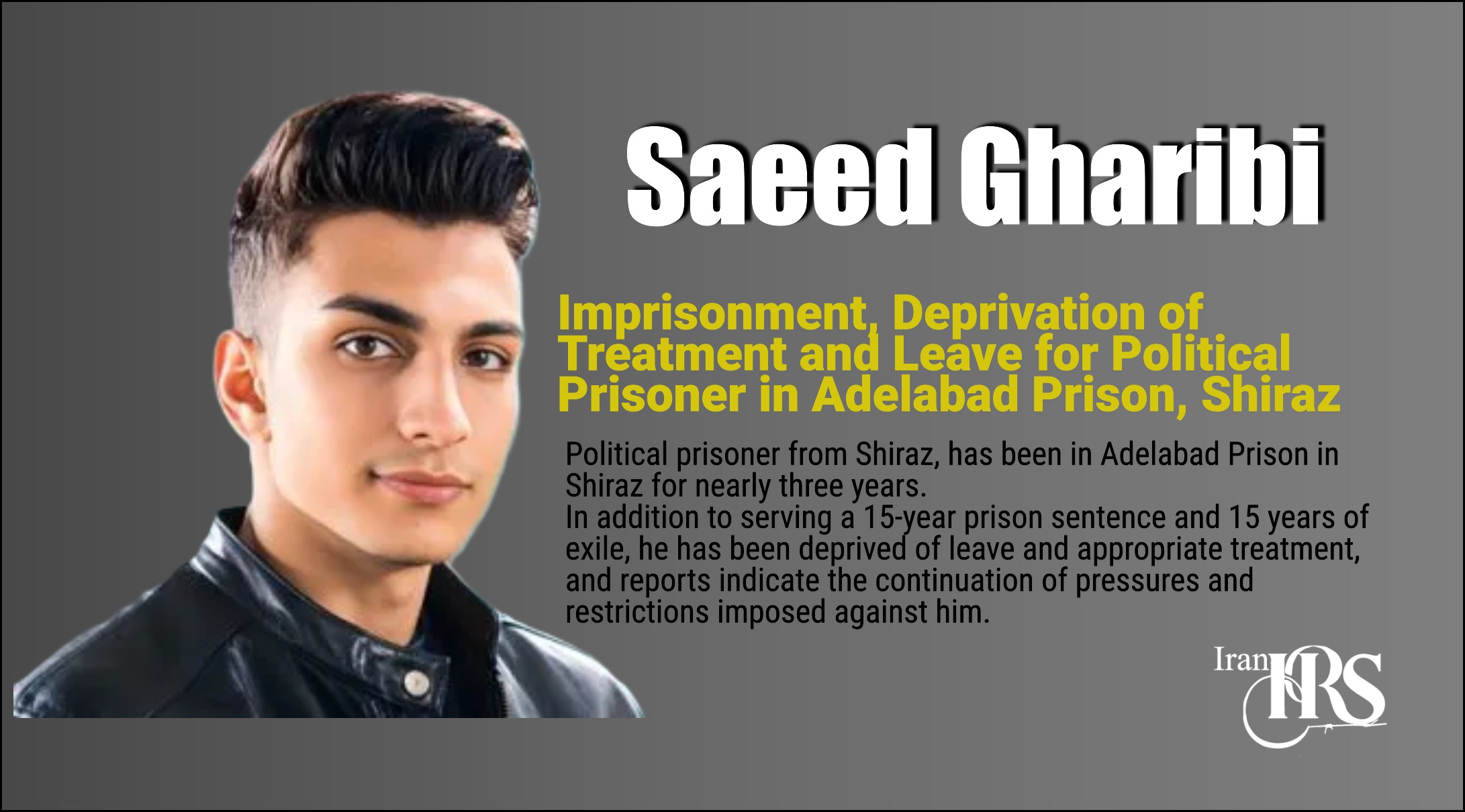
Saeed Gharibi, a political prisoner from Shiraz, has been in Adelabad Prison in Shiraz for nearly three years. In addition to serving a 15-year prison sentence and 15 years of exile, he has been deprived of leave and appropriate treatment, and reports indicate the continuation of pressures and restrictions imposed against him.
Iran Human Rights Society, Wednesday July 1, 2026 – The continuation of detention and deprivations imposed against Saeed Gharibi, a political prisoner held in Adelabad Prison in Shiraz, has created new concerns about his health status and legal rights. This political prisoner who was arrested after the nationwide protests and sentenced to long-term imprisonment and exile, has also been deprived of transfer to medical centers and receiving appropriate medical services after a protest self-immolation action.
Latest Status of Saeed Gharibi in Adelabad Prison, Shiraz
Saeed Gharibi, born in 2003 and from Shiraz, is now spending about three years of his sentence in Adelabad Prison in Shiraz. According to published reports, he has been deprived of the right to use leave throughout this period and is still being held in restrictive prison conditions.

Reports also indicate that the restrictions imposed in the prison have imposed additional pressures on this political prisoner and have confronted his physical and mental condition with serious concerns.
How and with what charges was Saeed Gharibi arrested?
Saeed Gharibi was first arrested on December 20, 2022 in connection with the nationwide protests of that year and was temporarily released after about three months, on March 6, 2023.
He was arrested again on December 12, 2023 in the city of Shiraz and transferred to Adelabad Prison. According to available reports, after transfer to prison he was subjected to interrogation and torture.
In the continuation of the judicial process, Branch One of the Shiraz Revolutionary Court, presided over by Judge Sadati, sentenced Saeed Gharibi on charges of “propaganda against the system,” “insulting Khamenei,” and “burning public property” to 15 years in prison and 15 years of exile to Tabas city.
Why has Saeed Gharibi’s physical condition caused concern?
One of the most important concerns about Saeed Gharibi’s condition is his deprivation of appropriate medical services.
According to reports, this political prisoner in late November 2024 protested the issued sentence and conditions of detention in Adelabad Prison in Shiraz by carrying out a protest self-immolation.
Following this action, he suffered severe burns on both hands and his waist. Despite the severity of the injuries, reports indicate that he is still being held in prison and has been deprived of transfer to hospital and receiving specialized medical care.
Also, the restrictions imposed in the prison have created difficult conditions for the continuation of treatment and improvement of his physical condition.
What are the consequences of deprivation of treatment and leave?
The continuation of holding Saeed Gharibi in prison, while according to reports he needs specialized medical care, has increased concerns about his health condition.
Human rights activists have always emphasized that prisoners’ access to appropriate medical services is part of their fundamental rights and deprivation of treatment or delay in providing medical services can endanger the health and life of prisoners.
Also, multi-year deprivation of leave, along with heavy sentencing and continuous restrictions, imposes additional mental and psychological pressures on prisoners and their families.
Legal examination of the case based on domestic laws
Legal ambiguities
The continuation of holding Saeed Gharibi in prison despite reports of physical injuries resulting from self-immolation, deprivation of specialized treatment, lack of benefit from leave, and issuance of heavy sentences, raises questions about compliance with prisoners’ rights and legal requirements regarding preservation of their health and dignity.
Related legal articles
Article 22 of the Constitution: The dignity, life, and rights of persons are inviolable except by law.
Article 32 of the Constitution: Arrest must be in accordance with the law and with observance of legal formalities.

Article 34 of the Constitution: The right to petition is an absolute right of every individual.
Article 35 of the Constitution: The accused has the right to access a lawyer.
Article 39 of the Constitution: Violation of dignity and humiliating treatment towards prisoners is prohibited.
Criminal Procedure Code and Prison Organization Regulations: Emphasize the necessity of providing medical services and preserving the health of prisoners.
Instances of law violation
Long-term deprivation of specialized medical services.
Continuation of detention in prison despite urgent need for treatment.
Multi-year deprivation of leave.
Reports of torture and mistreatment during interrogation.
Imposition of restrictions that can endanger the prisoner’s physical and mental health.
Why can Saeed Gharibi’s case be considered an example of human rights violation?
Saeed Gharibi’s case from a human rights perspective raises issues such as the right to health, prohibition of inhuman behaviors, the right to fair trial, and respect for the dignity of prisoners. The continuation of holding an injured prisoner without sufficient access to medical services, along with deprivation of leave and reports of torture, are among the cases that have always been the focus of human rights institutions.
Violated articles
Article 5 of the Universal Declaration of Human Rights and Article 7 of the International Covenant on Civil and Political Rights: Prohibition of torture and cruel, inhuman or degrading treatment or punishment. Deprivation of treatment and reports of torture create concerns about compliance with this principle.
Article 9 of the Universal Declaration of Human Rights: Protection against arbitrary arrest and detention and the necessity of observing the legal rights of detainees.
Article 10 of the Universal Declaration of Human Rights and Article 14 of the International Covenant on Civil and Political Rights: The right to a fair trial and guarantees of the defense rights of the accused.
Article 12 of the International Covenant on Economic, Social and Cultural Rights: The right to the highest attainable standard of physical and mental health, including prisoners’ access to appropriate medical services.
The continuation of Saeed Gharibi’s imprisonment in Adelabad Prison in Shiraz, simultaneously with deprivation of leave, restriction in access to medical services, and reports of physical injuries resulting from protest self-immolation, has increased concerns about the condition of this political prisoner. The continuation of these conditions, along with heavy sentencing and long-term exile, has once again placed the issue of respecting prisoners’ rights and their access to medical care and fair trial at the center of attention.
See also the below articles:
- Ahmad Alizadeh: New Prison Sentence for Retired Teacher and Activist
- Iman Khedri Faces Prolonged Detention in Iran
Follow Iran Human Rights Society on social networks:
Telegram /Twitter /Instagram / YouTube / Facebook
Join Iran Human Rights Society on Twitter