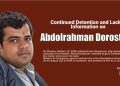
More than 20 days have passed since the arrest of Abdolrahman Dorostaran, the brother of the executed Baluch political prisoner, Omar Dorostaran; however, his family is still unaware of his state of health and exact whereabouts.

Iran Human Rights Society, Sunday, November 1, 2026 – Abdolrahman Dorostaran, a 30-year-old Baluch citizen and the brother of Omar Dorostaran, remains in a state of lack of information and judicial uncertainty more than 20 days after being arrested by agents of the Ministry of Intelligence.
According to information published by HalVash, he is the son of Abdolqadir and a resident of Firoozabad in Rask County.
Informed sources say that Abdolrahman is being held in one of the security detention centers in Zahedan, but his exact location and state of health are not clear to the family.
Arrest of Abdolrahman Dorostaran While Following Up on the Body of His Executed Brother
On Monday, October 12, 2025, after being informed of the execution of his brother, Omar Dorostaran, Abdolrahman Dorostaran intended to go to Zahedan to follow up on the matter and retrieve his body.
Ministry of Intelligence agents arrested him at the Ahmadabad checkpoint, located on the exit route from Rask to Iranshahr, and transferred him to an unknown location.
Since then, his family has not had the opportunity to contact or visit him, and no clear information has been published regarding the charges and the status of his case. Informed sources report security pressures to force him into cooperation and deprivation of contact, visits, and a lawyer.
Threats for Security Cooperation Prior to the Execution of Omar Dorostaran
Informed sources say that Abdolrahman Dorostaran had no political activity and, prior to his brother’s execution, had been repeatedly pressured by IRGC intelligence forces for security cooperation.
According to these sources, the agents had promised that if Abdolrahman cooperated, there would be a reduction in Omar Dorostaran’s punishment.
Sources have also described the purpose of his arrest and the continuation of his deprivation of legal rights as exerting pressure to impose security cooperation.
These statements have increased concerns about the use of arresting relatives of political prisoners as a tool of pressure.
Execution of Omar Dorostaran and Continued Pressure on the Family
Omar Dorostaran, a Baluch seminary student, was executed on October 12, 2025, in the Central Prison of Zahedan.
Human rights reports indicated physical torture and the extraction of forced confessions during his detention.
The Iran Human Rights Society had previously published a report regarding the arrest and months of silence concerning Omar Dorostaran.
The report on the execution of Omar Dorostaran following torture reports had also addressed the situation of this political prisoner.
The arrest of Abdolrahman on the day of his brother’s execution has left the Dorostaran family facing fresh concerns about the fate of their other child.
Legal Review of Abdolrahman Dorostaran’s Case Based on Domestic Laws
The dictatorial laws ruling over Iran have always been criticized due to limiting human rights and contradicting fair trial standards. Reviewing this case does not mean endorsing these laws, but rather demonstrating the failure to observe even these very regulations.
Legal Ambiguities of the Case
The charges, the basis of the arrest, the exact location of detention, and the competent judicial authority are not specified.
Related Legal Articles
Articles 32 and 35 of the Constitution emphasize being informed of the charge and the right to have a lawyer. Article 50 of the Code of Criminal Procedure also recognizes the right to inform the family.
Cases of Violation of the Law
Deprivation of a lawyer, severing family communication, and the continuation of uncertainty create serious concern about the violation of the legal rights of the detainee.
Review of the Case from a Human Rights Perspective
Articles 5, 9, and 10 of the Universal Declaration of Human Rights prohibit torture and arbitrary detention and guarantee a fair trial.
Articles 7, 9, and 14 of the International Covenant on Civil and Political Rights also emphasize the prohibition of ill-treatment, the right to liberty and security of person, and the enjoyment of an effective defense.
Arrest accompanied by severed contact and deprivation of a lawyer, especially under the reported conditions of pressure for security cooperation, conflicts with these standards.
See also the below articles:
- Shahab Zohdi Sentenced to Death a Second Time in Tehran
- Mai Sato at the UN: Repression Has Not Stopped the People of Iran from Protesting
Follow Iran Human Rights Society on social networks:
Telegram /Twitter /Instagram / YouTube / Facebook
Join Iran Human Rights Society on Twitter